

390
7 Classical Statistical Mechanics
for the three terms on the left-hand side of the Liouville equation (7.5.13). Notice
that we have also suppressed the subscript ‘1’ in the final results on the right-hand
sides of our equations. The intermolecular interaction term on the right-hand side of
the Liouville equation is slightly more complicated than the other terms, however,
and must be handled more carefully. We begin by integrating over the phase space
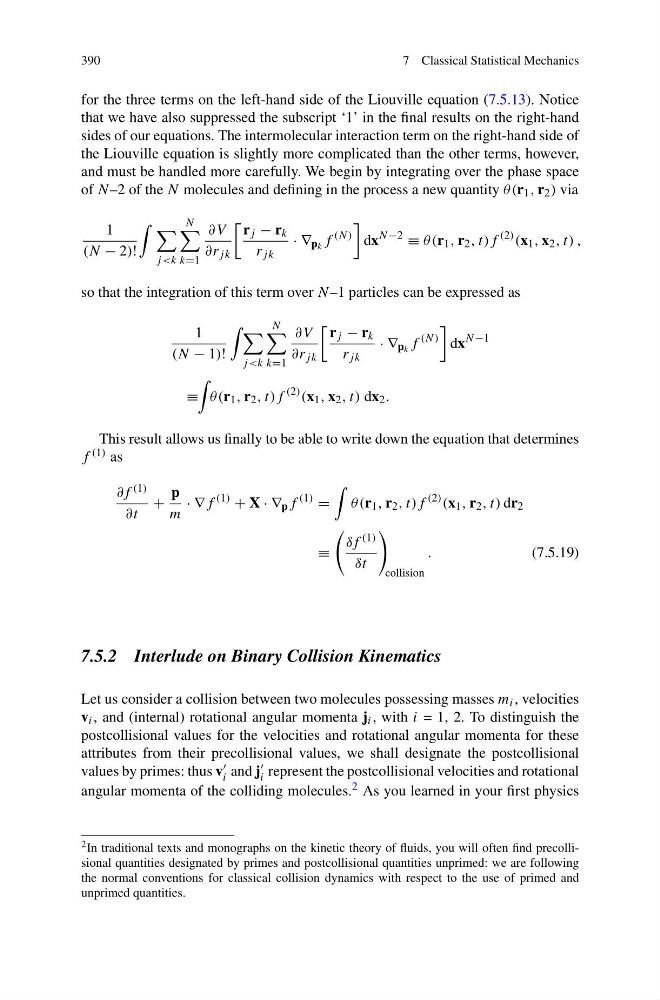
of N –2 of the N molecules and defining in the process a new quantity θ(r 1 , r 2 ) via
1
(N − 2)!
j
k=1
∂V
∂r jk
r j − r k
r jk
· ∇ p k f
(N )
dx
N −2
≡ θ(r 1 , r 2 , t)f
(2) (x 1 , x 2 , t) ,
so that the integration of this term over N–1 particles can be expressed as
1
(N − 1)!
j
k=1
∂V
∂r jk
r j − r k
r jk
· ∇ p k f
(N )
dx
N −1
≡
θ(r 1 , r 2 , t)f
(2) (x 1 , x 2 , t) dx 2 .
This result allows us finally to be able to write down the equation that determines
f (1) as
∂f (1)
∂t
+
p
m
· ∇f
(1)
+ X · ∇ p f
(1)
=
θ(r 1 , r 2 , t)f
(2) (x 1 , r 2 , t) dr 2
≡
δf (1)
δt
collision
.
(7.5.19)
7.5.2 Interlude on Binary Collision Kinematics
Let us consider a collision between two molecules possessing masses m i , velocities
v i , and (internal) rotational angular momenta j i , with i = 1, 2. To distinguish the
postcollisional values for the velocities and rotational angular momenta for these
attributes from their precollisional values, we shall designate the postcollisional
values by primes: thus v
i and j
i represent the postcollisional velocities and rotational
angular momenta of the colliding molecules. 2 As you learned in your first physics
2 In traditional texts and monographs on the kinetic theory of fluids, you will often find precollisional quantities designated by primes and postcollisional quantities unprimed: we are following
the normal conventions for classical collision dynamics with respect to the use of primed and
unprimed quantities.
7 Classical Statistical Mechanics
for the three terms on the left-hand side of the Liouville equation (7.5.13). Notice
that we have also suppressed the subscript ‘1’ in the final results on the right-hand
sides of our equations. The intermolecular interaction term on the right-hand side of
the Liouville equation is slightly more complicated than the other terms, however,
and must be handled more carefully. We begin by integrating over the phase space
of N –2 of the N molecules and defining in the process a new quantity θ(r 1 , r 2 ) via
1
(N − 2)!
j
k=1
∂V
∂r jk
r j − r k
r jk
· ∇ p k f
(N )
dx
N −2
≡ θ(r 1 , r 2 , t)f
(2) (x 1 , x 2 , t) ,
so that the integration of this term over N–1 particles can be expressed as
1
(N − 1)!
j
k=1
∂V
∂r jk
r j − r k
r jk
· ∇ p k f
(N )
dx
N −1
≡
θ(r 1 , r 2 , t)f
(2) (x 1 , x 2 , t) dx 2 .
This result allows us finally to be able to write down the equation that determines
f (1) as
∂f (1)
∂t
+
p
m
· ∇f
(1)
+ X · ∇ p f
(1)
=
θ(r 1 , r 2 , t)f
(2) (x 1 , r 2 , t) dr 2
≡
δf (1)
δt
collision
.
(7.5.19)
7.5.2 Interlude on Binary Collision Kinematics
Let us consider a collision between two molecules possessing masses m i , velocities
v i , and (internal) rotational angular momenta j i , with i = 1, 2. To distinguish the
postcollisional values for the velocities and rotational angular momenta for these
attributes from their precollisional values, we shall designate the postcollisional
values by primes: thus v
i and j
i represent the postcollisional velocities and rotational
angular momenta of the colliding molecules. 2 As you learned in your first physics
2 In traditional texts and monographs on the kinetic theory of fluids, you will often find precollisional quantities designated by primes and postcollisional quantities unprimed: we are following
the normal conventions for classical collision dynamics with respect to the use of primed and
unprimed quantities.