

7.5 The Liouville and Boltzmann Equations
389
f
(1) (x
1 , t) =
1
(N − 1)!
f
(N ) (x
N , t) dx
N −1 ,
(7.5.15)
or more generally, f (s) (x s , t) is obtained from f (N ) as
f
(s) (x
s , t) =
1
(N − s)!
f
(N ) (x
N , t) dx
N −s .
With this choice of normalization, we have
f
(1) (x
1 , t) dx
1
= N ,
(7.5.16)
and
f
(2) (x
2 , t) dx
2
= N(N − 1) .
(7.5.17)
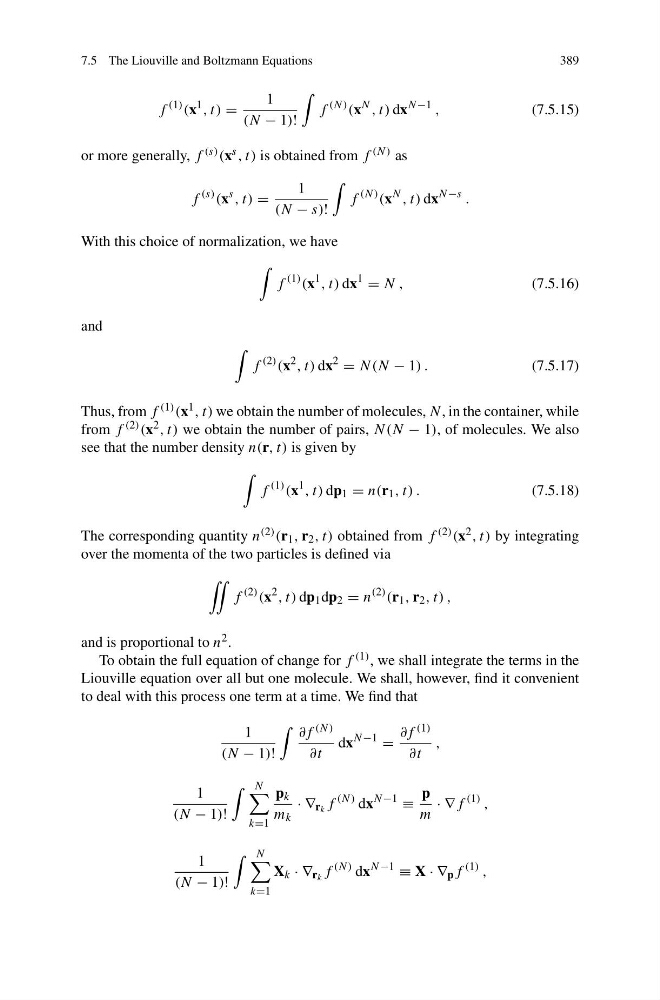
Thus, from f (1) (x 1 , t) we obtain the number of molecules, N , in the container, while
from f (2) (x 2 , t) we obtain the number of pairs, N(N − 1), of molecules. We also
see that the number density n(r, t) is given by
f
(1) (x
1 , t) dp 1 = n(r 1 , t) .
(7.5.18)
The corresponding quantity n (2) (r 1 , r 2 , t) obtained from f (2) (x 2 , t) by integrating
over the momenta of the two particles is defined via
f
(2) (x
2 , t) dp 1 dp 2 = n
(2) (r 1 , r 2 , t) ,
and is proportional to n 2 .
To obtain the full equation of change for f (1) , we shall integrate the terms in the
Liouville equation over all but one molecule. We shall, however, find it convenient
to deal with this process one term at a time. We find that
1
(N − 1)!
∂f (N )
∂t
dx
N −1
=
∂f (1)
∂t
,
1
(N − 1)!
N
k=1
p k
m k
· ∇ r k f
(N ) dx
N −1
≡
p
m
· ∇f
(1) ,
1
(N − 1)!
N
k=1
X k · ∇ r k f
(N ) dx
N −1
≡ X · ∇ p f
(1) ,
389
f
(1) (x
1 , t) =
1
(N − 1)!
f
(N ) (x
N , t) dx
N −1 ,
(7.5.15)
or more generally, f (s) (x s , t) is obtained from f (N ) as
f
(s) (x
s , t) =
1
(N − s)!
f
(N ) (x
N , t) dx
N −s .
With this choice of normalization, we have
f
(1) (x
1 , t) dx
1
= N ,
(7.5.16)
and
f
(2) (x
2 , t) dx
2
= N(N − 1) .
(7.5.17)
Thus, from f (1) (x 1 , t) we obtain the number of molecules, N , in the container, while
from f (2) (x 2 , t) we obtain the number of pairs, N(N − 1), of molecules. We also
see that the number density n(r, t) is given by
f
(1) (x
1 , t) dp 1 = n(r 1 , t) .
(7.5.18)
The corresponding quantity n (2) (r 1 , r 2 , t) obtained from f (2) (x 2 , t) by integrating
over the momenta of the two particles is defined via
f
(2) (x
2 , t) dp 1 dp 2 = n
(2) (r 1 , r 2 , t) ,
and is proportional to n 2 .
To obtain the full equation of change for f (1) , we shall integrate the terms in the
Liouville equation over all but one molecule. We shall, however, find it convenient
to deal with this process one term at a time. We find that
1
(N − 1)!
∂f (N )
∂t
dx
N −1
=
∂f (1)
∂t
,
1
(N − 1)!
N
k=1
p k
m k
· ∇ r k f
(N ) dx
N −1
≡
p
m
· ∇f
(1) ,
1
(N − 1)!
N
k=1
X k · ∇ r k f
(N ) dx
N −1
≡ X · ∇ p f
(1) ,