

388
7 Classical Statistical Mechanics
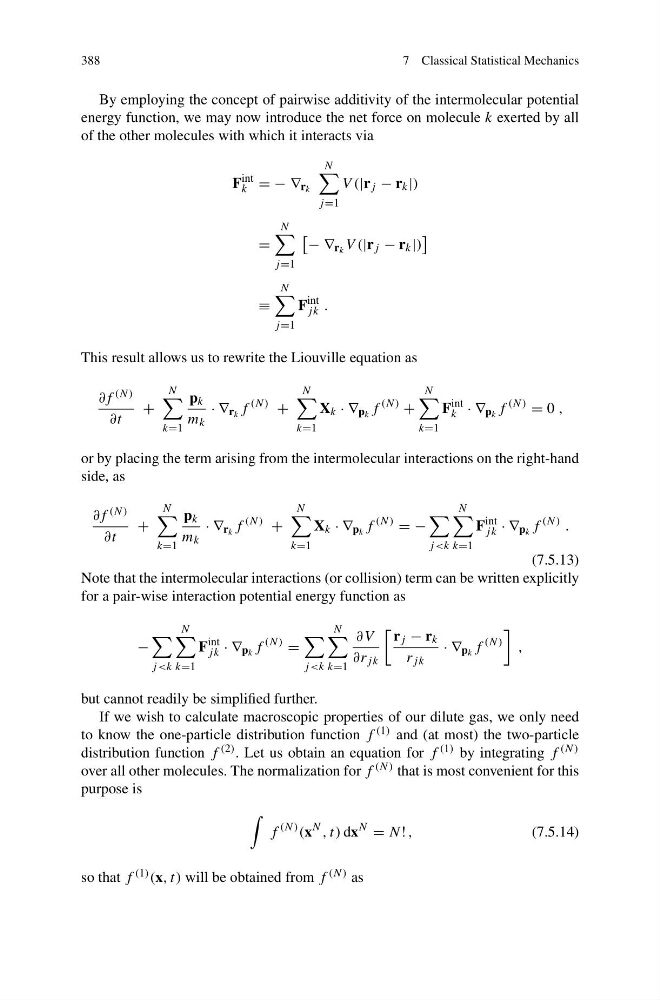
By employing the concept of pairwise additivity of the intermolecular potential
energy function, we may now introduce the net force on molecule k exerted by all
of the other molecules with which it interacts via
F
int
k = − ∇ r k
N
j =1
V (|r j − r k |)
=
N
j =1
− ∇ r k V (|r j − r k |)
≡
N
j =1
F
int
jk .
This result allows us to rewrite the Liouville equation as
∂f (N )
∂t
+
N
k=1
p k
m k
· ∇ r k f
(N )
+
N
k=1
X k · ∇ p k f
(N )
+
N
k=1
F
int
k · ∇ p k f
(N )
= 0 ,
or by placing the term arising from the intermolecular interactions on the right-hand
side, as
∂f (N )
∂t
+
N
k=1
p k
m k
· ∇ r k f
(N )
+
N
k=1
X k · ∇ p k f
(N )
= −
j
k=1
F
int
jk · ∇ p k f
(N ) .
(7.5.13)
Note that the intermolecular interactions (or collision) term can be written explicitly
for a pair-wise interaction potential energy function as
−
j
k=1
F
int
jk · ∇ p k f
(N )
=
j
k=1
∂V
∂r jk
r j − r k
r jk
· ∇ p k f
(N )
,
but cannot readily be simplified further.
If we wish to calculate macroscopic properties of our dilute gas, we only need
to know the one-particle distribution function f (1) and (at most) the two-particle
distribution function f (2) . Let us obtain an equation for f (1) by integrating f (N )
over all other molecules. The normalization for f (N ) that is most convenient for this
purpose is
f
(N ) (x
N , t) dx
N
= N ! ,
(7.5.14)
so that f (1) (x, t) will be obtained from f (N ) as
7 Classical Statistical Mechanics
By employing the concept of pairwise additivity of the intermolecular potential
energy function, we may now introduce the net force on molecule k exerted by all
of the other molecules with which it interacts via
F
int
k = − ∇ r k
N
j =1
V (|r j − r k |)
=
N
j =1
− ∇ r k V (|r j − r k |)
≡
N
j =1
F
int
jk .
This result allows us to rewrite the Liouville equation as
∂f (N )
∂t
+
N
k=1
p k
m k
· ∇ r k f
(N )
+
N
k=1
X k · ∇ p k f
(N )
+
N
k=1
F
int
k · ∇ p k f
(N )
= 0 ,
or by placing the term arising from the intermolecular interactions on the right-hand
side, as
∂f (N )
∂t
+
N
k=1
p k
m k
· ∇ r k f
(N )
+
N
k=1
X k · ∇ p k f
(N )
= −
j
k=1
F
int
jk · ∇ p k f
(N ) .
(7.5.13)
Note that the intermolecular interactions (or collision) term can be written explicitly
for a pair-wise interaction potential energy function as
−
j
k=1
F
int
jk · ∇ p k f
(N )
=
j
k=1
∂V
∂r jk
r j − r k
r jk
· ∇ p k f
(N )
,
but cannot readily be simplified further.
If we wish to calculate macroscopic properties of our dilute gas, we only need
to know the one-particle distribution function f (1) and (at most) the two-particle
distribution function f (2) . Let us obtain an equation for f (1) by integrating f (N )
over all other molecules. The normalization for f (N ) that is most convenient for this
purpose is
f
(N ) (x
N , t) dx
N
= N ! ,
(7.5.14)
so that f (1) (x, t) will be obtained from f (N ) as