

392
7 Classical Statistical Mechanics
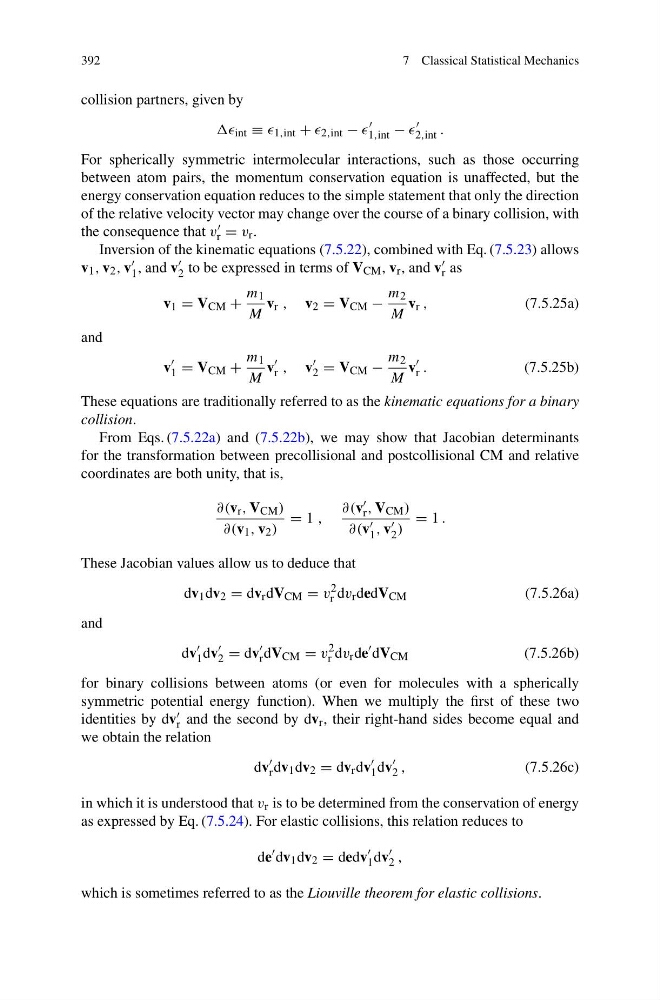
collision partners, given by
int ≡ 1,int + 2,int −
1,int −
2,int .
For spherically symmetric intermolecular interactions, such as those occurring
between atom pairs, the momentum conservation equation is unaffected, but the
energy conservation equation reduces to the simple statement that only the direction
of the relative velocity vector may change over the course of a binary collision, with
the consequence that v
r = v r .
Inversion of the kinematic equations (7.5.22), combined with Eq. (7.5.23) allows
v 1 , v 2 , v
1 , and v
2 to be expressed in terms of V CM , v r , and v
r as
v 1 = V CM +
m 1
M
v r , v 2 = V CM −
m 2
M
v r ,
(7.5.25a)
and
v
1 = V CM +
m 1
M
v
r , v
2 = V CM −
m 2
M
v
r .
(7.5.25b)
These equations are traditionally referred to as the kinematic equations for a binary
collision.
From Eqs. (7.5.22a) and (7.5.22b), we may show that Jacobian determinants
for the transformation between precollisional and postcollisional CM and relative
coordinates are both unity, that is,
∂(v r , V CM )
∂(v 1 , v 2 )
= 1 ,
∂(v
r , V CM )
∂(v
1 , v
2 )
= 1 .
These Jacobian values allow us to deduce that
dv 1 dv 2 = dv r dV CM = v
2
r dv r dedV CM
(7.5.26a)
and
dv
1 dv
2 = dv
r dV CM = v
2
r dv r de
dV CM
(7.5.26b)
for binary collisions between atoms (or even for molecules with a spherically
symmetric potential energy function). When we multiply the first of these two
identities by dv
r and the second by dv r , their right-hand sides become equal and
we obtain the relation
dv
r dv 1 dv 2 = dv r dv
1 dv
2 ,
(7.5.26c)
in which it is understood that v r is to be determined from the conservation of energy
as expressed by Eq. (7.5.24). For elastic collisions, this relation reduces to
de
dv 1 dv 2 = dedv
1 dv
2 ,
which is sometimes referred to as the Liouville theorem for elastic collisions.
7 Classical Statistical Mechanics
collision partners, given by
int ≡ 1,int + 2,int −
1,int −
2,int .
For spherically symmetric intermolecular interactions, such as those occurring
between atom pairs, the momentum conservation equation is unaffected, but the
energy conservation equation reduces to the simple statement that only the direction
of the relative velocity vector may change over the course of a binary collision, with
the consequence that v
r = v r .
Inversion of the kinematic equations (7.5.22), combined with Eq. (7.5.23) allows
v 1 , v 2 , v
1 , and v
2 to be expressed in terms of V CM , v r , and v
r as
v 1 = V CM +
m 1
M
v r , v 2 = V CM −
m 2
M
v r ,
(7.5.25a)
and
v
1 = V CM +
m 1
M
v
r , v
2 = V CM −
m 2
M
v
r .
(7.5.25b)
These equations are traditionally referred to as the kinematic equations for a binary
collision.
From Eqs. (7.5.22a) and (7.5.22b), we may show that Jacobian determinants
for the transformation between precollisional and postcollisional CM and relative
coordinates are both unity, that is,
∂(v r , V CM )
∂(v 1 , v 2 )
= 1 ,
∂(v
r , V CM )
∂(v
1 , v
2 )
= 1 .
These Jacobian values allow us to deduce that
dv 1 dv 2 = dv r dV CM = v
2
r dv r dedV CM
(7.5.26a)
and
dv
1 dv
2 = dv
r dV CM = v
2
r dv r de
dV CM
(7.5.26b)
for binary collisions between atoms (or even for molecules with a spherically
symmetric potential energy function). When we multiply the first of these two
identities by dv
r and the second by dv r , their right-hand sides become equal and
we obtain the relation
dv
r dv 1 dv 2 = dv r dv
1 dv
2 ,
(7.5.26c)
in which it is understood that v r is to be determined from the conservation of energy
as expressed by Eq. (7.5.24). For elastic collisions, this relation reduces to
de
dv 1 dv 2 = dedv
1 dv
2 ,
which is sometimes referred to as the Liouville theorem for elastic collisions.