

7.4 An Approximate Description for Dense Fluids
381
V N =
1
2 N
∞
0
4πr
2 V (r)ρg(r) dr .
(7.4.2)
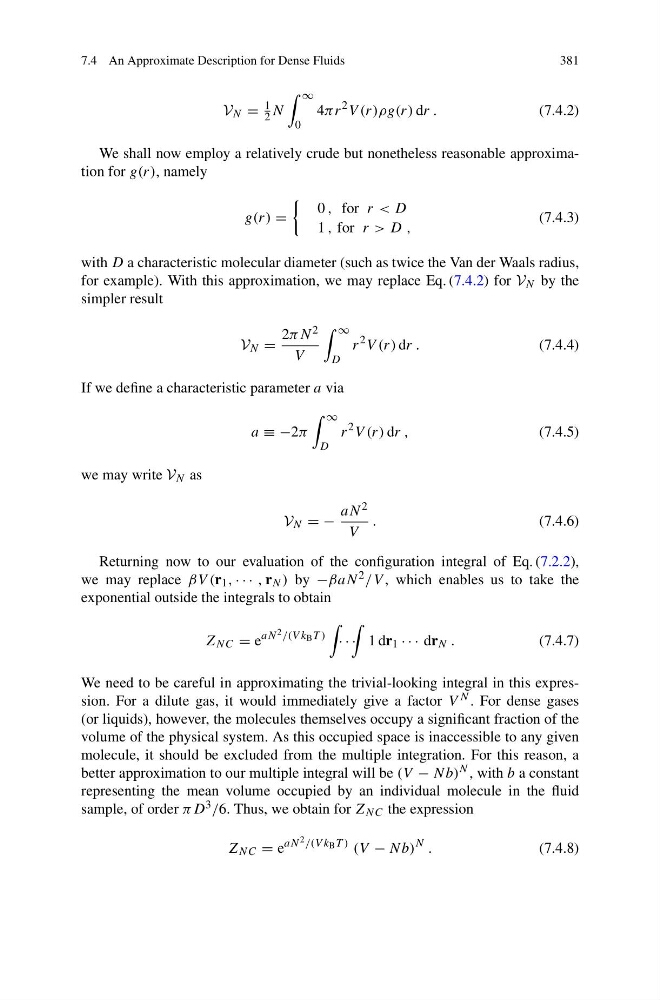
We shall now employ a relatively crude but nonetheless reasonable approximation for g(r), namely
g(r) =
0 , for r < D
1 , for r > D ,
(7.4.3)
with D a characteristic molecular diameter (such as twice the Van der Waals radius,
for example). With this approximation, we may replace Eq. (7.4.2) for V N by the
simpler result
V N =
2πN 2
V
∞
D
r
2 V (r) dr .
(7.4.4)
If we define a characteristic parameter a via
a ≡ −2π
∞
D
r
2 V (r) dr ,
(7.4.5)
we may write V N as
V N = −
aN 2
V
.
(7.4.6)
Returning now to our evaluation of the configuration integral of Eq. (7.2.2),
we may replace βV (r 1 , · · · , r N ) by −βaN 2 /V , which enables us to take the
exponential outside the integrals to obtain
Z NC = e
aN 2 /(V k B T )
· · ·
1 dr 1 · · · dr N .
(7.4.7)
We need to be careful in approximating the trivial-looking integral in this expression. For a dilute gas, it would immediately give a factor V N . For dense gases
(or liquids), however, the molecules themselves occupy a significant fraction of the
volume of the physical system. As this occupied space is inaccessible to any given
molecule, it should be excluded from the multiple integration. For this reason, a
better approximation to our multiple integral will be (V − Nb) N , with b a constant
representing the mean volume occupied by an individual molecule in the fluid
sample, of order πD 3 /6. Thus, we obtain for Z NC the expression
Z NC = e
aN 2 /(V k B T ) (V − Nb)
N .
(7.4.8)
381
V N =
1
2 N
∞
0
4πr
2 V (r)ρg(r) dr .
(7.4.2)
We shall now employ a relatively crude but nonetheless reasonable approximation for g(r), namely
g(r) =
0 , for r < D
1 , for r > D ,
(7.4.3)
with D a characteristic molecular diameter (such as twice the Van der Waals radius,
for example). With this approximation, we may replace Eq. (7.4.2) for V N by the
simpler result
V N =
2πN 2
V
∞
D
r
2 V (r) dr .
(7.4.4)
If we define a characteristic parameter a via
a ≡ −2π
∞
D
r
2 V (r) dr ,
(7.4.5)
we may write V N as
V N = −
aN 2
V
.
(7.4.6)
Returning now to our evaluation of the configuration integral of Eq. (7.2.2),
we may replace βV (r 1 , · · · , r N ) by −βaN 2 /V , which enables us to take the
exponential outside the integrals to obtain
Z NC = e
aN 2 /(V k B T )
· · ·
1 dr 1 · · · dr N .
(7.4.7)
We need to be careful in approximating the trivial-looking integral in this expression. For a dilute gas, it would immediately give a factor V N . For dense gases
(or liquids), however, the molecules themselves occupy a significant fraction of the
volume of the physical system. As this occupied space is inaccessible to any given
molecule, it should be excluded from the multiple integration. For this reason, a
better approximation to our multiple integral will be (V − Nb) N , with b a constant
representing the mean volume occupied by an individual molecule in the fluid
sample, of order πD 3 /6. Thus, we obtain for Z NC the expression
Z NC = e
aN 2 /(V k B T ) (V − Nb)
N .
(7.4.8)