

380
7 Classical Statistical Mechanics
and writing z rot (T ) as
z rot (T ) =
π (w−5)N/2
σ
T
rot,m
(w−3)N/2
,
with w being the total number of translational plus rotational degrees of freedom in
the molecule (w has the value 5 for linear molecules and 6 for nonlinear molecules),
with the understanding that for a linear molecule, rot,m = rot .
We need to find a means of approximating Z NC by developing a relation for the
potential energy associated with the interacting molecules. For dense fluids, such as
liquids, a useful approach is to employ the concept of the radial distribution function
designated by g(r) and defined so that 4πr 2 ρg(r)dr represents the number density
of molecules with centres between r and r + dr measured relative to a specific
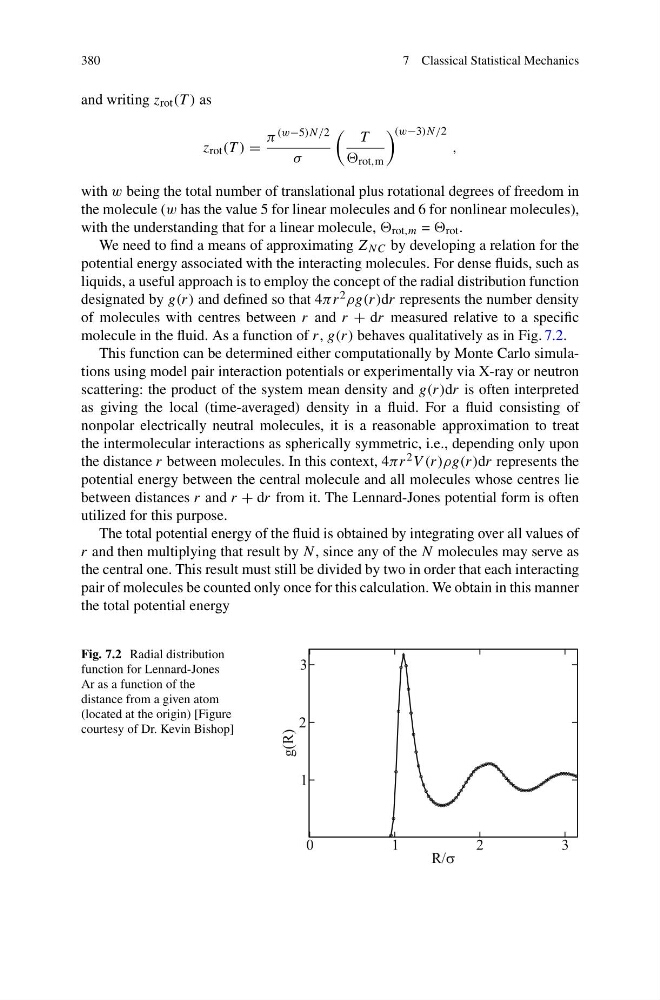
molecule in the fluid. As a function of r, g(r) behaves qualitatively as in Fig. 7.2.
This function can be determined either computationally by Monte Carlo simulations using model pair interaction potentials or experimentally via X-ray or neutron
scattering: the product of the system mean density and g(r)dr is often interpreted
as giving the local (time-averaged) density in a fluid. For a fluid consisting of
nonpolar electrically neutral molecules, it is a reasonable approximation to treat
the intermolecular interactions as spherically symmetric, i.e., depending only upon
the distance r between molecules. In this context, 4πr 2 V (r)ρg(r)dr represents the
potential energy between the central molecule and all molecules whose centres lie
between distances r and r + dr from it. The Lennard-Jones potential form is often
utilized for this purpose.
The total potential energy of the fluid is obtained by integrating over all values of
r and then multiplying that result by N, since any of the N molecules may serve as
the central one. This result must still be divided by two in order that each interacting
pair of molecules be counted only once for this calculation. We obtain in this manner
the total potential energy
Fig. 7.2 Radial distribution
function for Lennard-Jones
Ar as a function of the
distance from a given atom
(located at the origin) [Figure
courtesy of Dr. Kevin Bishop]
0
1
2
3
R/σ
1
2
3
g(R)
7 Classical Statistical Mechanics
and writing z rot (T ) as
z rot (T ) =
π (w−5)N/2
σ
T
rot,m
(w−3)N/2
,
with w being the total number of translational plus rotational degrees of freedom in
the molecule (w has the value 5 for linear molecules and 6 for nonlinear molecules),
with the understanding that for a linear molecule, rot,m = rot .
We need to find a means of approximating Z NC by developing a relation for the
potential energy associated with the interacting molecules. For dense fluids, such as
liquids, a useful approach is to employ the concept of the radial distribution function
designated by g(r) and defined so that 4πr 2 ρg(r)dr represents the number density
of molecules with centres between r and r + dr measured relative to a specific
molecule in the fluid. As a function of r, g(r) behaves qualitatively as in Fig. 7.2.
This function can be determined either computationally by Monte Carlo simulations using model pair interaction potentials or experimentally via X-ray or neutron
scattering: the product of the system mean density and g(r)dr is often interpreted
as giving the local (time-averaged) density in a fluid. For a fluid consisting of
nonpolar electrically neutral molecules, it is a reasonable approximation to treat
the intermolecular interactions as spherically symmetric, i.e., depending only upon
the distance r between molecules. In this context, 4πr 2 V (r)ρg(r)dr represents the
potential energy between the central molecule and all molecules whose centres lie
between distances r and r + dr from it. The Lennard-Jones potential form is often
utilized for this purpose.
The total potential energy of the fluid is obtained by integrating over all values of
r and then multiplying that result by N, since any of the N molecules may serve as
the central one. This result must still be divided by two in order that each interacting
pair of molecules be counted only once for this calculation. We obtain in this manner
the total potential energy
Fig. 7.2 Radial distribution
function for Lennard-Jones
Ar as a function of the
distance from a given atom
(located at the origin) [Figure
courtesy of Dr. Kevin Bishop]
0
1
2
3
R/σ
1
2
3
g(R)