

7.4 An Approximate Description for Dense Fluids
379
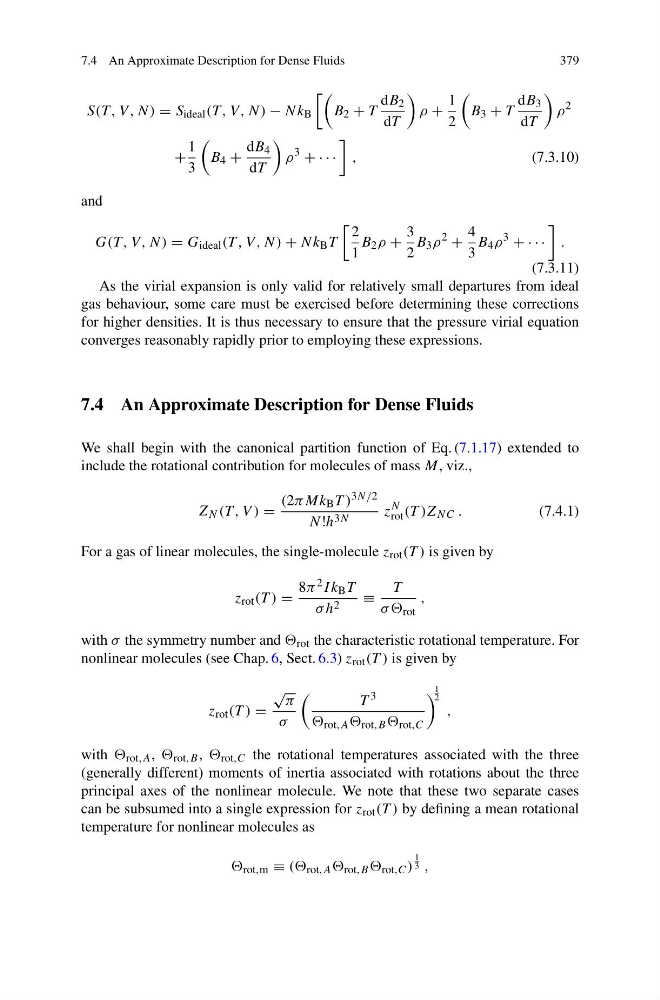
S(T , V , N) = S ideal (T , V , N) − Nk B
B 2 + T
dB 2
dT
ρ +
1
2
B 3 + T
dB 3
dT
ρ
2
+
1
3
B 4 +
dB 4
dT
ρ
3
+ · · ·
,
(7.3.10)
and
G(T , V , N ) = G ideal (T , V , N) + Nk B T
2
1
B 2 ρ +
3
2
B 3 ρ
2
+
4
3
B 4 ρ
3
+ · · ·
.
(7.3.11)
As the virial expansion is only valid for relatively small departures from ideal
gas behaviour, some care must be exercised before determining these corrections
for higher densities. It is thus necessary to ensure that the pressure virial equation
converges reasonably rapidly prior to employing these expressions.
7.4 An Approximate Description for Dense Fluids
We shall begin with the canonical partition function of Eq. (7.1.17) extended to
include the rotational contribution for molecules of mass M, viz.,
Z N (T , V ) =
(2πMk B T ) 3N/2
N!h 3N
z
N
rot (T )Z NC .
(7.4.1)
For a gas of linear molecules, the single-molecule z rot (T ) is given by
z rot (T ) =
8π 2 I k B T
σ h 2
≡
T
σ σ rot
,
with σ the symmetry number and rot the characteristic rotational temperature. For
nonlinear molecules (see Chap. 6, Sect. 6.3) z rot (T ) is given by
z rot (T ) =
√
π
σ
T 3
rot,A rot,B rot,C
1
2
,
with rot,A , rot,B , rot,C the rotational temperatures associated with the three
(generally different) moments of inertia associated with rotations about the three
principal axes of the nonlinear molecule. We note that these two separate cases
can be subsumed into a single expression for z rot (T ) by defining a mean rotational
temperature for nonlinear molecules as
rot,m ≡ (( rot,A rot,B rot,C )
1
3 ,
379
S(T , V , N) = S ideal (T , V , N) − Nk B
B 2 + T
dB 2
dT
ρ +
1
2
B 3 + T
dB 3
dT
ρ
2
+
1
3
B 4 +
dB 4
dT
ρ
3
+ · · ·
,
(7.3.10)
and
G(T , V , N ) = G ideal (T , V , N) + Nk B T
2
1
B 2 ρ +
3
2
B 3 ρ
2
+
4
3
B 4 ρ
3
+ · · ·
.
(7.3.11)
As the virial expansion is only valid for relatively small departures from ideal
gas behaviour, some care must be exercised before determining these corrections
for higher densities. It is thus necessary to ensure that the pressure virial equation
converges reasonably rapidly prior to employing these expressions.
7.4 An Approximate Description for Dense Fluids
We shall begin with the canonical partition function of Eq. (7.1.17) extended to
include the rotational contribution for molecules of mass M, viz.,
Z N (T , V ) =
(2πMk B T ) 3N/2
N!h 3N
z
N
rot (T )Z NC .
(7.4.1)
For a gas of linear molecules, the single-molecule z rot (T ) is given by
z rot (T ) =
8π 2 I k B T
σ h 2
≡
T
σ σ rot
,
with σ the symmetry number and rot the characteristic rotational temperature. For
nonlinear molecules (see Chap. 6, Sect. 6.3) z rot (T ) is given by
z rot (T ) =
√
π
σ
T 3
rot,A rot,B rot,C
1
2
,
with rot,A , rot,B , rot,C the rotational temperatures associated with the three
(generally different) moments of inertia associated with rotations about the three
principal axes of the nonlinear molecule. We note that these two separate cases
can be subsumed into a single expression for z rot (T ) by defining a mean rotational
temperature for nonlinear molecules as
rot,m ≡ (( rot,A rot,B rot,C )
1
3 ,