

378
7 Classical Statistical Mechanics
B 2 (T ) =
V
dr
1 − e
−βV (r)
.
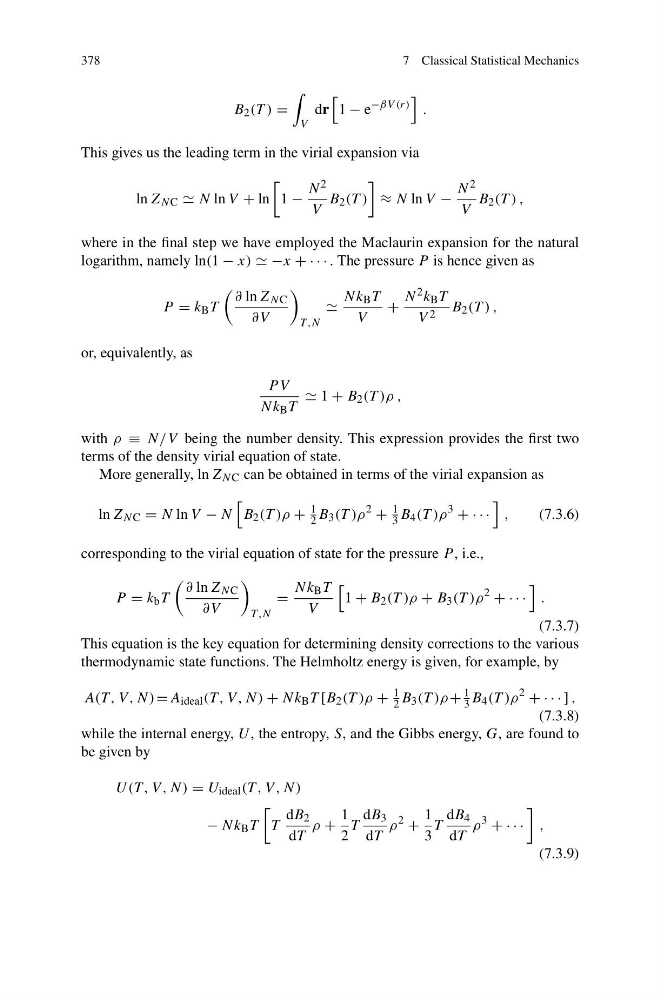
This gives us the leading term in the virial expansion via
ln Z N C N ln V + ln
1 −
N 2
V
B 2 (T )
≈ N ln V −
N 2
V
B 2 (T ) ,
where in the final step we have employed the Maclaurin expansion for the natural
logarithm, namely ln(1 − x) −x + · · · . The pressure P is hence given as
P = k B T
∂ ln Z N C
∂V
T ,N
Nk B T
V
+
N 2 k B T
V 2 B 2 (T ) ,
or, equivalently, as
P V
Nk B T
1 + B 2 (T )ρ ,
with ρ ≡ N/V being the number density. This expression provides the first two
terms of the density virial equation of state.
More generally, ln Z N C can be obtained in terms of the virial expansion as
ln Z N C = N ln V − N
B 2 (T )ρ +
1
2 B 3 (T )ρ
2
+
1
3 B 4 (T )ρ
3
+ · · ·
,
(7.3.6)
corresponding to the virial equation of state for the pressure P , i.e.,
P = k b T
∂ ln Z N C
∂V
T ,N
=
Nk B T
V
1 + B 2 (T )ρ + B 3 (T )ρ
2
+ · · ·
.
(7.3.7)
This equation is the key equation for determining density corrections to the various
thermodynamic state functions. The Helmholtz energy is given, for example, by
A(T , V , N) = A ideal (T , V , N) + Nk B T [B 2 (T )ρ +
1
2 B 3 (T )ρ +
1
3 B 4 (T )ρ
2
+ · · · ] ,
(7.3.8)
while the internal energy, U , the entropy, S, and the Gibbs energy, G, are found to
be given by
U(T , V , N) = U ideal (T , V , N)
− Nk B T
T
dB 2
dT
ρ +
1
2
T
dB 3
dT
ρ
2
+
1
3
T
dB 4
dT
ρ
3
+ · · ·
,
(7.3.9)
7 Classical Statistical Mechanics
B 2 (T ) =
V
dr
1 − e
−βV (r)
.
This gives us the leading term in the virial expansion via
ln Z N C N ln V + ln
1 −
N 2
V
B 2 (T )
≈ N ln V −
N 2
V
B 2 (T ) ,
where in the final step we have employed the Maclaurin expansion for the natural
logarithm, namely ln(1 − x) −x + · · · . The pressure P is hence given as
P = k B T
∂ ln Z N C
∂V
T ,N
Nk B T
V
+
N 2 k B T
V 2 B 2 (T ) ,
or, equivalently, as
P V
Nk B T
1 + B 2 (T )ρ ,
with ρ ≡ N/V being the number density. This expression provides the first two
terms of the density virial equation of state.
More generally, ln Z N C can be obtained in terms of the virial expansion as
ln Z N C = N ln V − N
B 2 (T )ρ +
1
2 B 3 (T )ρ
2
+
1
3 B 4 (T )ρ
3
+ · · ·
,
(7.3.6)
corresponding to the virial equation of state for the pressure P , i.e.,
P = k b T
∂ ln Z N C
∂V
T ,N
=
Nk B T
V
1 + B 2 (T )ρ + B 3 (T )ρ
2
+ · · ·
.
(7.3.7)
This equation is the key equation for determining density corrections to the various
thermodynamic state functions. The Helmholtz energy is given, for example, by
A(T , V , N) = A ideal (T , V , N) + Nk B T [B 2 (T )ρ +
1
2 B 3 (T )ρ +
1
3 B 4 (T )ρ
2
+ · · · ] ,
(7.3.8)
while the internal energy, U , the entropy, S, and the Gibbs energy, G, are found to
be given by
U(T , V , N) = U ideal (T , V , N)
− Nk B T
T
dB 2
dT
ρ +
1
2
T
dB 3
dT
ρ
2
+
1
3
T
dB 4
dT
ρ
3
+ · · ·
,
(7.3.9)