

7.3 Beyond the Ideal Gas
377
e
−β
i>j V (r ij ) =
i>j
e
−βV (r ij )
=
i>j
1 +
e
−βV (r ij )
− 1
,
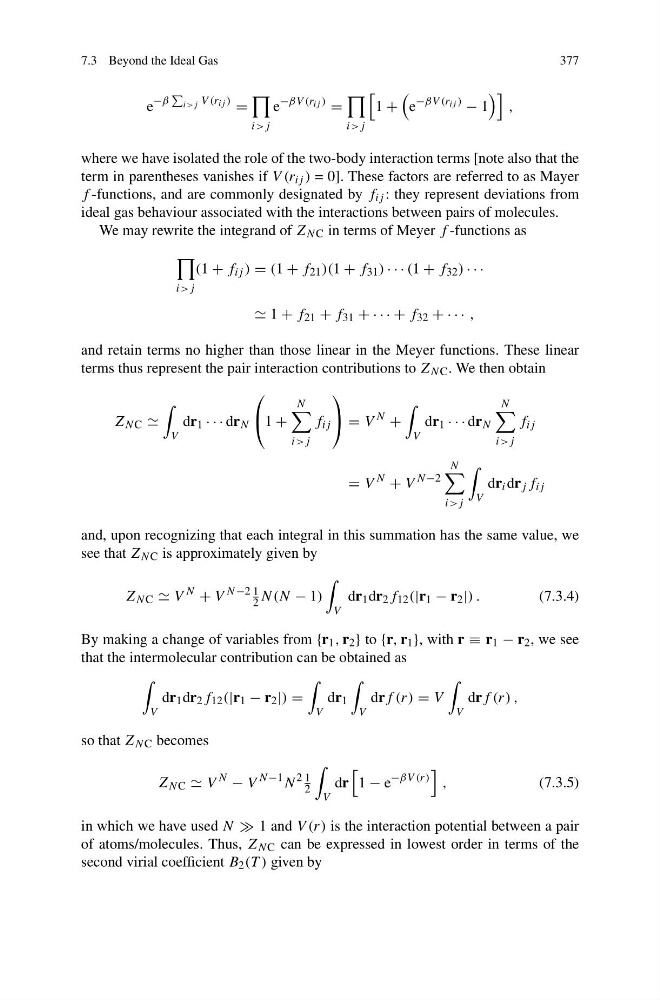
where we have isolated the role of the two-body interaction terms [note also that the
term in parentheses vanishes if V (r ij ) = 0]. These factors are referred to as Mayer
f -functions, and are commonly designated by f ij : they represent deviations from
ideal gas behaviour associated with the interactions between pairs of molecules.
We may rewrite the integrand of Z N C in terms of Meyer f -functions as
i>j
(1 + f ij ) = (1 + f 21 )(1 + f 31 ) · · · (1 + f 32 ) · · ·
1 + f 21 + f 31 + · · · + f 32 + · · · ,
and retain terms no higher than those linear in the Meyer functions. These linear
terms thus represent the pair interaction contributions to Z N C . We then obtain
Z N C
V
dr 1 · · · dr N
⎛
⎝ 1 +
N
i>j
f ij
⎞
⎠ = V
N
+
V
dr 1 · · · dr N
N
i>j
f ij
= V
N
+ V
N −2
N
i>j
V
dr i dr j f ij
and, upon recognizing that each integral in this summation has the same value, we
see that Z N C is approximately given by
Z N C V
N
+ V
N −2 1
2 N(N − 1)
V
dr 1 dr 2 f 12 (|r 1 − r 2 |) .
(7.3.4)
By making a change of variables from {r 1 , r 2 } to {r, r 1 }, with r ≡ r 1 − r 2 , we see
that the intermolecular contribution can be obtained as
V
dr 1 dr 2 f 12 (|r 1 − r 2 |) =
V
dr 1
V
drf (r) = V
V
drf (r) ,
so that Z N C becomes
Z N C V
N
− V
N −1 N
2 1
2
V
dr
1 − e
−βV (r)
,
(7.3.5)
in which we have used N 1 and V (r) is the interaction potential between a pair
of atoms/molecules. Thus, Z N C can be expressed in lowest order in terms of the
second virial coefficient B 2 (T ) given by
377
e
−β
i>j V (r ij ) =
i>j
e
−βV (r ij )
=
i>j
1 +
e
−βV (r ij )
− 1
,
where we have isolated the role of the two-body interaction terms [note also that the
term in parentheses vanishes if V (r ij ) = 0]. These factors are referred to as Mayer
f -functions, and are commonly designated by f ij : they represent deviations from
ideal gas behaviour associated with the interactions between pairs of molecules.
We may rewrite the integrand of Z N C in terms of Meyer f -functions as
i>j
(1 + f ij ) = (1 + f 21 )(1 + f 31 ) · · · (1 + f 32 ) · · ·
1 + f 21 + f 31 + · · · + f 32 + · · · ,
and retain terms no higher than those linear in the Meyer functions. These linear
terms thus represent the pair interaction contributions to Z N C . We then obtain
Z N C
V
dr 1 · · · dr N
⎛
⎝ 1 +
N
i>j
f ij
⎞
⎠ = V
N
+
V
dr 1 · · · dr N
N
i>j
f ij
= V
N
+ V
N −2
N
i>j
V
dr i dr j f ij
and, upon recognizing that each integral in this summation has the same value, we
see that Z N C is approximately given by
Z N C V
N
+ V
N −2 1
2 N(N − 1)
V
dr 1 dr 2 f 12 (|r 1 − r 2 |) .
(7.3.4)
By making a change of variables from {r 1 , r 2 } to {r, r 1 }, with r ≡ r 1 − r 2 , we see
that the intermolecular contribution can be obtained as
V
dr 1 dr 2 f 12 (|r 1 − r 2 |) =
V
dr 1
V
drf (r) = V
V
drf (r) ,
so that Z N C becomes
Z N C V
N
− V
N −1 N
2 1
2
V
dr
1 − e
−βV (r)
,
(7.3.5)
in which we have used N 1 and V (r) is the interaction potential between a pair
of atoms/molecules. Thus, Z N C can be expressed in lowest order in terms of the
second virial coefficient B 2 (T ) given by