

376
7 Classical Statistical Mechanics
7.3 Beyond the Ideal Gas
Deviations from ideal gas behaviour are driven by the intermolecular interactions
that have been neglected for the most part prior to this chapter. Let us begin our
discussion for extending our statistical description of thermodynamics beyond ideal
gas behaviour by considering the canonical partition function of Eq. (7.2.26), but
now including also internal state contributions. Thus, we start with the canonical
partition function for a pure fluid, namely
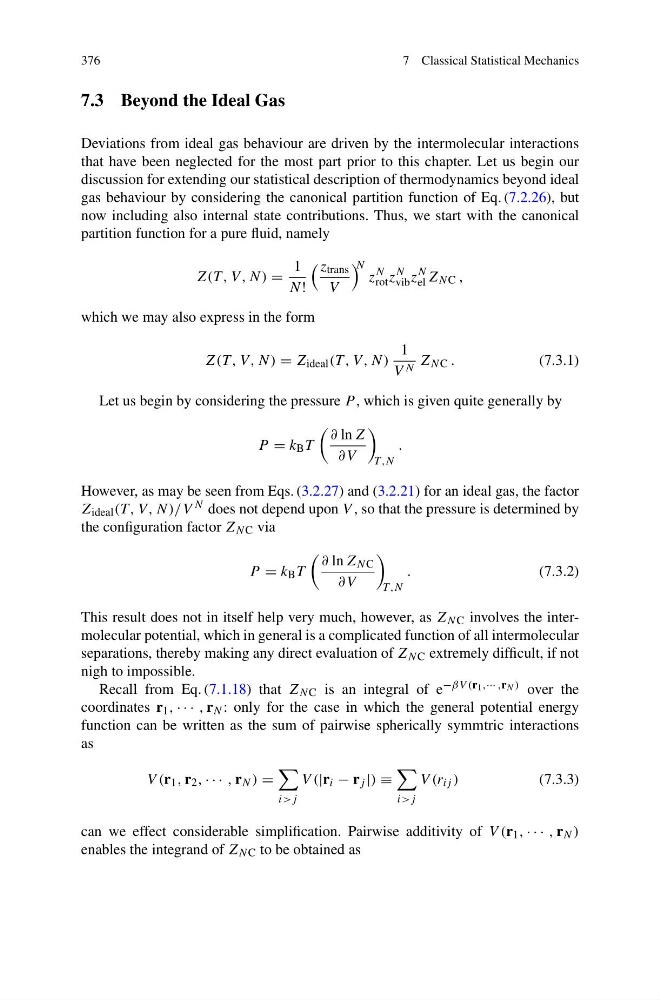
Z(T , V , N) =
1
N!
z trans
V
N
z
N
rot z
N
vib z
N
el Z N C ,
which we may also express in the form
Z(T , V , N) = Z ideal (T , V , N)
1
V N Z N C .
(7.3.1)
Let us begin by considering the pressure P , which is given quite generally by
P = k B T
∂ ln Z
∂V
T ,N
.
However, as may be seen from Eqs. (3.2.27) and (3.2.21) for an ideal gas, the factor
Z ideal (T , V , N)/V N does not depend upon V , so that the pressure is determined by
the configuration factor Z N C via
P = k B T
∂ ln Z N C
∂V
T ,N
.
(7.3.2)
This result does not in itself help very much, however, as Z N C involves the intermolecular potential, which in general is a complicated function of all intermolecular
separations, thereby making any direct evaluation of Z N C extremely difficult, if not
nigh to impossible.
Recall from Eq. (7.1.18) that Z N C is an integral of e −βV (r 1 ,··· ,r N ) over the
coordinates r 1 , · · · , r N : only for the case in which the general potential energy
function can be written as the sum of pairwise spherically symmtric interactions
as
V (r 1 , r 2 , · · · , r N ) =
i>j
V (|r i − r j |) ≡
i>j
V (r ij )
(7.3.3)
can we effect considerable simplification. Pairwise additivity of V (r 1 , · · · , r N )
enables the integrand of Z N C to be obtained as
7 Classical Statistical Mechanics
7.3 Beyond the Ideal Gas
Deviations from ideal gas behaviour are driven by the intermolecular interactions
that have been neglected for the most part prior to this chapter. Let us begin our
discussion for extending our statistical description of thermodynamics beyond ideal
gas behaviour by considering the canonical partition function of Eq. (7.2.26), but
now including also internal state contributions. Thus, we start with the canonical
partition function for a pure fluid, namely
Z(T , V , N) =
1
N!
z trans
V
N
z
N
rot z
N
vib z
N
el Z N C ,
which we may also express in the form
Z(T , V , N) = Z ideal (T , V , N)
1
V N Z N C .
(7.3.1)
Let us begin by considering the pressure P , which is given quite generally by
P = k B T
∂ ln Z
∂V
T ,N
.
However, as may be seen from Eqs. (3.2.27) and (3.2.21) for an ideal gas, the factor
Z ideal (T , V , N)/V N does not depend upon V , so that the pressure is determined by
the configuration factor Z N C via
P = k B T
∂ ln Z N C
∂V
T ,N
.
(7.3.2)
This result does not in itself help very much, however, as Z N C involves the intermolecular potential, which in general is a complicated function of all intermolecular
separations, thereby making any direct evaluation of Z N C extremely difficult, if not
nigh to impossible.
Recall from Eq. (7.1.18) that Z N C is an integral of e −βV (r 1 ,··· ,r N ) over the
coordinates r 1 , · · · , r N : only for the case in which the general potential energy
function can be written as the sum of pairwise spherically symmtric interactions
as
V (r 1 , r 2 , · · · , r N ) =
i>j
V (|r i − r j |) ≡
i>j
V (r ij )
(7.3.3)
can we effect considerable simplification. Pairwise additivity of V (r 1 , · · · , r N )
enables the integrand of Z N C to be obtained as