

7.2 The Virial Equation of State
375
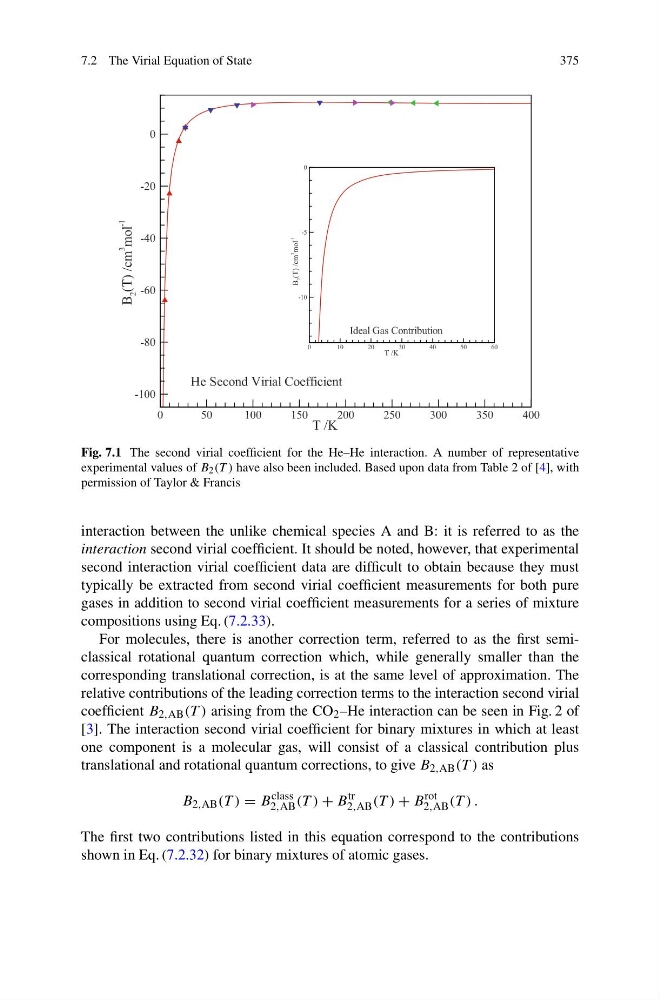
Fig. 7.1 The second virial coefficient for the He–He interaction. A number of representative
experimental values of B 2 (T ) have also been included. Based upon data from Table 2 of [4], with
permission of Taylor & Francis
interaction between the unlike chemical species A and B: it is referred to as the
interaction second virial coefficient. It should be noted, however, that experimental
second interaction virial coefficient data are difficult to obtain because they must
typically be extracted from second virial coefficient measurements for both pure
gases in addition to second virial coefficient measurements for a series of mixture
compositions using Eq. (7.2.33).
For molecules, there is another correction term, referred to as the first semiclassical rotational quantum correction which, while generally smaller than the
corresponding translational correction, is at the same level of approximation. The
relative contributions of the leading correction terms to the interaction second virial
coefficient B 2,AB (T ) arising from the CO 2 –He interaction can be seen in Fig. 2 of
[3]. The interaction second virial coefficient for binary mixtures in which at least
one component is a molecular gas, will consist of a classical contribution plus
translational and rotational quantum corrections, to give B 2,AB (T ) as
B 2,AB (T ) = B
class
2,AB (T ) + B
tr
2,AB (T ) + B
rot
2,AB (T ) .
The first two contributions listed in this equation correspond to the contributions
shown in Eq. (7.2.32) for binary mixtures of atomic gases.
375
Fig. 7.1 The second virial coefficient for the He–He interaction. A number of representative
experimental values of B 2 (T ) have also been included. Based upon data from Table 2 of [4], with
permission of Taylor & Francis
interaction between the unlike chemical species A and B: it is referred to as the
interaction second virial coefficient. It should be noted, however, that experimental
second interaction virial coefficient data are difficult to obtain because they must
typically be extracted from second virial coefficient measurements for both pure
gases in addition to second virial coefficient measurements for a series of mixture
compositions using Eq. (7.2.33).
For molecules, there is another correction term, referred to as the first semiclassical rotational quantum correction which, while generally smaller than the
corresponding translational correction, is at the same level of approximation. The
relative contributions of the leading correction terms to the interaction second virial
coefficient B 2,AB (T ) arising from the CO 2 –He interaction can be seen in Fig. 2 of
[3]. The interaction second virial coefficient for binary mixtures in which at least
one component is a molecular gas, will consist of a classical contribution plus
translational and rotational quantum corrections, to give B 2,AB (T ) as
B 2,AB (T ) = B
class
2,AB (T ) + B
tr
2,AB (T ) + B
rot
2,AB (T ) .
The first two contributions listed in this equation correspond to the contributions
shown in Eq. (7.2.32) for binary mixtures of atomic gases.