

7.2 The Virial Equation of State
369
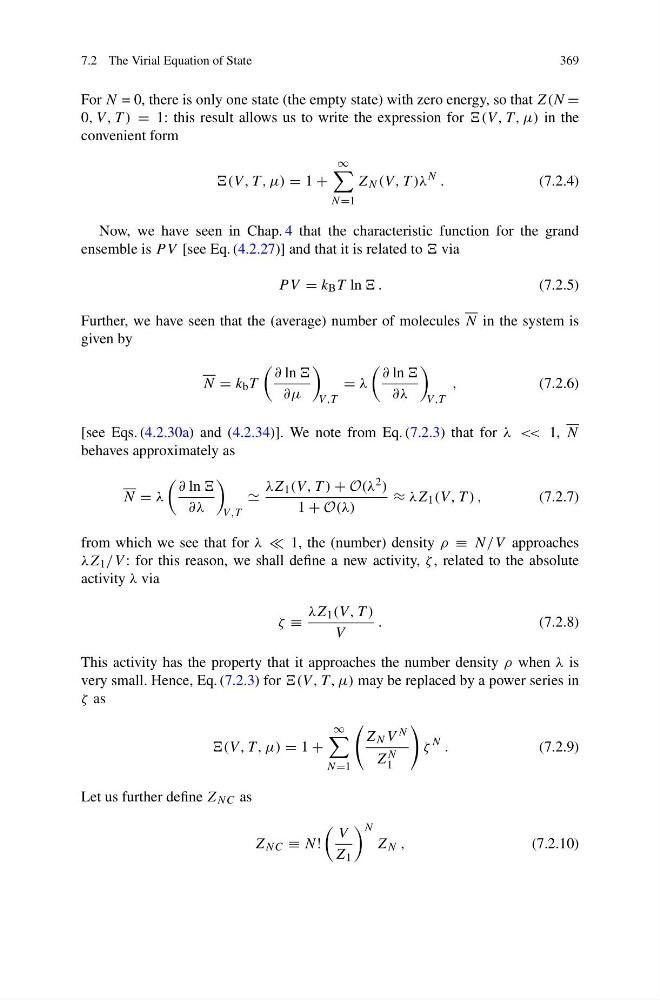
For N = 0, there is only one state (the empty state) with zero energy, so that Z(N =
0, V , T ) = 1: this result allows us to write the expression for , T , μ) in the
convenient form
, T , μ) = 1 +
∞
N =1
Z N (V , T )λ
N .
(7.2.4)
Now, we have seen in Chap. 4 that the characteristic function for the grand
ensemble is P V [see Eq. (4.2.27)] and that it is related to via
P V = k B T ln .
(7.2.5)
Further, we have seen that the (average) number of molecules N in the system is
given by
N = k b T
∂ ln
∂μ
V ,T
= λ
∂ ln
∂λ
V ,T
,
(7.2.6)
[see Eqs. (4.2.30a) and (4.2.34)]. We note from Eq. (7.2.3) that for λ << 1, N
behaves approximately as
N = λ
∂ ln
∂λ
V ,T
λZ 1 (V , T ) + O(λ 2 )
1 + O(λ)
≈ λZ 1 (V , T ) ,
(7.2.7)
from which we see that for λ 1, the (number) density ρ ≡ N/V approaches
λZ 1 /V : for this reason, we shall define a new activity, ζ , related to the absolute
activity λ via
ζ ≡
λZ 1 (V , T )
V
.
(7.2.8)
This activity has the property that it approaches the number density ρ when λ is
very small. Hence, Eq. (7.2.3) for (V , T , μ) may be replaced by a power series in
ζ as
(V , T , μ) = 1 +
∞
N =1
Z N V N
Z N
1
ζ
N .
(7.2.9)
Let us further define Z NC as
Z NC ≡ N!
V
Z 1
N
Z N ,
(7.2.10)
369
For N = 0, there is only one state (the empty state) with zero energy, so that Z(N =
0, V , T ) = 1: this result allows us to write the expression for , T , μ) in the
convenient form
, T , μ) = 1 +
∞
N =1
Z N (V , T )λ
N .
(7.2.4)
Now, we have seen in Chap. 4 that the characteristic function for the grand
ensemble is P V [see Eq. (4.2.27)] and that it is related to via
P V = k B T ln .
(7.2.5)
Further, we have seen that the (average) number of molecules N in the system is
given by
N = k b T
∂ ln
∂μ
V ,T
= λ
∂ ln
∂λ
V ,T
,
(7.2.6)
[see Eqs. (4.2.30a) and (4.2.34)]. We note from Eq. (7.2.3) that for λ << 1, N
behaves approximately as
N = λ
∂ ln
∂λ
V ,T
λZ 1 (V , T ) + O(λ 2 )
1 + O(λ)
≈ λZ 1 (V , T ) ,
(7.2.7)
from which we see that for λ 1, the (number) density ρ ≡ N/V approaches
λZ 1 /V : for this reason, we shall define a new activity, ζ , related to the absolute
activity λ via
ζ ≡
λZ 1 (V , T )
V
.
(7.2.8)
This activity has the property that it approaches the number density ρ when λ is
very small. Hence, Eq. (7.2.3) for (V , T , μ) may be replaced by a power series in
ζ as
(V , T , μ) = 1 +
∞
N =1
Z N V N
Z N
1
ζ
N .
(7.2.9)
Let us further define Z NC as
Z NC ≡ N!
V
Z 1
N
Z N ,
(7.2.10)