

370
7 Classical Statistical Mechanics
the reason for which will become clear a little later in our development. The
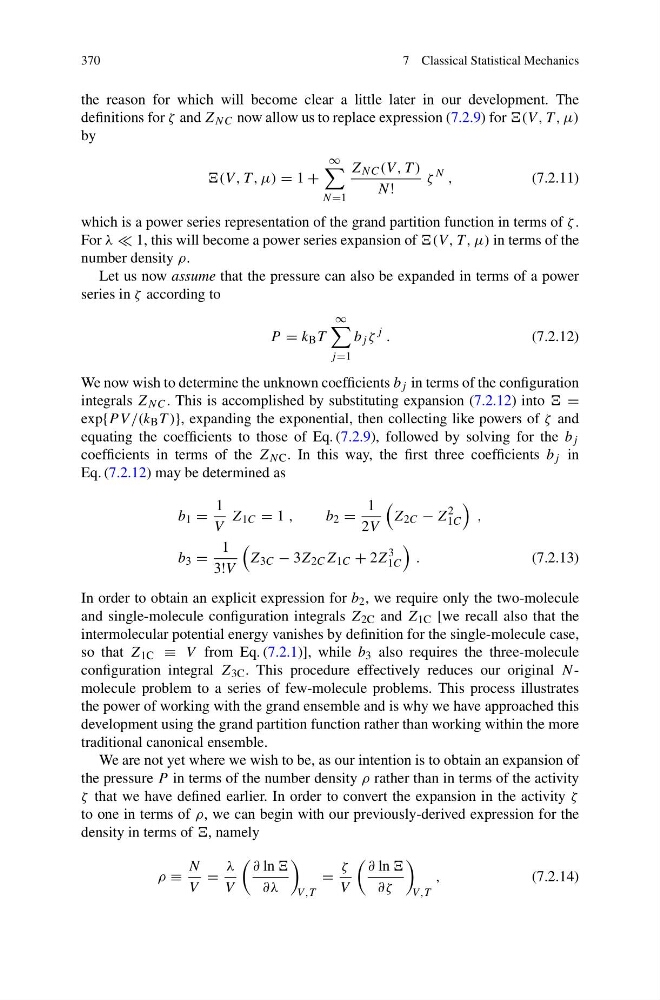
definitions for ζ and Z NC now allow us to replace expression (7.2.9) for (V , T , μ)
by
(V , T , μ) = 1 +
∞
N =1
Z NC (V , T )
N!
ζ
N ,
(7.2.11)
which is a power series representation of the grand partition function in terms of ζ .
For λ 1, this will become a power series expansion of , T , μ) in terms of the
number density ρ.
Let us now assume that the pressure can also be expanded in terms of a power
series in ζ according to
P = k B T
∞
j =1
b j ζ
j .
(7.2.12)
We now wish to determine the unknown coefficients b j in terms of the configuration
integrals Z NC . This is accomplished by substituting expansion (7.2.12) into =
exp{P V /(k B T )}, expanding the exponential, then collecting like powers of ζ and
equating the coefficients to those of Eq. (7.2.9), followed by solving for the b j
coefficients in terms of the Z N C . In this way, the first three coefficients b j in
Eq. (7.2.12) may be determined as
b 1 =
1
V
Z 1C = 1 ,
b 2 =
1
2V
Z 2C − Z
2
1C
,
b 3 =
1
3!V
Z 3C − 3Z 2C Z 1C + 2Z
3
1C
.
(7.2.13)
In order to obtain an explicit expression for b 2 , we require only the two-molecule
and single-molecule configuration integrals Z 2C and Z 1C [we recall also that the
intermolecular potential energy vanishes by definition for the single-molecule case,
so that Z 1C ≡ V from Eq. (7.2.1)], while b 3 also requires the three-molecule
configuration integral Z 3C . This procedure effectively reduces our original Nmolecule problem to a series of few-molecule problems. This process illustrates
the power of working with the grand ensemble and is why we have approached this
development using the grand partition function rather than working within the more
traditional canonical ensemble.
We are not yet where we wish to be, as our intention is to obtain an expansion of
the pressure P in terms of the number density ρ rather than in terms of the activity
ζ that we have defined earlier. In order to convert the expansion in the activity ζ
to one in terms of ρ, we can begin with our previously-derived expression for the
density in terms of , namely
ρ ≡
N
V
=
λ
V
∂ ln
∂λ
V ,T
=
ζ
V
∂ ln
∂ζ
V ,T
,
(7.2.14)
7 Classical Statistical Mechanics
the reason for which will become clear a little later in our development. The
definitions for ζ and Z NC now allow us to replace expression (7.2.9) for (V , T , μ)
by
(V , T , μ) = 1 +
∞
N =1
Z NC (V , T )
N!
ζ
N ,
(7.2.11)
which is a power series representation of the grand partition function in terms of ζ .
For λ 1, this will become a power series expansion of , T , μ) in terms of the
number density ρ.
Let us now assume that the pressure can also be expanded in terms of a power
series in ζ according to
P = k B T
∞
j =1
b j ζ
j .
(7.2.12)
We now wish to determine the unknown coefficients b j in terms of the configuration
integrals Z NC . This is accomplished by substituting expansion (7.2.12) into =
exp{P V /(k B T )}, expanding the exponential, then collecting like powers of ζ and
equating the coefficients to those of Eq. (7.2.9), followed by solving for the b j
coefficients in terms of the Z N C . In this way, the first three coefficients b j in
Eq. (7.2.12) may be determined as
b 1 =
1
V
Z 1C = 1 ,
b 2 =
1
2V
Z 2C − Z
2
1C
,
b 3 =
1
3!V
Z 3C − 3Z 2C Z 1C + 2Z
3
1C
.
(7.2.13)
In order to obtain an explicit expression for b 2 , we require only the two-molecule
and single-molecule configuration integrals Z 2C and Z 1C [we recall also that the
intermolecular potential energy vanishes by definition for the single-molecule case,
so that Z 1C ≡ V from Eq. (7.2.1)], while b 3 also requires the three-molecule
configuration integral Z 3C . This procedure effectively reduces our original Nmolecule problem to a series of few-molecule problems. This process illustrates
the power of working with the grand ensemble and is why we have approached this
development using the grand partition function rather than working within the more
traditional canonical ensemble.
We are not yet where we wish to be, as our intention is to obtain an expansion of
the pressure P in terms of the number density ρ rather than in terms of the activity
ζ that we have defined earlier. In order to convert the expansion in the activity ζ
to one in terms of ρ, we can begin with our previously-derived expression for the
density in terms of , namely
ρ ≡
N
V
=
λ
V
∂ ln
∂λ
V ,T
=
ζ
V
∂ ln
∂ζ
V ,T
,
(7.2.14)