

368
7 Classical Statistical Mechanics
simple molecules are quite high, typically vib > 1000 K, and electronic excitation energies even higher than vibrational excitation energies, it is not a poor
approximation to ignore these degrees of freedom for simple fluids. To include the
classical rotational contributions it is only necessary to insert an additional factor
z N
rot into Eq. (7.1.17): this factor is obtained by carrying out the integration over
the conjugate momenta p θ and p φ appearing in the rotational Hamiltonian. The
classical configuration integral is, however, quite a bit more complicated due to the
angular dependencies introduced into the potential energy function V (r 1 , · · · , r N )
for molecules, as even the pair interactions become angle-dependent (anisotropic).
7.2 The Virial Equation of State
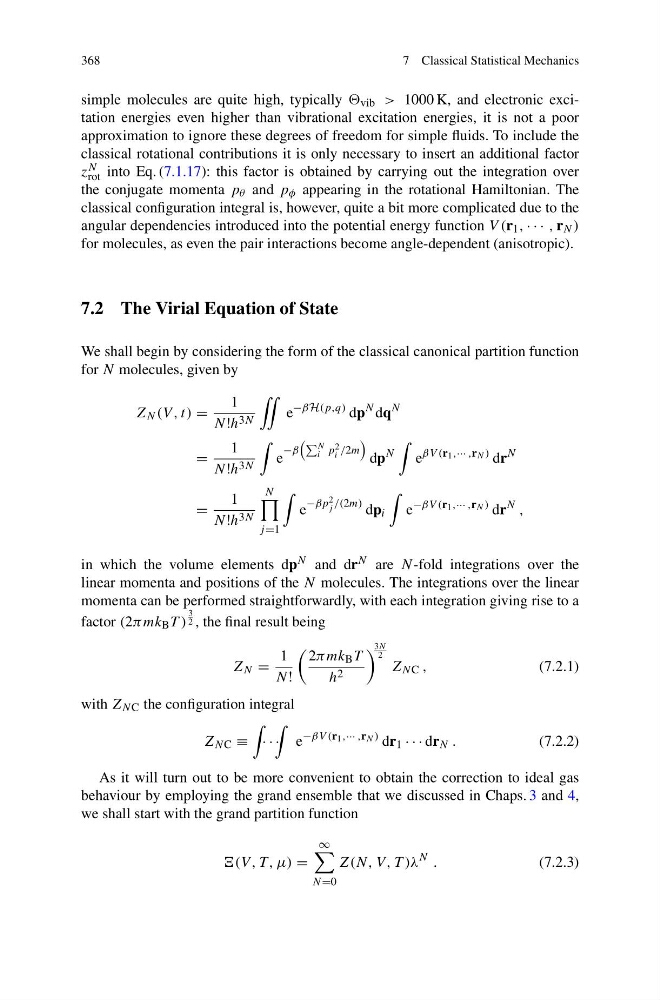
We shall begin by considering the form of the classical canonical partition function
for N molecules, given by
Z N (V , t) =
1
N!h 3N
e
−βH(p,q) dp
N dq
N
=
1
N!h 3N
e
−β
N
i p 2
i /2m
dp
N
e
βV (r 1 ,··· ,r N ) dr
N
=
1
N!h 3N
N
j =1
e
−βp 2
j /(2m) dp i
e
−βV (r 1 ,··· ,r N ) dr
N ,
in which the volume elements dp N and dr N are N-fold integrations over the
linear momenta and positions of the N molecules. The integrations over the linear
momenta can be performed straightforwardly, with each integration giving rise to a
factor (2πmk B T )
3
2 , the final result being
Z N =
1
N!
2πmk B T
h 2
3N
2
Z N C ,
(7.2.1)
with Z N C the configuration integral
Z N C ≡
· · ·
e
−βV (r 1 ,··· ,r N ) dr 1 · · · dr N .
(7.2.2)
As it will turn out to be more convenient to obtain the correction to ideal gas
behaviour by employing the grand ensemble that we discussed in Chaps. 3 and 4,
we shall start with the grand partition function
, T , μ) =
∞
N =0
Z(N, V , T )λ
N .
(7.2.3)
7 Classical Statistical Mechanics
simple molecules are quite high, typically vib > 1000 K, and electronic excitation energies even higher than vibrational excitation energies, it is not a poor
approximation to ignore these degrees of freedom for simple fluids. To include the
classical rotational contributions it is only necessary to insert an additional factor
z N
rot into Eq. (7.1.17): this factor is obtained by carrying out the integration over
the conjugate momenta p θ and p φ appearing in the rotational Hamiltonian. The
classical configuration integral is, however, quite a bit more complicated due to the
angular dependencies introduced into the potential energy function V (r 1 , · · · , r N )
for molecules, as even the pair interactions become angle-dependent (anisotropic).
7.2 The Virial Equation of State
We shall begin by considering the form of the classical canonical partition function
for N molecules, given by
Z N (V , t) =
1
N!h 3N
e
−βH(p,q) dp
N dq
N
=
1
N!h 3N
e
−β
N
i p 2
i /2m
dp
N
e
βV (r 1 ,··· ,r N ) dr
N
=
1
N!h 3N
N
j =1
e
−βp 2
j /(2m) dp i
e
−βV (r 1 ,··· ,r N ) dr
N ,
in which the volume elements dp N and dr N are N-fold integrations over the
linear momenta and positions of the N molecules. The integrations over the linear
momenta can be performed straightforwardly, with each integration giving rise to a
factor (2πmk B T )
3
2 , the final result being
Z N =
1
N!
2πmk B T
h 2
3N
2
Z N C ,
(7.2.1)
with Z N C the configuration integral
Z N C ≡
· · ·
e
−βV (r 1 ,··· ,r N ) dr 1 · · · dr N .
(7.2.2)
As it will turn out to be more convenient to obtain the correction to ideal gas
behaviour by employing the grand ensemble that we discussed in Chaps. 3 and 4,
we shall start with the grand partition function
, T , μ) =
∞
N =0
Z(N, V , T )λ
N .
(7.2.3)