

7.1 Introduction
367
If we gather the two terms together, we obtain
u(T ) = k B T
5
2
−
η
e η − 1
,
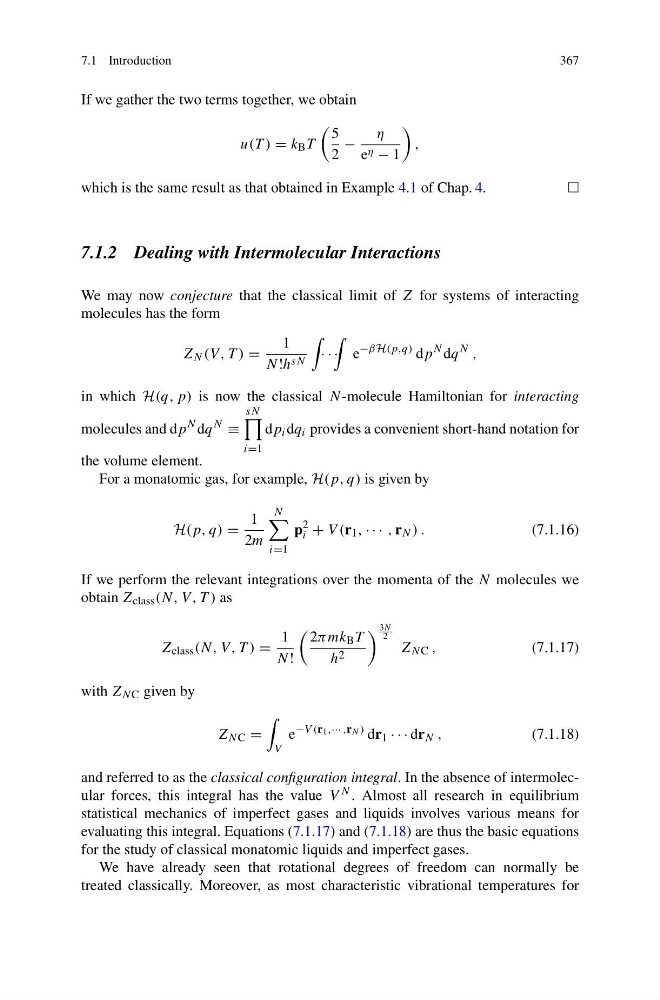
which is the same result as that obtained in Example 4.1 of Chap. 4.
7.1.2 Dealing with Intermolecular Interactions
We may now conjecture that the classical limit of Z for systems of interacting
molecules has the form
Z N (V , T ) =
1
N!h sN
· · ·
e
−βH(p,q) dp
N dq
N ,
in which H(q, p) is now the classical N-molecule Hamiltonian for interacting
molecules and dp
N dq
N
≡
sN
i=1
dp i dq i provides a convenient short-hand notation for
the volume element.
For a monatomic gas, for example, H(p, q) is given by
H(p, q) =
1
2m
N
i=1
p
2
i + V (r 1 , · · · , r N ) .
(7.1.16)
If we perform the relevant integrations over the momenta of the N molecules we
obtain Z class (N, V , T ) as
Z class (N, V , T ) =
1
N!
2πmk B T
h 2
3N
2
Z N C ,
(7.1.17)
with Z N C given by
Z N C =
V
e
−V (r 1 ,··· ,r N ) dr 1 · · · dr N ,
(7.1.18)
and referred to as the classical configuration integral. In the absence of intermolecular forces, this integral has the value V N . Almost all research in equilibrium
statistical mechanics of imperfect gases and liquids involves various means for
evaluating this integral. Equations (7.1.17) and (7.1.18) are thus the basic equations
for the study of classical monatomic liquids and imperfect gases.
We have already seen that rotational degrees of freedom can normally be
treated classically. Moreover, as most characteristic vibrational temperatures for
367
If we gather the two terms together, we obtain
u(T ) = k B T
5
2
−
η
e η − 1
,
which is the same result as that obtained in Example 4.1 of Chap. 4.
7.1.2 Dealing with Intermolecular Interactions
We may now conjecture that the classical limit of Z for systems of interacting
molecules has the form
Z N (V , T ) =
1
N!h sN
· · ·
e
−βH(p,q) dp
N dq
N ,
in which H(q, p) is now the classical N-molecule Hamiltonian for interacting
molecules and dp
N dq
N
≡
sN
i=1
dp i dq i provides a convenient short-hand notation for
the volume element.
For a monatomic gas, for example, H(p, q) is given by
H(p, q) =
1
2m
N
i=1
p
2
i + V (r 1 , · · · , r N ) .
(7.1.16)
If we perform the relevant integrations over the momenta of the N molecules we
obtain Z class (N, V , T ) as
Z class (N, V , T ) =
1
N!
2πmk B T
h 2
3N
2
Z N C ,
(7.1.17)
with Z N C given by
Z N C =
V
e
−V (r 1 ,··· ,r N ) dr 1 · · · dr N ,
(7.1.18)
and referred to as the classical configuration integral. In the absence of intermolecular forces, this integral has the value V N . Almost all research in equilibrium
statistical mechanics of imperfect gases and liquids involves various means for
evaluating this integral. Equations (7.1.17) and (7.1.18) are thus the basic equations
for the study of classical monatomic liquids and imperfect gases.
We have already seen that rotational degrees of freedom can normally be
treated classically. Moreover, as most characteristic vibrational temperatures for