

6.3 Extension to the Ideal Polyatomic Gas
315
−
3N a −6
i=1
ln(1 − e
− vib,i /T ) + ln ω e1
,
(6.3.15)
U(T , V ) − H
◦
f 0 = RT
3
2
+
3
2
+
3N a −6
i=1
vib,i /T
e vib,i /T − 1
,
(6.3.16)
C V (T ) = R
⎧
⎨
⎩
3
2
+
3
2
+
3N a −6
j =i
vib,i
T
2
e vib,i /T
(e vib,i /T − 1) 2
⎫
⎬
⎭
,
(6.3.17)
S(T , V ) = R
⎧
⎨
⎩
ln
2πMk B T
h 2
3
2 V
◦ e
5
2
N
+ ln
⎡
⎣
√
π e
3
2
σ
T 3
A B C
1
2
⎤
⎦
+
3N a −6
i=1
vib,i /T
e vib,i /T − 1
− ln(1 − e
− vib,i /T )
+ ln ω e1
.
(6.3.18)
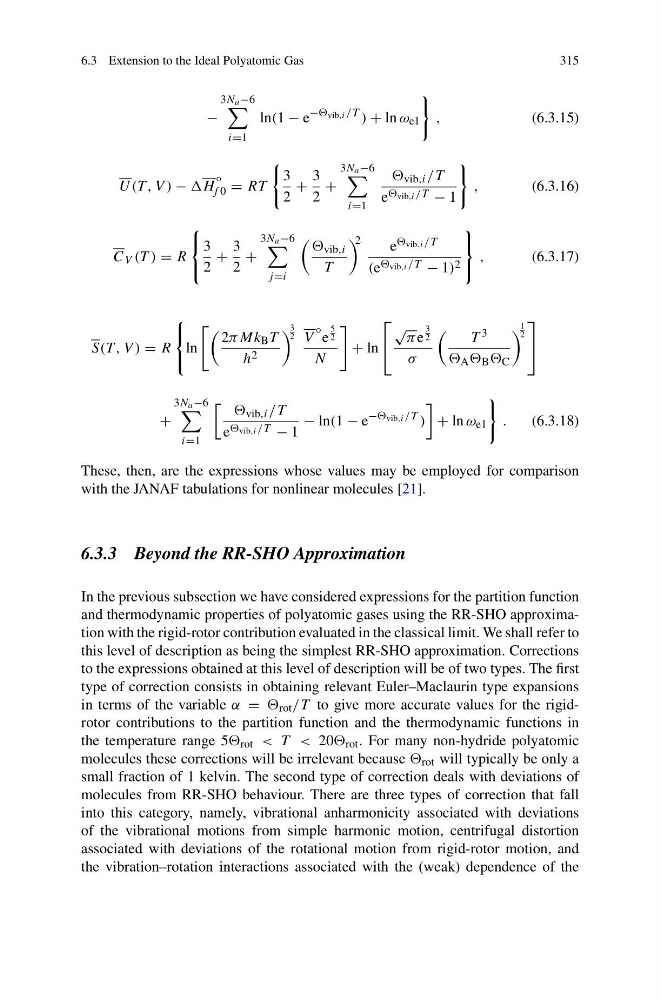
These, then, are the expressions whose values may be employed for comparison
with the JANAF tabulations for nonlinear molecules [21].
6.3.3 Beyond the RR-SHO Approximation
In the previous subsection we have considered expressions for the partition function
and thermodynamic properties of polyatomic gases using the RR-SHO approximation with the rigid-rotor contribution evaluated in the classical limit. We shall refer to
this level of description as being the simplest RR-SHO approximation. Corrections
to the expressions obtained at this level of description will be of two types. The first
type of correction consists in obtaining relevant Euler–Maclaurin type expansions
in terms of the variable α = rot /T to give more accurate values for the rigidrotor contributions to the partition function and the thermodynamic functions in
the temperature range 5 rot < T < 20 rot . For many non-hydride polyatomic
molecules these corrections will be irrelevant because rot will typically be only a
small fraction of 1 kelvin. The second type of correction deals with deviations of
molecules from RR-SHO behaviour. There are three types of correction that fall
into this category, namely, vibrational anharmonicity associated with deviations
of the vibrational motions from simple harmonic motion, centrifugal distortion
associated with deviations of the rotational motion from rigid-rotor motion, and
the vibration–rotation interactions associated with the (weak) dependence of the
315
−
3N a −6
i=1
ln(1 − e
− vib,i /T ) + ln ω e1
,
(6.3.15)
U(T , V ) − H
◦
f 0 = RT
3
2
+
3
2
+
3N a −6
i=1
vib,i /T
e vib,i /T − 1
,
(6.3.16)
C V (T ) = R
⎧
⎨
⎩
3
2
+
3
2
+
3N a −6
j =i
vib,i
T
2
e vib,i /T
(e vib,i /T − 1) 2
⎫
⎬
⎭
,
(6.3.17)
S(T , V ) = R
⎧
⎨
⎩
ln
2πMk B T
h 2
3
2 V
◦ e
5
2
N
+ ln
⎡
⎣
√
π e
3
2
σ
T 3
A B C
1
2
⎤
⎦
+
3N a −6
i=1
vib,i /T
e vib,i /T − 1
− ln(1 − e
− vib,i /T )
+ ln ω e1
.
(6.3.18)
These, then, are the expressions whose values may be employed for comparison
with the JANAF tabulations for nonlinear molecules [21].
6.3.3 Beyond the RR-SHO Approximation
In the previous subsection we have considered expressions for the partition function
and thermodynamic properties of polyatomic gases using the RR-SHO approximation with the rigid-rotor contribution evaluated in the classical limit. We shall refer to
this level of description as being the simplest RR-SHO approximation. Corrections
to the expressions obtained at this level of description will be of two types. The first
type of correction consists in obtaining relevant Euler–Maclaurin type expansions
in terms of the variable α = rot /T to give more accurate values for the rigidrotor contributions to the partition function and the thermodynamic functions in
the temperature range 5 rot < T < 20 rot . For many non-hydride polyatomic
molecules these corrections will be irrelevant because rot will typically be only a
small fraction of 1 kelvin. The second type of correction deals with deviations of
molecules from RR-SHO behaviour. There are three types of correction that fall
into this category, namely, vibrational anharmonicity associated with deviations
of the vibrational motions from simple harmonic motion, centrifugal distortion
associated with deviations of the rotational motion from rigid-rotor motion, and
the vibration–rotation interactions associated with the (weak) dependence of the