

314
6 Molecular Systems
A(T , V ) − H
◦
f 0 = −RT
ln
2πMk B T
h 2
3
2 V
◦ e
N
+ ln
T
σ σ rot
−
3N a −5
i=1
ln(1 − e
− vib,i /T ) + ln ω e1
,
(6.3.10)
U(T , V ) − H
◦
f 0 = RT
3
2
+
2
2
+
3N a −5
i=1
vib,i /T
e vib,i /T − 1
,
(6.3.11)
C V (T ) = R
3
2
+
2
2
+
3N a −5
i=1
vib,i
T
2
e vib,i /T
(e vib,i /T − 1) 2
,
(6.3.12)
S(T , V ) = R
ln
2πMk B T
h 2
3
2 V
◦ e
5
2
N
+ ln
T e
σ σ rot
+
3N a −5
i=1
vib,i /T
e vib,i /T − 1
− ln(1 − e
− vib,i /T )
+ ln ω e1
.
(6.3.13)
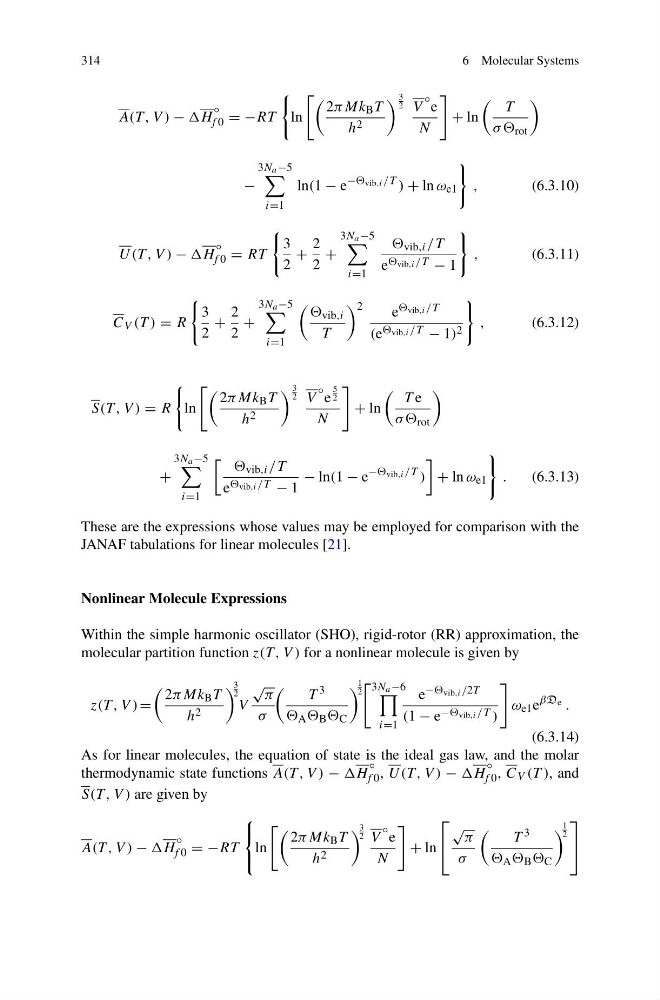
These are the expressions whose values may be employed for comparison with the
JANAF tabulations for linear molecules [21].
Nonlinear Molecule Expressions
Within the simple harmonic oscillator (SHO), rigid-rotor (RR) approximation, the
molecular partition function z(T , V ) for a nonlinear molecule is given by
z(T , V ) =
2πMk B T
h 2
3
2
V
√
π
σ
T 3
A B C
1
2
3N a −6
i=1
e − vib,i /2T
(1 − e − vib,i /T )
ω e1 e
βD e .
(6.3.14)
As for linear molecules, the equation of state is the ideal gas law, and the molar
thermodynamic state functions A(T , V ) − H
◦
f 0 , U(T , V ) − H
◦
f 0 , C V (T ), and
S(T , V ) are given by
A(T , V ) − H
◦
f 0 = −RT
⎧
⎨
⎩
ln
2πMk B T
h 2
3
2 V
◦ e
N
+ ln
⎡
⎣
√
π
σ
T 3
A B C
1
2
⎤
⎦
6 Molecular Systems
A(T , V ) − H
◦
f 0 = −RT
ln
2πMk B T
h 2
3
2 V
◦ e
N
+ ln
T
σ σ rot
−
3N a −5
i=1
ln(1 − e
− vib,i /T ) + ln ω e1
,
(6.3.10)
U(T , V ) − H
◦
f 0 = RT
3
2
+
2
2
+
3N a −5
i=1
vib,i /T
e vib,i /T − 1
,
(6.3.11)
C V (T ) = R
3
2
+
2
2
+
3N a −5
i=1
vib,i
T
2
e vib,i /T
(e vib,i /T − 1) 2
,
(6.3.12)
S(T , V ) = R
ln
2πMk B T
h 2
3
2 V
◦ e
5
2
N
+ ln
T e
σ σ rot
+
3N a −5
i=1
vib,i /T
e vib,i /T − 1
− ln(1 − e
− vib,i /T )
+ ln ω e1
.
(6.3.13)
These are the expressions whose values may be employed for comparison with the
JANAF tabulations for linear molecules [21].
Nonlinear Molecule Expressions
Within the simple harmonic oscillator (SHO), rigid-rotor (RR) approximation, the
molecular partition function z(T , V ) for a nonlinear molecule is given by
z(T , V ) =
2πMk B T
h 2
3
2
V
√
π
σ
T 3
A B C
1
2
3N a −6
i=1
e − vib,i /2T
(1 − e − vib,i /T )
ω e1 e
βD e .
(6.3.14)
As for linear molecules, the equation of state is the ideal gas law, and the molar
thermodynamic state functions A(T , V ) − H
◦
f 0 , U(T , V ) − H
◦
f 0 , C V (T ), and
S(T , V ) are given by
A(T , V ) − H
◦
f 0 = −RT
⎧
⎨
⎩
ln
2πMk B T
h 2
3
2 V
◦ e
N
+ ln
⎡
⎣
√
π
σ
T 3
A B C
1
2
⎤
⎦