

6.3 Extension to the Ideal Polyatomic Gas
313
how to deal with vibrational modes that are neither infrared nor Raman active
(relatively rare occurrences for simple polyatomic molecules, but increasingly more
frequent occurrences for large molecules, such as biomolecules and polymers) and
anomalous behaviour of the entropy at very low temperature (leading to apparent
violations of the usual statements of the third law of thermodynamics). We shall
briefly deal with both of these special cases in later subsections.
Because polyatomic molecules are readily divided into the two distinct categories
of linear and nonlinear molecules, with each category requiring a slight variant
for the treatment of its vibrational and rotational degrees of freedom, we shall
summarize the expressions for the thermodynamic state functions separately, with
one set of expressions for linear, the other for nonlinear, molecules.
As for diatomic molecules, we shall treat the degrees of freedom for a particular
motion classically when the energy level separations associated with them are
small in comparison with k B T . Here, too, with the exception of simple hydrides,
the rotational degrees of freedom can be treated classically for all but very low
temperatures, and the vibrational degrees of freedom must always be treated
quantum mechanically. Although the occurrence of relatively low-lying electronic
states is more common for polyatomic molecules than it is for diatomic molecules,
we shall not consider such cases here.
The quantity D e may be thought of as the global minimum in the (multidimensional) potential energy surface for the polyatomic molecule. A value of D 0 for
a polyatomic molecule may be thought of as the energy required to atomize the
molecule into its constituent separated stationary atoms at infinity. Both D 0 and
D e may be inferred from spectroscopic measurements, but apart from the special
case of diatomic molecules, it is rather difficult to do so. However, as for diatomic
molecules, a value of D 0 can be obtained directly from the thermodynamic molar
heat of formation, H
◦
f 0 , for a molecule, so that the relevant listings in the JANAF
Tables [21] are for H − H
◦
f 0 and A − H
◦
f 0 , as for diatomic molecules.
Linear Molecule Expressions
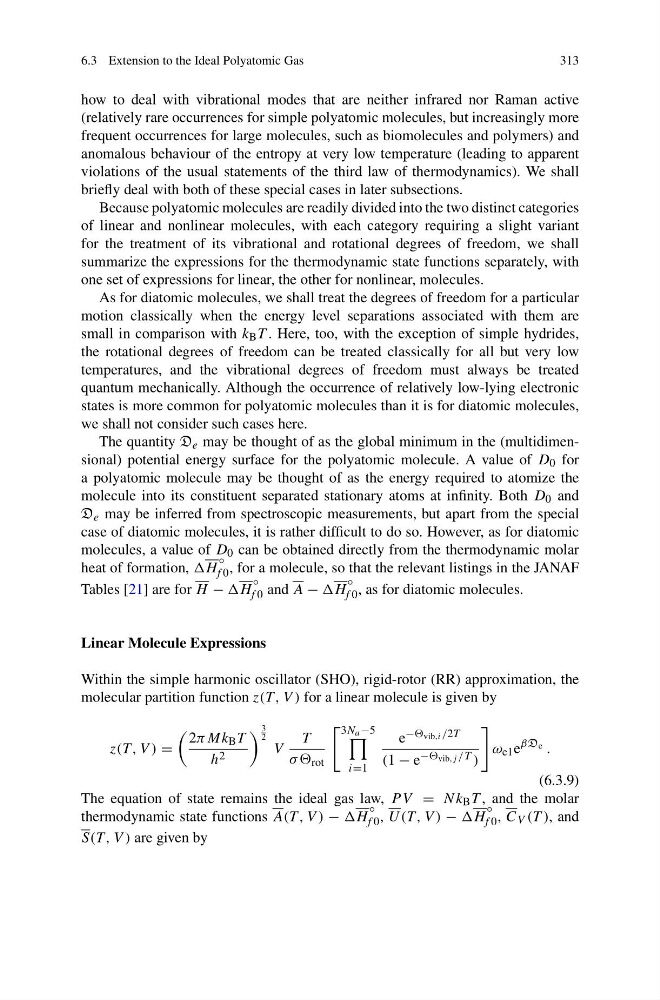
Within the simple harmonic oscillator (SHO), rigid-rotor (RR) approximation, the
molecular partition function z(T , V ) for a linear molecule is given by
z(T , V ) =
2πMk B T
h 2
3
2
V
T
σ σ rot
3N a −5
i=1
e − vib,i /2T
(1 − e − vib,j /T )
ω e1 e
βD e .
(6.3.9)
The equation of state remains the ideal gas law, P V = Nk B T , and the molar
thermodynamic state functions A(T , V ) − H
◦
f 0 , U(T , V ) − H
◦
f 0 , C V (T ), and
S(T , V ) are given by
313
how to deal with vibrational modes that are neither infrared nor Raman active
(relatively rare occurrences for simple polyatomic molecules, but increasingly more
frequent occurrences for large molecules, such as biomolecules and polymers) and
anomalous behaviour of the entropy at very low temperature (leading to apparent
violations of the usual statements of the third law of thermodynamics). We shall
briefly deal with both of these special cases in later subsections.
Because polyatomic molecules are readily divided into the two distinct categories
of linear and nonlinear molecules, with each category requiring a slight variant
for the treatment of its vibrational and rotational degrees of freedom, we shall
summarize the expressions for the thermodynamic state functions separately, with
one set of expressions for linear, the other for nonlinear, molecules.
As for diatomic molecules, we shall treat the degrees of freedom for a particular
motion classically when the energy level separations associated with them are
small in comparison with k B T . Here, too, with the exception of simple hydrides,
the rotational degrees of freedom can be treated classically for all but very low
temperatures, and the vibrational degrees of freedom must always be treated
quantum mechanically. Although the occurrence of relatively low-lying electronic
states is more common for polyatomic molecules than it is for diatomic molecules,
we shall not consider such cases here.
The quantity D e may be thought of as the global minimum in the (multidimensional) potential energy surface for the polyatomic molecule. A value of D 0 for
a polyatomic molecule may be thought of as the energy required to atomize the
molecule into its constituent separated stationary atoms at infinity. Both D 0 and
D e may be inferred from spectroscopic measurements, but apart from the special
case of diatomic molecules, it is rather difficult to do so. However, as for diatomic
molecules, a value of D 0 can be obtained directly from the thermodynamic molar
heat of formation, H
◦
f 0 , for a molecule, so that the relevant listings in the JANAF
Tables [21] are for H − H
◦
f 0 and A − H
◦
f 0 , as for diatomic molecules.
Linear Molecule Expressions
Within the simple harmonic oscillator (SHO), rigid-rotor (RR) approximation, the
molecular partition function z(T , V ) for a linear molecule is given by
z(T , V ) =
2πMk B T
h 2
3
2
V
T
σ σ rot
3N a −5
i=1
e − vib,i /2T
(1 − e − vib,j /T )
ω e1 e
βD e .
(6.3.9)
The equation of state remains the ideal gas law, P V = Nk B T , and the molar
thermodynamic state functions A(T , V ) − H
◦
f 0 , U(T , V ) − H
◦
f 0 , C V (T ), and
S(T , V ) are given by