

312
6 Molecular Systems
rotational degrees of freedom which have their axes of rotation perpendicular to the
molecular figure axis, and one rotational degree of freedom which has the molecular
figure axis as its axis of rotation (and a moment-of-inertia that is essentially zero).
As a consequence, the expressions for z rot , U rot , and C V ,rot are precisely the same
as those for a diatomic molecule. For a rigid nonlinear polyatomic molecule, there
are in principle three distinct moments-of-inertia, designated by convention as I A ,
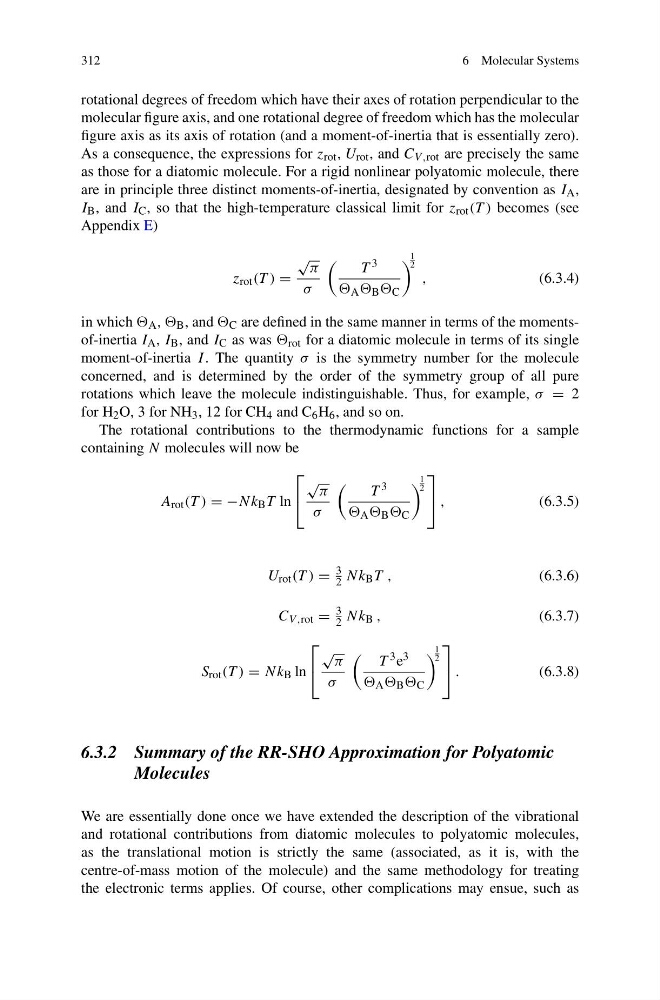
I B , and I C , so that the high-temperature classical limit for z rot (T ) becomes (see
Appendix E)
z rot (T ) =
√
π
σ
T 3
A B C
1
2
,
(6.3.4)
in which A , B , and C are defined in the same manner in terms of the momentsof-inertia I A , I B , and I C as was rot for a diatomic molecule in terms of its single
moment-of-inertia I . The quantity σ is the symmetry number for the molecule
concerned, and is determined by the order of the symmetry group of all pure
rotations which leave the molecule indistinguishable. Thus, for example, σ = 2
for H 2 O, 3 for NH 3 , 12 for CH 4 and C 6 H 6 , and so on.
The rotational contributions to the thermodynamic functions for a sample
containing N molecules will now be
A rot (T ) = −Nk B T ln
⎡
⎣
√
π
σ
T 3
A B C
1
2
⎤
⎦ ,
(6.3.5)
U rot (T ) =
3
2 Nk B T ,
(6.3.6)
C V ,rot =
3
2 Nk B ,
(6.3.7)
S rot (T ) = Nk B ln
⎡
⎣
√
π
σ
T 3 e 3
A B C
1
2
⎤
⎦ .
(6.3.8)
6.3.2 Summary of the RR-SHO Approximation for Polyatomic
Molecules
We are essentially done once we have extended the description of the vibrational
and rotational contributions from diatomic molecules to polyatomic molecules,
as the translational motion is strictly the same (associated, as it is, with the
centre-of-mass motion of the molecule) and the same methodology for treating
the electronic terms applies. Of course, other complications may ensue, such as
6 Molecular Systems
rotational degrees of freedom which have their axes of rotation perpendicular to the
molecular figure axis, and one rotational degree of freedom which has the molecular
figure axis as its axis of rotation (and a moment-of-inertia that is essentially zero).
As a consequence, the expressions for z rot , U rot , and C V ,rot are precisely the same
as those for a diatomic molecule. For a rigid nonlinear polyatomic molecule, there
are in principle three distinct moments-of-inertia, designated by convention as I A ,
I B , and I C , so that the high-temperature classical limit for z rot (T ) becomes (see
Appendix E)
z rot (T ) =
√
π
σ
T 3
A B C
1
2
,
(6.3.4)
in which A , B , and C are defined in the same manner in terms of the momentsof-inertia I A , I B , and I C as was rot for a diatomic molecule in terms of its single
moment-of-inertia I . The quantity σ is the symmetry number for the molecule
concerned, and is determined by the order of the symmetry group of all pure
rotations which leave the molecule indistinguishable. Thus, for example, σ = 2
for H 2 O, 3 for NH 3 , 12 for CH 4 and C 6 H 6 , and so on.
The rotational contributions to the thermodynamic functions for a sample
containing N molecules will now be
A rot (T ) = −Nk B T ln
⎡
⎣
√
π
σ
T 3
A B C
1
2
⎤
⎦ ,
(6.3.5)
U rot (T ) =
3
2 Nk B T ,
(6.3.6)
C V ,rot =
3
2 Nk B ,
(6.3.7)
S rot (T ) = Nk B ln
⎡
⎣
√
π
σ
T 3 e 3
A B C
1
2
⎤
⎦ .
(6.3.8)
6.3.2 Summary of the RR-SHO Approximation for Polyatomic
Molecules
We are essentially done once we have extended the description of the vibrational
and rotational contributions from diatomic molecules to polyatomic molecules,
as the translational motion is strictly the same (associated, as it is, with the
centre-of-mass motion of the molecule) and the same methodology for treating
the electronic terms applies. Of course, other complications may ensue, such as