

6.3 Extension to the Ideal Polyatomic Gas
311
transitions in the molecule. Note, however, that in some relatively rare cases, there
are vibrational degrees of freedom that are neither IR nor Raman active. The
additional vibrational degrees of freedom for polyatomic molecules result in the
vibrational partition function being represented by a product function of vibrational
partition functions corresponding to the individual independent vibrational degrees
of freedom of the polyatomic molecule.
6.3.1 The Rigid-Rotor Simple Harmonic Oscillator
Approximation
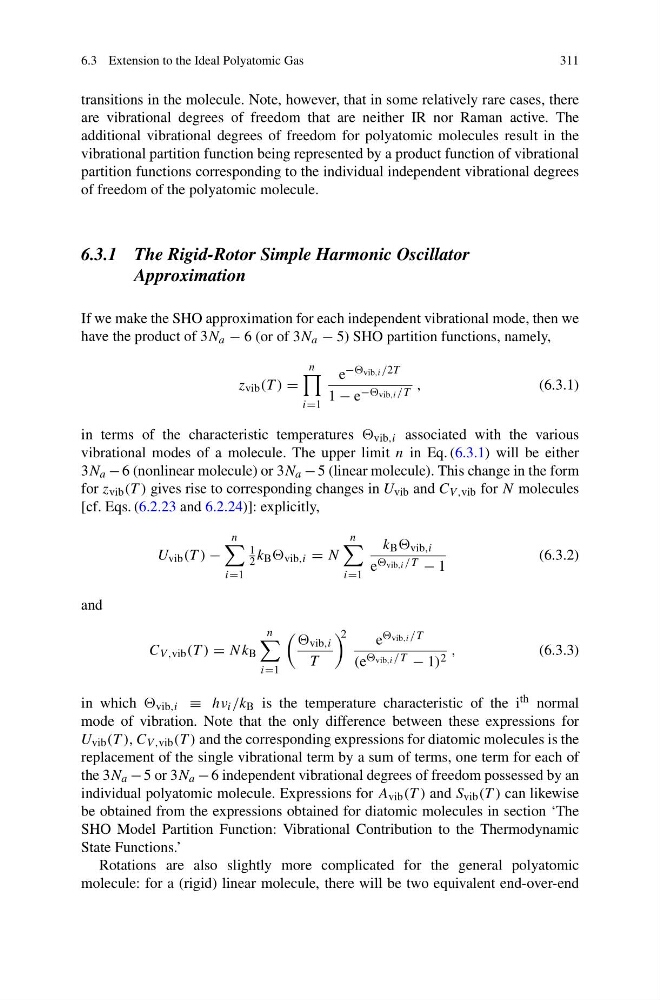
If we make the SHO approximation for each independent vibrational mode, then we
have the product of 3N a − 6 (or of 3N a − 5) SHO partition functions, namely,
z vib (T ) =
n
i=1
e − vib,i /2T
1 − e − vib,i /T ,
(6.3.1)
in terms of the characteristic temperatures vib,i associated with the various
vibrational modes of a molecule. The upper limit n in Eq. (6.3.1) will be either
3N a − 6 (nonlinear molecule) or 3N a − 5 (linear molecule). This change in the form
for z vib (T ) gives rise to corresponding changes in U vib and C V ,vib for N molecules
[cf. Eqs. (6.2.23 and 6.2.24)]: explicitly,
U vib (T ) −
n
i=1
1
2 k B vib,i = N
n
i=1
k B vib,i
e vib,i /T − 1
(6.3.2)
and
C V ,vib (T ) = Nk B
n
i=1
vib,i
T
2
e vib,i /T
(e vib,i /T − 1) 2 ,
(6.3.3)
in which vib,i ≡ hν i /k B is the temperature characteristic of the i th normal
mode of vibration. Note that the only difference between these expressions for
U vib (T ), C V ,vib (T ) and the corresponding expressions for diatomic molecules is the
replacement of the single vibrational term by a sum of terms, one term for each of
the 3N a − 5 or 3N a − 6 independent vibrational degrees of freedom possessed by an
individual polyatomic molecule. Expressions for A vib (T ) and S vib (T ) can likewise
be obtained from the expressions obtained for diatomic molecules in section ‘The
SHO Model Partition Function: Vibrational Contribution to the Thermodynamic
State Functions.’
Rotations are also slightly more complicated for the general polyatomic
molecule: for a (rigid) linear molecule, there will be two equivalent end-over-end
311
transitions in the molecule. Note, however, that in some relatively rare cases, there
are vibrational degrees of freedom that are neither IR nor Raman active. The
additional vibrational degrees of freedom for polyatomic molecules result in the
vibrational partition function being represented by a product function of vibrational
partition functions corresponding to the individual independent vibrational degrees
of freedom of the polyatomic molecule.
6.3.1 The Rigid-Rotor Simple Harmonic Oscillator
Approximation
If we make the SHO approximation for each independent vibrational mode, then we
have the product of 3N a − 6 (or of 3N a − 5) SHO partition functions, namely,
z vib (T ) =
n
i=1
e − vib,i /2T
1 − e − vib,i /T ,
(6.3.1)
in terms of the characteristic temperatures vib,i associated with the various
vibrational modes of a molecule. The upper limit n in Eq. (6.3.1) will be either
3N a − 6 (nonlinear molecule) or 3N a − 5 (linear molecule). This change in the form
for z vib (T ) gives rise to corresponding changes in U vib and C V ,vib for N molecules
[cf. Eqs. (6.2.23 and 6.2.24)]: explicitly,
U vib (T ) −
n
i=1
1
2 k B vib,i = N
n
i=1
k B vib,i
e vib,i /T − 1
(6.3.2)
and
C V ,vib (T ) = Nk B
n
i=1
vib,i
T
2
e vib,i /T
(e vib,i /T − 1) 2 ,
(6.3.3)
in which vib,i ≡ hν i /k B is the temperature characteristic of the i th normal
mode of vibration. Note that the only difference between these expressions for
U vib (T ), C V ,vib (T ) and the corresponding expressions for diatomic molecules is the
replacement of the single vibrational term by a sum of terms, one term for each of
the 3N a − 5 or 3N a − 6 independent vibrational degrees of freedom possessed by an
individual polyatomic molecule. Expressions for A vib (T ) and S vib (T ) can likewise
be obtained from the expressions obtained for diatomic molecules in section ‘The
SHO Model Partition Function: Vibrational Contribution to the Thermodynamic
State Functions.’
Rotations are also slightly more complicated for the general polyatomic
molecule: for a (rigid) linear molecule, there will be two equivalent end-over-end