

310
6 Molecular Systems
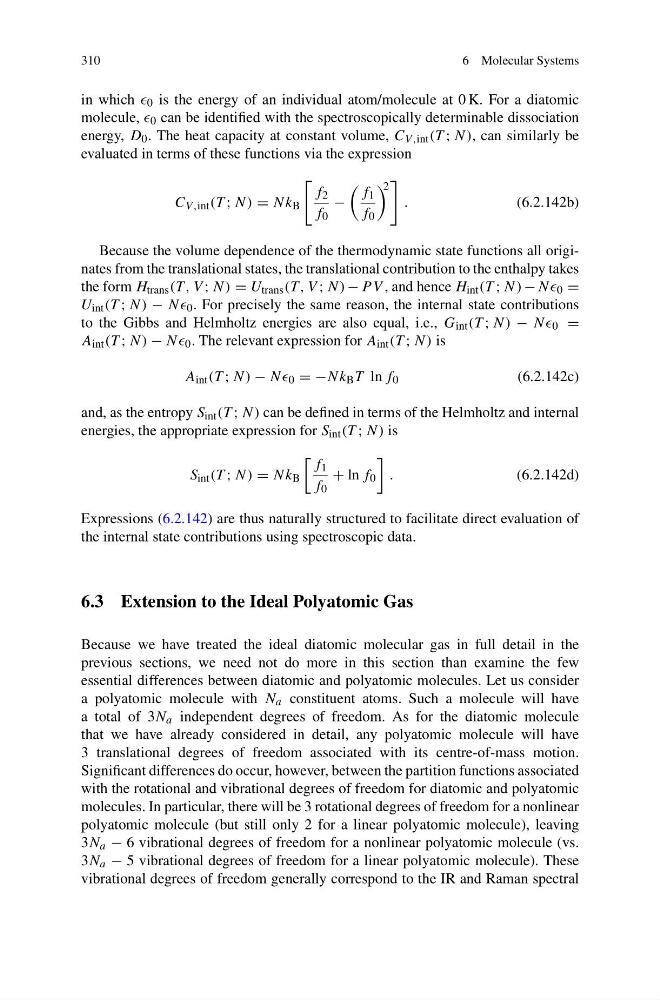
in which 0 is the energy of an individual atom/molecule at 0 K. For a diatomic
molecule, 0 can be identified with the spectroscopically determinable dissociation
energy, D 0 . The heat capacity at constant volume, C V ,int (T ; N), can similarly be
evaluated in terms of these functions via the expression
C V ,int (T ; N) = Nk B
f 2
f 0
−
f 1
f 0
2
.
(6.2.142b)
Because the volume dependence of the thermodynamic state functions all originates from the translational states, the translational contribution to the enthalpy takes
the form H trans (T , V ; N) = U trans (T , V ; N) − P V , and hence H int (T ; N) − NN 0 =
U int (T ; N) − NN 0 . For precisely the same reason, the internal state contributions
to the Gibbs and Helmholtz energies are also equal, i.e., G int (T ; N) − NN 0 =
A int (T ; N) − NN 0 . The relevant expression for A int (T ; N) is
A int (T ; N) − NN 0 = −Nk B T ln f 0
(6.2.142c)
and, as the entropy S int (T ; N) can be defined in terms of the Helmholtz and internal
energies, the appropriate expression for S int (T ; N) is
S int (T ; N) = Nk B
f 1
f 0
+ ln f 0
.
(6.2.142d)
Expressions (6.2.142) are thus naturally structured to facilitate direct evaluation of
the internal state contributions using spectroscopic data.
6.3 Extension to the Ideal Polyatomic Gas
Because we have treated the ideal diatomic molecular gas in full detail in the
previous sections, we need not do more in this section than examine the few
essential differences between diatomic and polyatomic molecules. Let us consider
a polyatomic molecule with N a constituent atoms. Such a molecule will have
a total of 3N a independent degrees of freedom. As for the diatomic molecule
that we have already considered in detail, any polyatomic molecule will have
3 translational degrees of freedom associated with its centre-of-mass motion.
Significant differences do occur, however, between the partition functions associated
with the rotational and vibrational degrees of freedom for diatomic and polyatomic
molecules. In particular, there will be 3 rotational degrees of freedom for a nonlinear
polyatomic molecule (but still only 2 for a linear polyatomic molecule), leaving
3N a − 6 vibrational degrees of freedom for a nonlinear polyatomic molecule (vs.
3N a − 5 vibrational degrees of freedom for a linear polyatomic molecule). These
vibrational degrees of freedom generally correspond to the IR and Raman spectral
6 Molecular Systems
in which 0 is the energy of an individual atom/molecule at 0 K. For a diatomic
molecule, 0 can be identified with the spectroscopically determinable dissociation
energy, D 0 . The heat capacity at constant volume, C V ,int (T ; N), can similarly be
evaluated in terms of these functions via the expression
C V ,int (T ; N) = Nk B
f 2
f 0
−
f 1
f 0
2
.
(6.2.142b)
Because the volume dependence of the thermodynamic state functions all originates from the translational states, the translational contribution to the enthalpy takes
the form H trans (T , V ; N) = U trans (T , V ; N) − P V , and hence H int (T ; N) − NN 0 =
U int (T ; N) − NN 0 . For precisely the same reason, the internal state contributions
to the Gibbs and Helmholtz energies are also equal, i.e., G int (T ; N) − NN 0 =
A int (T ; N) − NN 0 . The relevant expression for A int (T ; N) is
A int (T ; N) − NN 0 = −Nk B T ln f 0
(6.2.142c)
and, as the entropy S int (T ; N) can be defined in terms of the Helmholtz and internal
energies, the appropriate expression for S int (T ; N) is
S int (T ; N) = Nk B
f 1
f 0
+ ln f 0
.
(6.2.142d)
Expressions (6.2.142) are thus naturally structured to facilitate direct evaluation of
the internal state contributions using spectroscopic data.
6.3 Extension to the Ideal Polyatomic Gas
Because we have treated the ideal diatomic molecular gas in full detail in the
previous sections, we need not do more in this section than examine the few
essential differences between diatomic and polyatomic molecules. Let us consider
a polyatomic molecule with N a constituent atoms. Such a molecule will have
a total of 3N a independent degrees of freedom. As for the diatomic molecule
that we have already considered in detail, any polyatomic molecule will have
3 translational degrees of freedom associated with its centre-of-mass motion.
Significant differences do occur, however, between the partition functions associated
with the rotational and vibrational degrees of freedom for diatomic and polyatomic
molecules. In particular, there will be 3 rotational degrees of freedom for a nonlinear
polyatomic molecule (but still only 2 for a linear polyatomic molecule), leaving
3N a − 6 vibrational degrees of freedom for a nonlinear polyatomic molecule (vs.
3N a − 5 vibrational degrees of freedom for a linear polyatomic molecule). These
vibrational degrees of freedom generally correspond to the IR and Raman spectral