

6.2 Diatomic Molecules
309
z int (β) =
i
i e
−ββ i .
(6.2.137)
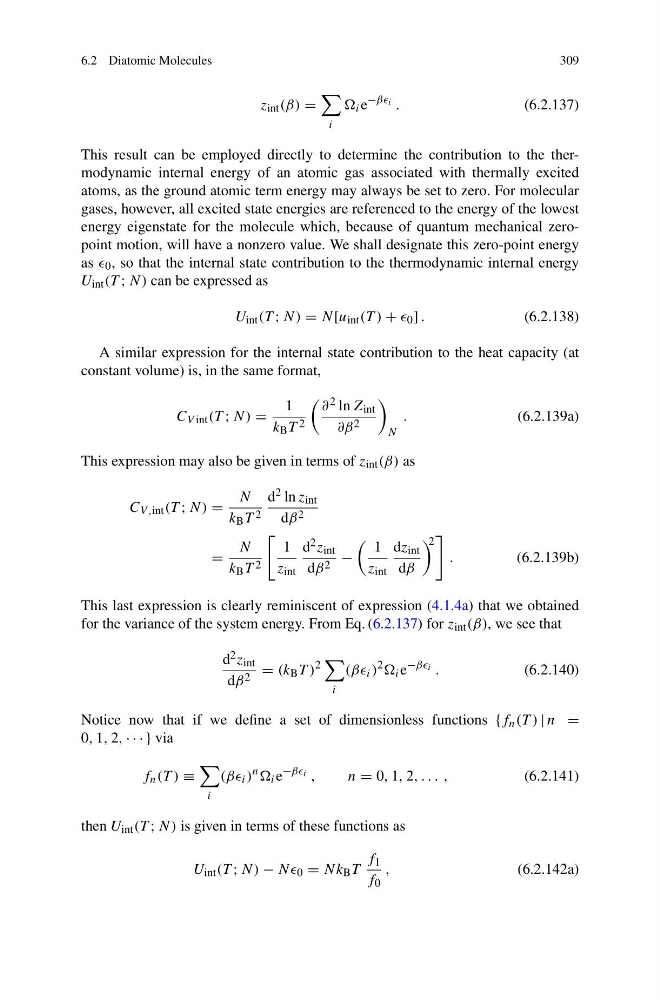
This result can be employed directly to determine the contribution to the thermodynamic internal energy of an atomic gas associated with thermally excited
atoms, as the ground atomic term energy may always be set to zero. For molecular
gases, however, all excited state energies are referenced to the energy of the lowest
energy eigenstate for the molecule which, because of quantum mechanical zeropoint motion, will have a nonzero value. We shall designate this zero-point energy
as 0 , so that the internal state contribution to the thermodynamic internal energy
U int (T ; N) can be expressed as
U int (T ; N) = N[u int (T ) + 0 ] .
(6.2.138)
A similar expression for the internal state contribution to the heat capacity (at
constant volume) is, in the same format,
C V int (T ; N) =
1
k B T 2
∂ 2 ln Z int
∂β 2
N
.
(6.2.139a)
This expression may also be given in terms of z int (β) as
C V ,int (T ; N) =
N
k B T 2
d 2 ln z int
dβ 2
=
N
k B T 2
1
z int
d 2 z int
dβ 2 −
1
z int
dz int
dβ
2
.
(6.2.139b)
This last expression is clearly reminiscent of expression (4.1.4a) that we obtained
for the variance of the system energy. From Eq. (6.2.137) for z int (β), we see that
d 2 z int
dβ 2 = (k B T )
2
i
(ββ i )
2 i e
−ββ i .
(6.2.140)
Notice now that if we define a set of dimensionless functions {f n (T ) | n =
0, 1, 2, · · · } via
f n (T ) ≡
i
(ββ i )
n i e
−ββ i ,
n= 0, 1, 2, . . . ,
(6.2.141)
then U int (T ; N) is given in terms of these functions as
U int (T ; N) − NN 0 = Nk B T
f 1
f 0
,
(6.2.142a)
309
z int (β) =
i
i e
−ββ i .
(6.2.137)
This result can be employed directly to determine the contribution to the thermodynamic internal energy of an atomic gas associated with thermally excited
atoms, as the ground atomic term energy may always be set to zero. For molecular
gases, however, all excited state energies are referenced to the energy of the lowest
energy eigenstate for the molecule which, because of quantum mechanical zeropoint motion, will have a nonzero value. We shall designate this zero-point energy
as 0 , so that the internal state contribution to the thermodynamic internal energy
U int (T ; N) can be expressed as
U int (T ; N) = N[u int (T ) + 0 ] .
(6.2.138)
A similar expression for the internal state contribution to the heat capacity (at
constant volume) is, in the same format,
C V int (T ; N) =
1
k B T 2
∂ 2 ln Z int
∂β 2
N
.
(6.2.139a)
This expression may also be given in terms of z int (β) as
C V ,int (T ; N) =
N
k B T 2
d 2 ln z int
dβ 2
=
N
k B T 2
1
z int
d 2 z int
dβ 2 −
1
z int
dz int
dβ
2
.
(6.2.139b)
This last expression is clearly reminiscent of expression (4.1.4a) that we obtained
for the variance of the system energy. From Eq. (6.2.137) for z int (β), we see that
d 2 z int
dβ 2 = (k B T )
2
i
(ββ i )
2 i e
−ββ i .
(6.2.140)
Notice now that if we define a set of dimensionless functions {f n (T ) | n =
0, 1, 2, · · · } via
f n (T ) ≡
i
(ββ i )
n i e
−ββ i ,
n= 0, 1, 2, . . . ,
(6.2.141)
then U int (T ; N) is given in terms of these functions as
U int (T ; N) − NN 0 = Nk B T
f 1
f 0
,
(6.2.142a)