

316
6 Molecular Systems
rotational constant on the vibrational state in which the rotational motion is taking
place.
We shall consider only those molecules for which the simplest RR-SHO
approximation is sufficient to provide near-quantitative agreement with experimental thermodynamic data. This means that we shall restrict ourselves to the
temperature range 10 K < T < 3000 K for many molecular gases, so that the
lowest-order corrections to the thermodynamic function values generally do not
exceed a few percent of the corresponding RR-SHO contributions. Vibrational
anharmonicity, centrifugal distortion, and vibration–rotation interaction corrections
may be considered simultaneously for both linear and nonlinear molecules. As
Euler–Maclaurin corrections are sensitive to indistinguishable nucleus interchange
symmetries, we shall consider corrections to the simplest RR-SHO approximation
in three steps.
Vibrational Anharmonicity Corrections
There will be an anharmonicity correction arising from each independent vibrational
degree of freedom for a polyatomic molecule. Each such correction will have
basically the same form as the anharmonicity correction for a diatomic molecule
(see section ‘Beyond the SHO Approximation: Anharmonicity Effects’), so that the
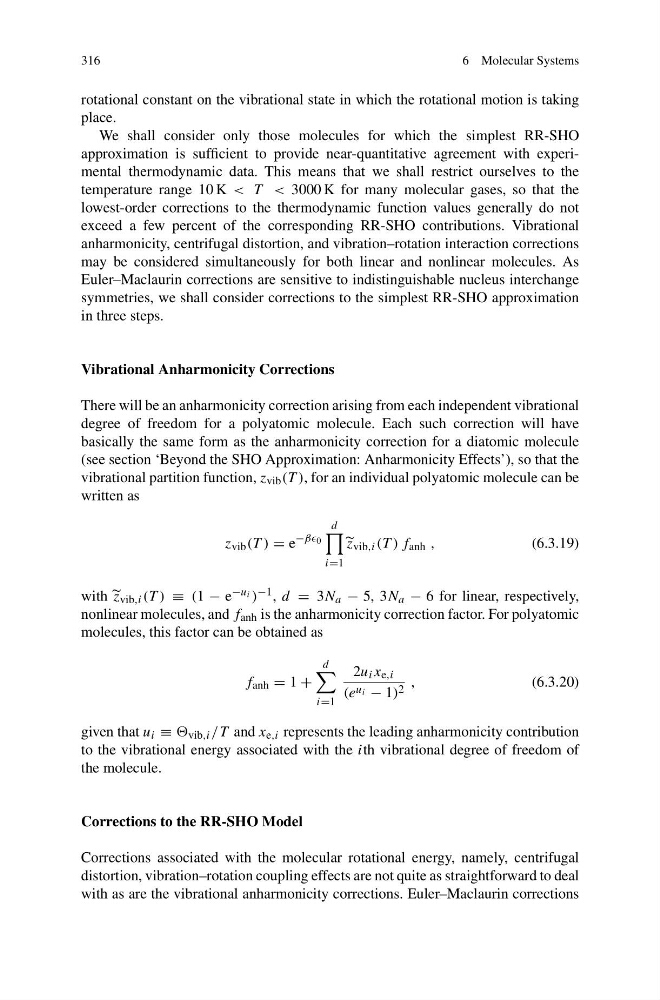
vibrational partition function, z vib (T ), for an individual polyatomic molecule can be
written as
z vib (T ) = e
−ββ 0
d
i=1
z vib,i (T ) f anh ,
(6.3.19)
with z vib,i (T ) ≡ (1 − e −u i ) −1 , d = 3N a − 5, 3N a − 6 for linear, respectively,
nonlinear molecules, and f anh is the anharmonicity correction factor. For polyatomic
molecules, this factor can be obtained as
f anh = 1 +
d
i=1
2u i x e,i
(e u i − 1) 2 ,
(6.3.20)
given that u i ≡ vib,i /T and x e,i represents the leading anharmonicity contribution
to the vibrational energy associated with the ith vibrational degree of freedom of
the molecule.
Corrections to the RR-SHO Model
Corrections associated with the molecular rotational energy, namely, centrifugal
distortion, vibration–rotation coupling effects are not quite as straightforward to deal
with as are the vibrational anharmonicity corrections. Euler–Maclaurin corrections
6 Molecular Systems
rotational constant on the vibrational state in which the rotational motion is taking
place.
We shall consider only those molecules for which the simplest RR-SHO
approximation is sufficient to provide near-quantitative agreement with experimental thermodynamic data. This means that we shall restrict ourselves to the
temperature range 10 K < T < 3000 K for many molecular gases, so that the
lowest-order corrections to the thermodynamic function values generally do not
exceed a few percent of the corresponding RR-SHO contributions. Vibrational
anharmonicity, centrifugal distortion, and vibration–rotation interaction corrections
may be considered simultaneously for both linear and nonlinear molecules. As
Euler–Maclaurin corrections are sensitive to indistinguishable nucleus interchange
symmetries, we shall consider corrections to the simplest RR-SHO approximation
in three steps.
Vibrational Anharmonicity Corrections
There will be an anharmonicity correction arising from each independent vibrational
degree of freedom for a polyatomic molecule. Each such correction will have
basically the same form as the anharmonicity correction for a diatomic molecule
(see section ‘Beyond the SHO Approximation: Anharmonicity Effects’), so that the
vibrational partition function, z vib (T ), for an individual polyatomic molecule can be
written as
z vib (T ) = e
−ββ 0
d
i=1
z vib,i (T ) f anh ,
(6.3.19)
with z vib,i (T ) ≡ (1 − e −u i ) −1 , d = 3N a − 5, 3N a − 6 for linear, respectively,
nonlinear molecules, and f anh is the anharmonicity correction factor. For polyatomic
molecules, this factor can be obtained as
f anh = 1 +
d
i=1
2u i x e,i
(e u i − 1) 2 ,
(6.3.20)
given that u i ≡ vib,i /T and x e,i represents the leading anharmonicity contribution
to the vibrational energy associated with the ith vibrational degree of freedom of
the molecule.
Corrections to the RR-SHO Model
Corrections associated with the molecular rotational energy, namely, centrifugal
distortion, vibration–rotation coupling effects are not quite as straightforward to deal
with as are the vibrational anharmonicity corrections. Euler–Maclaurin corrections