

302
6 Molecular Systems
Example 6.4 Oxygen, O 2 .
It is instructive to see how well the classical formulae work for a homonuclear
diatomic molecule. For molecular oxygen, 16 O 2 , for example, the full quantum
mechanical expression obtained for z rot−nuc (T ) is, from Eq. (6.2.109), given by
z rot−nuc (T ) =
∞
j =odd
(2j + 1)e
−j (j+1)) rot /T ,
while the classical expression is given by Eq. (6.2.66) to a good approximation as
z rot−nuc (T )
1
2 e
rot /(3T ) T
rot
1 +
1
90
rot
T
2
,
(6.2.117)
and the classical limit is z rot−nuc (T ) = T /(2 rot ). The results obtained for
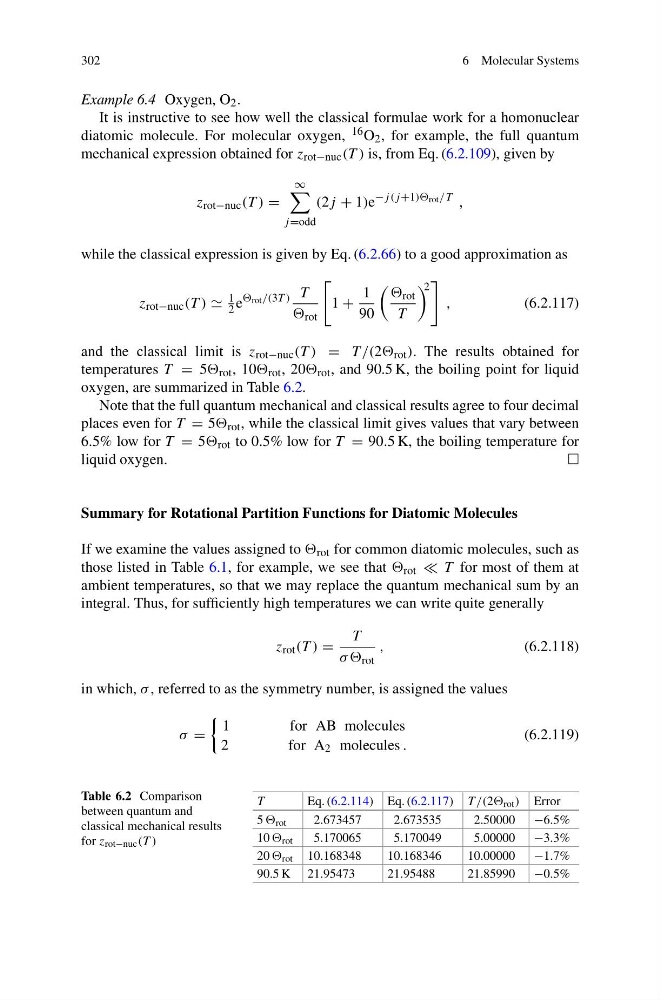
temperatures T = 5 rot , 10 rot , 20 rot , and 90.5 K, the boiling point for liquid
oxygen, are summarized in Table 6.2.
Note that the full quantum mechanical and classical results agree to four decimal
places even for T = 5 rot , while the classical limit gives values that vary between
6.5% low for T = 5 rot to 0.5% low for T = 90.5 K, the boiling temperature for
liquid oxygen.
Summary for Rotational Partition Functions for Diatomic Molecules
If we examine the values assigned to rot for common diatomic molecules, such as
those listed in Table 6.1, for example, we see that rot T for most of them at
ambient temperatures, so that we may replace the quantum mechanical sum by an
integral. Thus, for sufficiently high temperatures we can write quite generally
z rot (T ) =
T
σ σ rot
,
(6.2.118)
in which, σ , referred to as the symmetry number, is assigned the values
σ =
1
for AB molecules
2
f o r A 2 molecules .
(6.2.119)
Table 6.2 Comparison
between quantum and
classical mechanical results
for z rot−nuc (T )
T
Eq. (6.2.114) Eq. (6.2.117) T /(2 rot ) Error
5 rot
2.673457
2.673535
2.50000 −6.5%
10 rot
5.170065
5.170049
5.00000 −3.3%
20 rot 10.168348
10.168346
10.00000 −1.7%
90.5 K 21.95473
21.95488
21.85990 −0.5%
6 Molecular Systems
Example 6.4 Oxygen, O 2 .
It is instructive to see how well the classical formulae work for a homonuclear
diatomic molecule. For molecular oxygen, 16 O 2 , for example, the full quantum
mechanical expression obtained for z rot−nuc (T ) is, from Eq. (6.2.109), given by
z rot−nuc (T ) =
∞
j =odd
(2j + 1)e
−j (j+1)) rot /T ,
while the classical expression is given by Eq. (6.2.66) to a good approximation as
z rot−nuc (T )
1
2 e
rot /(3T ) T
rot
1 +
1
90
rot
T
2
,
(6.2.117)
and the classical limit is z rot−nuc (T ) = T /(2 rot ). The results obtained for
temperatures T = 5 rot , 10 rot , 20 rot , and 90.5 K, the boiling point for liquid
oxygen, are summarized in Table 6.2.
Note that the full quantum mechanical and classical results agree to four decimal
places even for T = 5 rot , while the classical limit gives values that vary between
6.5% low for T = 5 rot to 0.5% low for T = 90.5 K, the boiling temperature for
liquid oxygen.
Summary for Rotational Partition Functions for Diatomic Molecules
If we examine the values assigned to rot for common diatomic molecules, such as
those listed in Table 6.1, for example, we see that rot T for most of them at
ambient temperatures, so that we may replace the quantum mechanical sum by an
integral. Thus, for sufficiently high temperatures we can write quite generally
z rot (T ) =
T
σ σ rot
,
(6.2.118)
in which, σ , referred to as the symmetry number, is assigned the values
σ =
1
for AB molecules
2
f o r A 2 molecules .
(6.2.119)
Table 6.2 Comparison
between quantum and
classical mechanical results
for z rot−nuc (T )
T
Eq. (6.2.114) Eq. (6.2.117) T /(2 rot ) Error
5 rot
2.673457
2.673535
2.50000 −6.5%
10 rot
5.170065
5.170049
5.00000 −3.3%
20 rot 10.168348
10.168346
10.00000 −1.7%
90.5 K 21.95473
21.95488
21.85990 −0.5%