

6.2 Diatomic Molecules
303
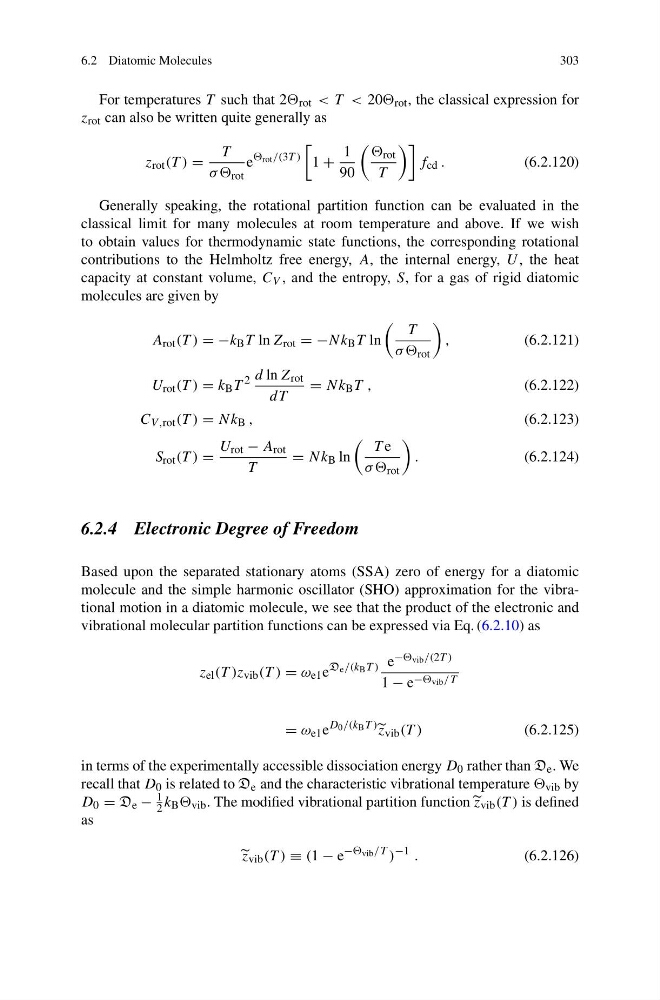
For temperatures T such that 2 rot < T < 20 rot , the classical expression for
z rot can also be written quite generally as
z rot (T ) =
T
σ σ rot
e
rot /(3T )
1 +
1
90
rot
T
f cd .
(6.2.120)
Generally speaking, the rotational partition function can be evaluated in the
classical limit for many molecules at room temperature and above. If we wish
to obtain values for thermodynamic state functions, the corresponding rotational
contributions to the Helmholtz free energy, A, the internal energy, U , the heat
capacity at constant volume, C V , and the entropy, S, for a gas of rigid diatomic
molecules are given by
A rot (T ) = −k B T ln Z rot = −Nk B T ln
T
σ σ rot
,
(6.2.121)
U rot (T ) = k B T
2 d ln Z rot
dT
= Nk B T ,
(6.2.122)
C V ,rot (T ) = Nk B ,
(6.2.123)
S rot (T ) =
U rot − A rot
T
= Nk B ln
T e
σ σ rot
.
(6.2.124)
6.2.4 Electronic Degree of Freedom
Based upon the separated stationary atoms (SSA) zero of energy for a diatomic
molecule and the simple harmonic oscillator (SHO) approximation for the vibrational motion in a diatomic molecule, we see that the product of the electronic and
vibrational molecular partition functions can be expressed via Eq. (6.2.10) as
z el (T )z vib (T ) = ω e1 e
D e /(k B T ) e − vib /(2T )
1 − e − vib /T
= ω e1 e
D 0 /(k B T )
z vib (T )
(6.2.125)
in terms of the experimentally accessible dissociation energy D 0 rather than D e . We
recall that D 0 is related to D e and the characteristic vibrational temperature vib by
D 0 = D e −
1
2 k B vib . The modified vibrational partition function z vib (T ) is defined
as
z vib (T ) ≡ (1 − e
− vib /T )
−1 .
(6.2.126)
303
For temperatures T such that 2 rot < T < 20 rot , the classical expression for
z rot can also be written quite generally as
z rot (T ) =
T
σ σ rot
e
rot /(3T )
1 +
1
90
rot
T
f cd .
(6.2.120)
Generally speaking, the rotational partition function can be evaluated in the
classical limit for many molecules at room temperature and above. If we wish
to obtain values for thermodynamic state functions, the corresponding rotational
contributions to the Helmholtz free energy, A, the internal energy, U , the heat
capacity at constant volume, C V , and the entropy, S, for a gas of rigid diatomic
molecules are given by
A rot (T ) = −k B T ln Z rot = −Nk B T ln
T
σ σ rot
,
(6.2.121)
U rot (T ) = k B T
2 d ln Z rot
dT
= Nk B T ,
(6.2.122)
C V ,rot (T ) = Nk B ,
(6.2.123)
S rot (T ) =
U rot − A rot
T
= Nk B ln
T e
σ σ rot
.
(6.2.124)
6.2.4 Electronic Degree of Freedom
Based upon the separated stationary atoms (SSA) zero of energy for a diatomic
molecule and the simple harmonic oscillator (SHO) approximation for the vibrational motion in a diatomic molecule, we see that the product of the electronic and
vibrational molecular partition functions can be expressed via Eq. (6.2.10) as
z el (T )z vib (T ) = ω e1 e
D e /(k B T ) e − vib /(2T )
1 − e − vib /T
= ω e1 e
D 0 /(k B T )
z vib (T )
(6.2.125)
in terms of the experimentally accessible dissociation energy D 0 rather than D e . We
recall that D 0 is related to D e and the characteristic vibrational temperature vib by
D 0 = D e −
1
2 k B vib . The modified vibrational partition function z vib (T ) is defined
as
z vib (T ) ≡ (1 − e
− vib /T )
−1 .
(6.2.126)