

6.2 Diatomic Molecules
301
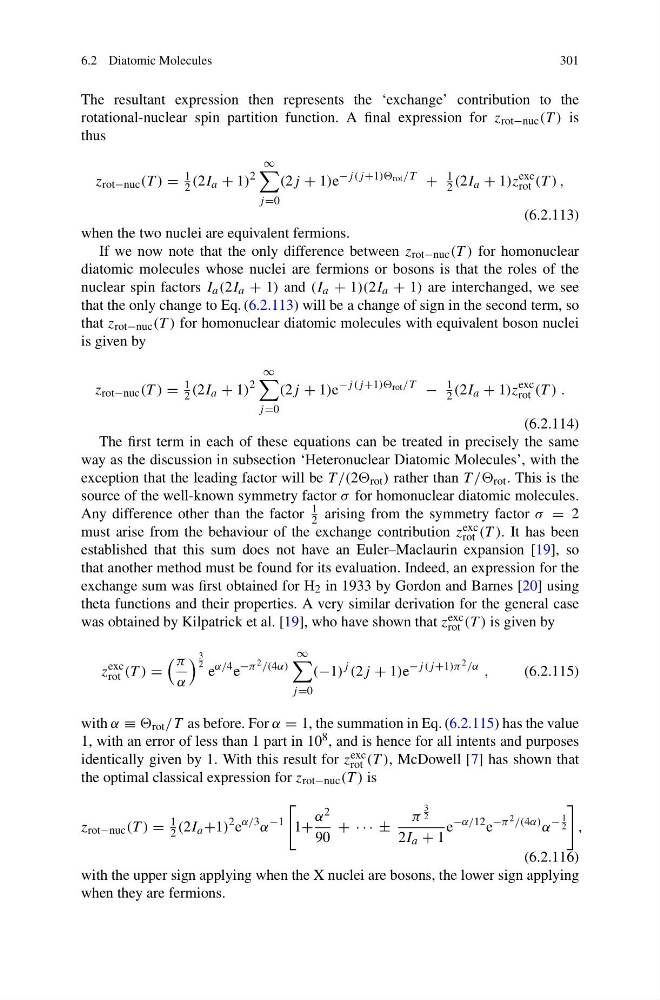
The resultant expression then represents the ‘exchange’ contribution to the
rotational-nuclear spin partition function. A final expression for z rot−nuc (T ) is
thus
z rot−nuc (T ) =
1
2 (2I a + 1)
2
∞
j =0
(2j + 1)e
−j (j+1)) rot /T
+
1
2 (2I a + 1)z
exc
rot (T ) ,
(6.2.113)
when the two nuclei are equivalent fermions.
If we now note that the only difference between z rot−nuc (T ) for homonuclear
diatomic molecules whose nuclei are fermions or bosons is that the roles of the
nuclear spin factors I a (2I a + 1) and (I a + 1)(2I a + 1) are interchanged, we see
that the only change to Eq. (6.2.113) will be a change of sign in the second term, so
that z rot−nuc (T ) for homonuclear diatomic molecules with equivalent boson nuclei
is given by
z rot−nuc (T ) =
1
2 (2I a + 1)
2
∞
j =0
(2j + 1)e
−j (j+1)) rot /T
−
1
2 (2I a + 1)z
exc
rot (T ) .
(6.2.114)
The first term in each of these equations can be treated in precisely the same
way as the discussion in subsection ‘Heteronuclear Diatomic Molecules’, with the
exception that the leading factor will be T /(2 rot ) rather than T // rot . This is the
source of the well-known symmetry factor σ for homonuclear diatomic molecules.
Any difference other than the factor
1
2 arising from the symmetry factor σ = 2
must arise from the behaviour of the exchange contribution z exc
rot (T ). It has been
established that this sum does not have an Euler–Maclaurin expansion [19], so
that another method must be found for its evaluation. Indeed, an expression for the
exchange sum was first obtained for H 2 in 1933 by Gordon and Barnes [20] using
theta functions and their properties. A very similar derivation for the general case
was obtained by Kilpatrick et al. [19], who have shown that z exc
rot (T ) is given by
z
exc
rot (T ) =
π
α
3
2 e
α/4 e
−π 2 /(4α)
∞
j =0
(−1)
j (2j + 1)e
−j (j+1)π 2 /α ,
(6.2.115)
with α ≡ rot /T as before. For α = 1, the summation in Eq. (6.2.115) has the value
1, with an error of less than 1 part in 10 8 , and is hence for all intents and purposes
identically given by 1. With this result for z exc
rot (T ), McDowell [7] has shown that
the optimal classical expression for z rot−nuc (T ) is
z rot−nuc (T ) =
1
2 (2I a +1)
2 e
α/3 α
−1
1+
α 2
90
+ · · · ±
π
3
2
2I a + 1
e
−α/12 e
−π 2 /(4α) α
−
1
2
,
(6.2.116)
with the upper sign applying when the X nuclei are bosons, the lower sign applying
when they are fermions.
301
The resultant expression then represents the ‘exchange’ contribution to the
rotational-nuclear spin partition function. A final expression for z rot−nuc (T ) is
thus
z rot−nuc (T ) =
1
2 (2I a + 1)
2
∞
j =0
(2j + 1)e
−j (j+1)) rot /T
+
1
2 (2I a + 1)z
exc
rot (T ) ,
(6.2.113)
when the two nuclei are equivalent fermions.
If we now note that the only difference between z rot−nuc (T ) for homonuclear
diatomic molecules whose nuclei are fermions or bosons is that the roles of the
nuclear spin factors I a (2I a + 1) and (I a + 1)(2I a + 1) are interchanged, we see
that the only change to Eq. (6.2.113) will be a change of sign in the second term, so
that z rot−nuc (T ) for homonuclear diatomic molecules with equivalent boson nuclei
is given by
z rot−nuc (T ) =
1
2 (2I a + 1)
2
∞
j =0
(2j + 1)e
−j (j+1)) rot /T
−
1
2 (2I a + 1)z
exc
rot (T ) .
(6.2.114)
The first term in each of these equations can be treated in precisely the same
way as the discussion in subsection ‘Heteronuclear Diatomic Molecules’, with the
exception that the leading factor will be T /(2 rot ) rather than T // rot . This is the
source of the well-known symmetry factor σ for homonuclear diatomic molecules.
Any difference other than the factor
1
2 arising from the symmetry factor σ = 2
must arise from the behaviour of the exchange contribution z exc
rot (T ). It has been
established that this sum does not have an Euler–Maclaurin expansion [19], so
that another method must be found for its evaluation. Indeed, an expression for the
exchange sum was first obtained for H 2 in 1933 by Gordon and Barnes [20] using
theta functions and their properties. A very similar derivation for the general case
was obtained by Kilpatrick et al. [19], who have shown that z exc
rot (T ) is given by
z
exc
rot (T ) =
π
α
3
2 e
α/4 e
−π 2 /(4α)
∞
j =0
(−1)
j (2j + 1)e
−j (j+1)π 2 /α ,
(6.2.115)
with α ≡ rot /T as before. For α = 1, the summation in Eq. (6.2.115) has the value
1, with an error of less than 1 part in 10 8 , and is hence for all intents and purposes
identically given by 1. With this result for z exc
rot (T ), McDowell [7] has shown that
the optimal classical expression for z rot−nuc (T ) is
z rot−nuc (T ) =
1
2 (2I a +1)
2 e
α/3 α
−1
1+
α 2
90
+ · · · ±
π
3
2
2I a + 1
e
−α/12 e
−π 2 /(4α) α
−
1
2
,
(6.2.116)
with the upper sign applying when the X nuclei are bosons, the lower sign applying
when they are fermions.