

300
6 Molecular Systems
z rot−nuc (T ) =
j =odd
(2j + 1)e
−j (j+1)) rot /T .
(6.2.110)
The same argument holds for the 18 O 2 isotopologue, as the 18 O isotope also has
nuclear spin I a = 0. The 17 O 2 isotopologue, however, has contributions from
both even and odd values of j , as the nuclear spin I a =
5
2 . As the mixed oxygen
molecular isotopologues are all heteronuclear diatomic molecules, they possess no
unusual symmetry properties.
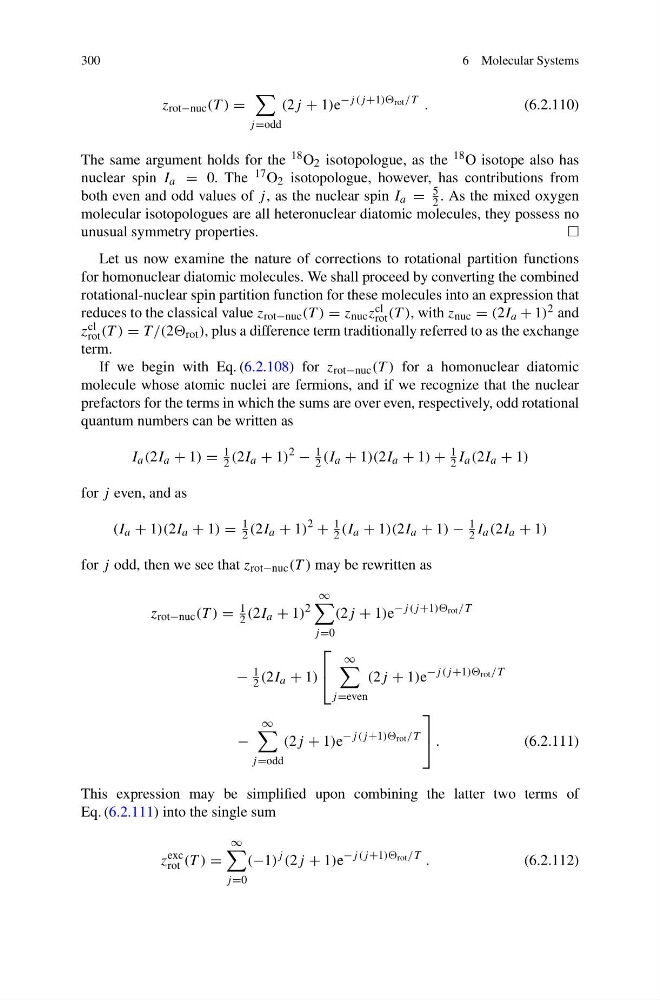
Let us now examine the nature of corrections to rotational partition functions
for homonuclear diatomic molecules. We shall proceed by converting the combined
rotational-nuclear spin partition function for these molecules into an expression that
reduces to the classical value z rot−nuc (T ) = z nuc z cl
rot (T ), with z nuc = (2I a + 1) 2 and
z cl
rot (T ) = T /(2 rot ), plus a difference term traditionally referred to as the exchange
term.
If we begin with Eq. (6.2.108) for z rot−nuc (T ) for a homonuclear diatomic
molecule whose atomic nuclei are fermions, and if we recognize that the nuclear
prefactors for the terms in which the sums are over even, respectively, odd rotational
quantum numbers can be written as
I a (2I a + 1) =
1
2 (2I a + 1)
2
−
1
2 (I a + 1)(2I a + 1) +
1
2 I a (2I a + 1)
for j even, and as
(I a + 1)(2I a + 1) =
1
2 (2I a + 1)
2
+
1
2 (I a + 1)(2I a + 1) −
1
2 I a (2I a + 1)
for j odd, then we see that z rot−nuc (T ) may be rewritten as
z rot−nuc (T ) =
1
2 (2I a + 1)
2
∞
j =0
(2j + 1)e
−j (j+1)) rot /T
−
1
2 (2I a + 1)
⎡
⎣
∞
j =even
(2j + 1)e
−j (j+1)) rot /T
−
∞
j =odd
(2j + 1)e
−j (j+1)) rot /T
⎤
⎦ .
(6.2.111)
This expression may be simplified upon combining the latter two terms of
Eq. (6.2.111) into the single sum
z
exc
rot (T ) =
∞
j =0
(−1)
j (2j + 1)e
−j (j+1)) rot /T .
(6.2.112)
6 Molecular Systems
z rot−nuc (T ) =
j =odd
(2j + 1)e
−j (j+1)) rot /T .
(6.2.110)
The same argument holds for the 18 O 2 isotopologue, as the 18 O isotope also has
nuclear spin I a = 0. The 17 O 2 isotopologue, however, has contributions from
both even and odd values of j , as the nuclear spin I a =
5
2 . As the mixed oxygen
molecular isotopologues are all heteronuclear diatomic molecules, they possess no
unusual symmetry properties.
Let us now examine the nature of corrections to rotational partition functions
for homonuclear diatomic molecules. We shall proceed by converting the combined
rotational-nuclear spin partition function for these molecules into an expression that
reduces to the classical value z rot−nuc (T ) = z nuc z cl
rot (T ), with z nuc = (2I a + 1) 2 and
z cl
rot (T ) = T /(2 rot ), plus a difference term traditionally referred to as the exchange
term.
If we begin with Eq. (6.2.108) for z rot−nuc (T ) for a homonuclear diatomic
molecule whose atomic nuclei are fermions, and if we recognize that the nuclear
prefactors for the terms in which the sums are over even, respectively, odd rotational
quantum numbers can be written as
I a (2I a + 1) =
1
2 (2I a + 1)
2
−
1
2 (I a + 1)(2I a + 1) +
1
2 I a (2I a + 1)
for j even, and as
(I a + 1)(2I a + 1) =
1
2 (2I a + 1)
2
+
1
2 (I a + 1)(2I a + 1) −
1
2 I a (2I a + 1)
for j odd, then we see that z rot−nuc (T ) may be rewritten as
z rot−nuc (T ) =
1
2 (2I a + 1)
2
∞
j =0
(2j + 1)e
−j (j+1)) rot /T
−
1
2 (2I a + 1)
⎡
⎣
∞
j =even
(2j + 1)e
−j (j+1)) rot /T
−
∞
j =odd
(2j + 1)e
−j (j+1)) rot /T
⎤
⎦ .
(6.2.111)
This expression may be simplified upon combining the latter two terms of
Eq. (6.2.111) into the single sum
z
exc
rot (T ) =
∞
j =0
(−1)
j (2j + 1)e
−j (j+1)) rot /T .
(6.2.112)