

6.2 Diatomic Molecules
297
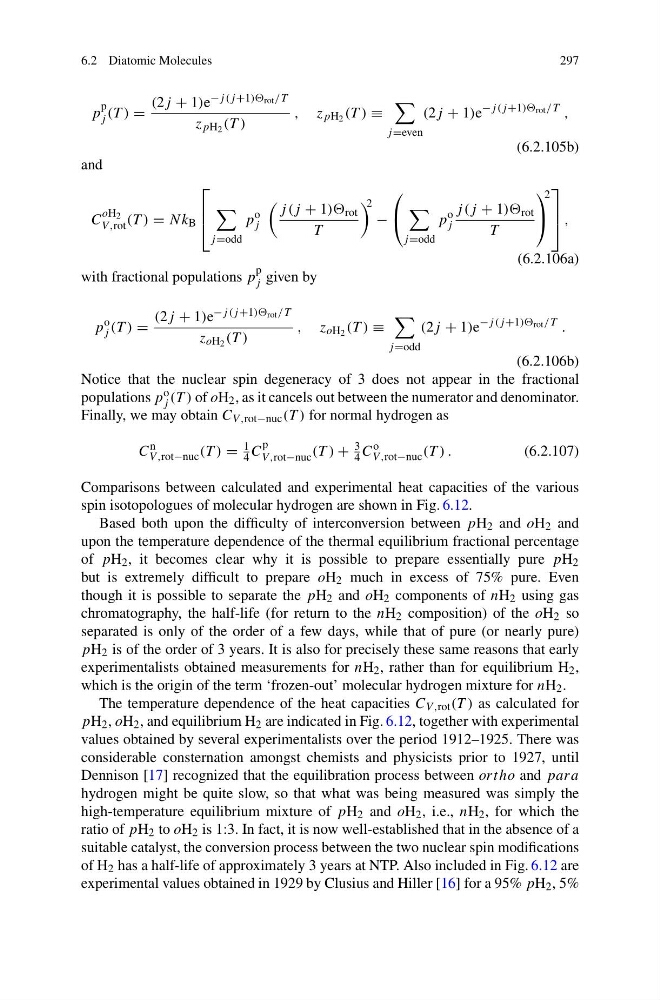
p
p
j (T ) =
(2j + 1)e −j (j+1)) rot /T
z pH 2 (T )
, z pH 2 (T ) ≡
j =even
(2j + 1)e
−j (j+1)) rot /T ,
(6.2.105b)
and
C
oH 2
V ,rot (T ) = Nk B
⎡
⎢
⎣
j =odd
p
o
j
j (j + 1)) rot
T
2
−
⎛
⎝
j =odd
p
o
j
j (j + 1)) rot
T
⎞
⎠
2
⎤
⎥
⎦ ,
(6.2.106a)
with fractional populations p
p
j given by
p
o
j (T ) =
(2j + 1)e −j (j+1)) rot /T
z oH 2 (T )
, z oH 2 (T ) ≡
j =odd
(2j + 1)e
−j (j+1)) rot /T .
(6.2.106b)
Notice that the nuclear spin degeneracy of 3 does not appear in the fractional
populations p o
j (T ) of oH 2 , as it cancels out between the numerator and denominator.
Finally, we may obtain C V ,rot−nuc (T ) for normal hydrogen as
C
n
V ,rot−nuc (T ) =
1
4 C
p
V ,rot−nuc (T ) +
3
4 C
o
V ,rot−nuc (T ) .
(6.2.107)
Comparisons between calculated and experimental heat capacities of the various
spin isotopologues of molecular hydrogen are shown in Fig. 6.12.
Based both upon the difficulty of interconversion between pH 2 and oH 2 and
upon the temperature dependence of the thermal equilibrium fractional percentage
of pH 2 , it becomes clear why it is possible to prepare essentially pure pH 2
but is extremely difficult to prepare oH 2 much in excess of 75% pure. Even
though it is possible to separate the pH 2 and oH 2 components of nH 2 using gas
chromatography, the half-life (for return to the nH 2 composition) of the oH 2 so
separated is only of the order of a few days, while that of pure (or nearly pure)
pH 2 is of the order of 3 years. It is also for precisely these same reasons that early
experimentalists obtained measurements for nH 2 , rather than for equilibrium H 2 ,
which is the origin of the term ‘frozen-out’ molecular hydrogen mixture for nH 2 .
The temperature dependence of the heat capacities C V ,rot (T ) as calculated for
pH 2 , oH 2 , and equilibrium H 2 are indicated in Fig. 6.12, together with experimental
values obtained by several experimentalists over the period 1912–1925. There was
considerable consternation amongst chemists and physicists prior to 1927, until
Dennison [17] recognized that the equilibration process between ortho and para
hydrogen might be quite slow, so that what was being measured was simply the
high-temperature equilibrium mixture of pH 2 and oH 2 , i.e., nH 2 , for which the
ratio of pH 2 to oH 2 is 1:3. In fact, it is now well-established that in the absence of a
suitable catalyst, the conversion process between the two nuclear spin modifications
of H 2 has a half-life of approximately 3 years at NTP. Also included in Fig. 6.12 are
experimental values obtained in 1929 by Clusius and Hiller [16] for a 95% pH 2 , 5%
297
p
p
j (T ) =
(2j + 1)e −j (j+1)) rot /T
z pH 2 (T )
, z pH 2 (T ) ≡
j =even
(2j + 1)e
−j (j+1)) rot /T ,
(6.2.105b)
and
C
oH 2
V ,rot (T ) = Nk B
⎡
⎢
⎣
j =odd
p
o
j
j (j + 1)) rot
T
2
−
⎛
⎝
j =odd
p
o
j
j (j + 1)) rot
T
⎞
⎠
2
⎤
⎥
⎦ ,
(6.2.106a)
with fractional populations p
p
j given by
p
o
j (T ) =
(2j + 1)e −j (j+1)) rot /T
z oH 2 (T )
, z oH 2 (T ) ≡
j =odd
(2j + 1)e
−j (j+1)) rot /T .
(6.2.106b)
Notice that the nuclear spin degeneracy of 3 does not appear in the fractional
populations p o
j (T ) of oH 2 , as it cancels out between the numerator and denominator.
Finally, we may obtain C V ,rot−nuc (T ) for normal hydrogen as
C
n
V ,rot−nuc (T ) =
1
4 C
p
V ,rot−nuc (T ) +
3
4 C
o
V ,rot−nuc (T ) .
(6.2.107)
Comparisons between calculated and experimental heat capacities of the various
spin isotopologues of molecular hydrogen are shown in Fig. 6.12.
Based both upon the difficulty of interconversion between pH 2 and oH 2 and
upon the temperature dependence of the thermal equilibrium fractional percentage
of pH 2 , it becomes clear why it is possible to prepare essentially pure pH 2
but is extremely difficult to prepare oH 2 much in excess of 75% pure. Even
though it is possible to separate the pH 2 and oH 2 components of nH 2 using gas
chromatography, the half-life (for return to the nH 2 composition) of the oH 2 so
separated is only of the order of a few days, while that of pure (or nearly pure)
pH 2 is of the order of 3 years. It is also for precisely these same reasons that early
experimentalists obtained measurements for nH 2 , rather than for equilibrium H 2 ,
which is the origin of the term ‘frozen-out’ molecular hydrogen mixture for nH 2 .
The temperature dependence of the heat capacities C V ,rot (T ) as calculated for
pH 2 , oH 2 , and equilibrium H 2 are indicated in Fig. 6.12, together with experimental
values obtained by several experimentalists over the period 1912–1925. There was
considerable consternation amongst chemists and physicists prior to 1927, until
Dennison [17] recognized that the equilibration process between ortho and para
hydrogen might be quite slow, so that what was being measured was simply the
high-temperature equilibrium mixture of pH 2 and oH 2 , i.e., nH 2 , for which the
ratio of pH 2 to oH 2 is 1:3. In fact, it is now well-established that in the absence of a
suitable catalyst, the conversion process between the two nuclear spin modifications
of H 2 has a half-life of approximately 3 years at NTP. Also included in Fig. 6.12 are
experimental values obtained in 1929 by Clusius and Hiller [16] for a 95% pH 2 , 5%