

296
6 Molecular Systems
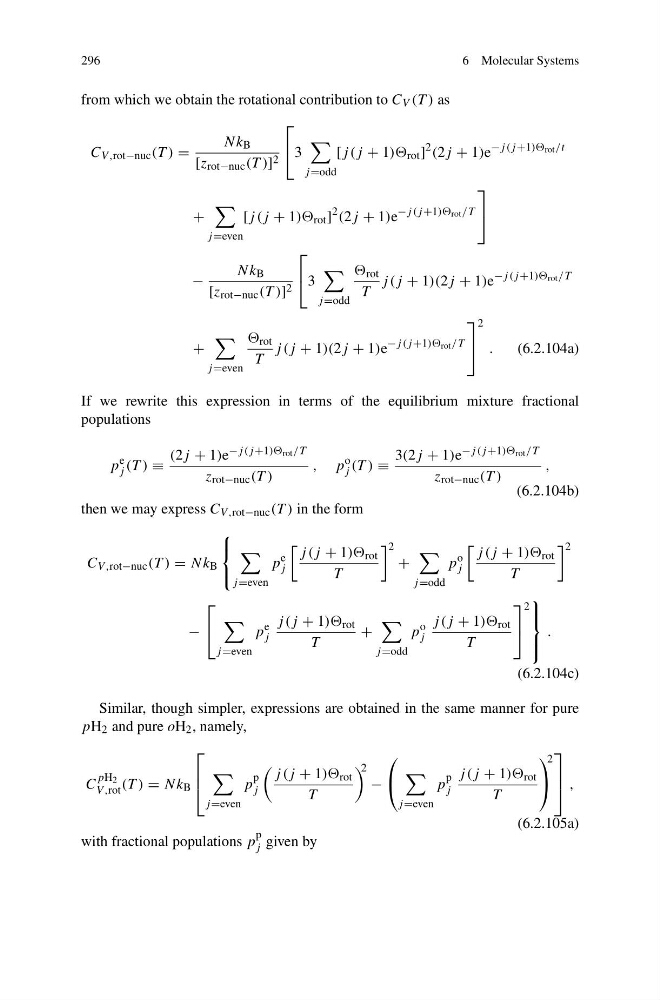
from which we obtain the rotational contribution to C V (T ) as
C V ,rot−nuc (T ) =
Nk B
[z rot−nuc (T )] 2
⎡
⎣ 3
j =odd
[j (j + 1)) rot ]
2 (2j + 1)e
−j (j+1)) rot /t
+
j =even
[j (j + 1)) rot ]
2 (2j + 1)e
−j (j+1)) rot /T
⎤
⎦
−
Nk B
[z rot−nuc (T )] 2
⎡
⎣ 3
j =odd
rot
T
j (j + 1)(2j + 1)e
−j (j+1)) rot /T
+
j =even
rot
T
j (j + 1)(2j + 1)e
−j (j+1)) rot /T
⎤
⎦
2
.
(6.2.104a)
If we rewrite this expression in terms of the equilibrium mixture fractional
populations
p
e
j (T ) ≡
(2j + 1)e −j (j+1)) rot /T
z rot−nuc (T )
, p
o
j (T ) ≡
3(2j + 1)e −j (j+1)) rot /T
z rot−nuc (T )
,
(6.2.104b)
then we may express C V ,rot−nuc (T ) in the form
C V ,rot−nuc (T ) = Nk B
⎧
⎨
⎩
j =even
p
e
j
j (j + 1)) rot
T
2
+
j =odd
p
o
j
j (j + 1)) rot
T
2
−
⎡
⎣
j =even
p
e
j
j (j + 1)) rot
T
+
j =odd
p
o
j
j (j + 1)) rot
T
⎤
⎦
2
⎫
⎪ ⎬
⎪ ⎭
.
(6.2.104c)
Similar, though simpler, expressions are obtained in the same manner for pure
pH 2 and pure oH 2 , namely,
C
pH 2
V ,rot (T ) = Nk B
⎡
⎢
⎣
j =even
p
p
j
j (j + 1)) rot
T
2
−
⎛
⎝
j =even
p
p
j
j (j + 1)) rot
T
⎞
⎠
2
⎤
⎥
⎦ ,
(6.2.105a)
with fractional populations p
p
j given by
6 Molecular Systems
from which we obtain the rotational contribution to C V (T ) as
C V ,rot−nuc (T ) =
Nk B
[z rot−nuc (T )] 2
⎡
⎣ 3
j =odd
[j (j + 1)) rot ]
2 (2j + 1)e
−j (j+1)) rot /t
+
j =even
[j (j + 1)) rot ]
2 (2j + 1)e
−j (j+1)) rot /T
⎤
⎦
−
Nk B
[z rot−nuc (T )] 2
⎡
⎣ 3
j =odd
rot
T
j (j + 1)(2j + 1)e
−j (j+1)) rot /T
+
j =even
rot
T
j (j + 1)(2j + 1)e
−j (j+1)) rot /T
⎤
⎦
2
.
(6.2.104a)
If we rewrite this expression in terms of the equilibrium mixture fractional
populations
p
e
j (T ) ≡
(2j + 1)e −j (j+1)) rot /T
z rot−nuc (T )
, p
o
j (T ) ≡
3(2j + 1)e −j (j+1)) rot /T
z rot−nuc (T )
,
(6.2.104b)
then we may express C V ,rot−nuc (T ) in the form
C V ,rot−nuc (T ) = Nk B
⎧
⎨
⎩
j =even
p
e
j
j (j + 1)) rot
T
2
+
j =odd
p
o
j
j (j + 1)) rot
T
2
−
⎡
⎣
j =even
p
e
j
j (j + 1)) rot
T
+
j =odd
p
o
j
j (j + 1)) rot
T
⎤
⎦
2
⎫
⎪ ⎬
⎪ ⎭
.
(6.2.104c)
Similar, though simpler, expressions are obtained in the same manner for pure
pH 2 and pure oH 2 , namely,
C
pH 2
V ,rot (T ) = Nk B
⎡
⎢
⎣
j =even
p
p
j
j (j + 1)) rot
T
2
−
⎛
⎝
j =even
p
p
j
j (j + 1)) rot
T
⎞
⎠
2
⎤
⎥
⎦ ,
(6.2.105a)
with fractional populations p
p
j given by