

298
6 Molecular Systems
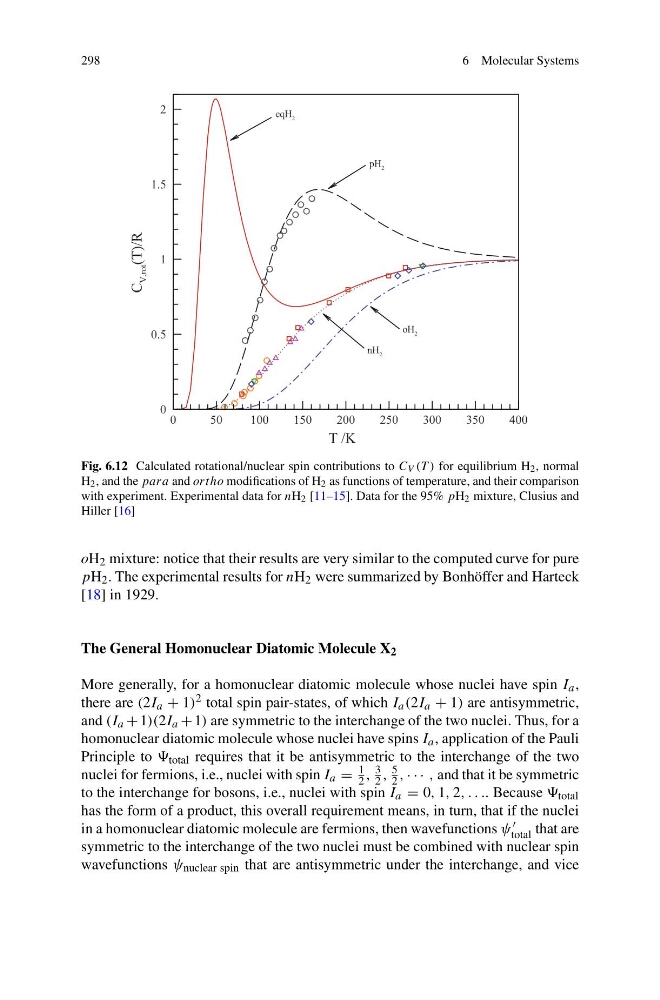
Fig. 6.12 Calculated rotational/nuclear spin contributions to C V (T ) for equilibrium H 2 , normal
H 2 , and the para and ortho modifications of H 2 as functions of temperature, and their comparison
with experiment. Experimental data for nH 2 [11–15]. Data for the 95% pH 2 mixture, Clusius and
Hiller [16]
oH 2 mixture: notice that their results are very similar to the computed curve for pure
pH 2 . The experimental results for nH 2 were summarized by Bonhöffer and Harteck
[18] in 1929.
The General Homonuclear Diatomic Molecule X 2
More generally, for a homonuclear diatomic molecule whose nuclei have spin I a ,
there are (2I a + 1) 2 total spin pair-states, of which I a (2I a + 1) are antisymmetric,
and (I a + 1)(2I a + 1) are symmetric to the interchange of the two nuclei. Thus, for a
homonuclear diatomic molecule whose nuclei have spins I a , application of the Pauli
Principle to total requires that it be antisymmetric to the interchange of the two
nuclei for fermions, i.e., nuclei with spin I a =
1
2 ,
3
2 ,
5
2 , · · · , and that it be symmetric
to the interchange for bosons, i.e., nuclei with spin I a = 0, 1, 2, . . .. Because total
has the form of a product, this overall requirement means, in turn, that if the nuclei
in a homonuclear diatomic molecule are fermions, then wavefunctions ψ
total that are
symmetric to the interchange of the two nuclei must be combined with nuclear spin
wavefunctions ψ nuclear spin that are antisymmetric under the interchange, and vice
6 Molecular Systems
Fig. 6.12 Calculated rotational/nuclear spin contributions to C V (T ) for equilibrium H 2 , normal
H 2 , and the para and ortho modifications of H 2 as functions of temperature, and their comparison
with experiment. Experimental data for nH 2 [11–15]. Data for the 95% pH 2 mixture, Clusius and
Hiller [16]
oH 2 mixture: notice that their results are very similar to the computed curve for pure
pH 2 . The experimental results for nH 2 were summarized by Bonhöffer and Harteck
[18] in 1929.
The General Homonuclear Diatomic Molecule X 2
More generally, for a homonuclear diatomic molecule whose nuclei have spin I a ,
there are (2I a + 1) 2 total spin pair-states, of which I a (2I a + 1) are antisymmetric,
and (I a + 1)(2I a + 1) are symmetric to the interchange of the two nuclei. Thus, for a
homonuclear diatomic molecule whose nuclei have spins I a , application of the Pauli
Principle to total requires that it be antisymmetric to the interchange of the two
nuclei for fermions, i.e., nuclei with spin I a =
1
2 ,
3
2 ,
5
2 , · · · , and that it be symmetric
to the interchange for bosons, i.e., nuclei with spin I a = 0, 1, 2, . . .. Because total
has the form of a product, this overall requirement means, in turn, that if the nuclei
in a homonuclear diatomic molecule are fermions, then wavefunctions ψ
total that are
symmetric to the interchange of the two nuclei must be combined with nuclear spin
wavefunctions ψ nuclear spin that are antisymmetric under the interchange, and vice