

6.2 Diatomic Molecules
287
We shall treat the interchange of the two identical nuclei as a 2-step process:
(i) rotation of the molecule by an angle π about an axis perpendicular to the bondaxis of the molecule, followed by
(ii) return of the electrons to their original positions.
As in Fig. 6.8, we place the diatomic molecule with its axis lying along the zaxis of the coordinate system, and we place the origin at the centre-of-mass of the
molecule. A rotation by an angle π about the x-axis, for example, permutes the
nuclei, and at the same time changes the coordinates of the electrons i via
(x i , y i , z i )
c 2 (x)
→
(x i , −y i , −z i ) .
We now return the electrons only to their original coordinates by means of two
transformations (which both leave the nuclei unchanged), namely inversion through
the centre of the molecule,
(x i , −y i , −z i )
ı
→
(−x i , y i , z i ) ,
followed by reflection across a vertical mirror plane (the yz-plane specifically), to
give
(−x i , y i , z i )
σ v (yz)
→
(x i , y i , z i ) .
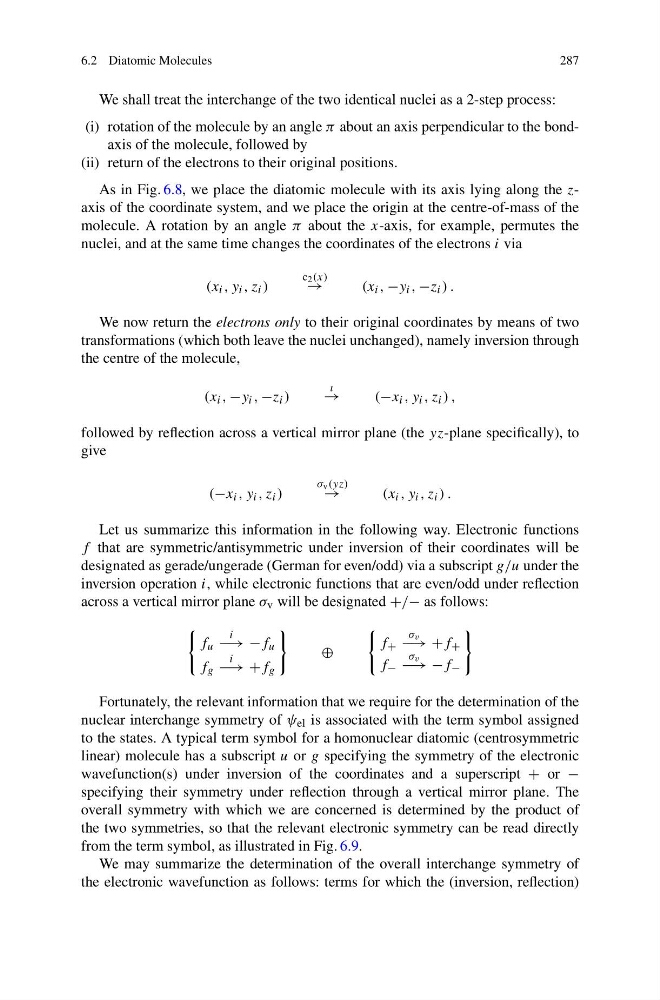
Let us summarize this information in the following way. Electronic functions
f that are symmetric/antisymmetric under inversion of their coordinates will be
designated as gerade/ungerade (German for even/odd) via a subscript g/u under the
inversion operation i, while electronic functions that are even/odd under reflection
across a vertical mirror plane σ v will be designated +/− as follows:
f u
i
−→ −f u
f g
i
−→ +f g
⊕
f +
σ v
−→ +f +
f −
σ v
−→ −f −
Fortunately, the relevant information that we require for the determination of the
nuclear interchange symmetry of ψ el is associated with the term symbol assigned
to the states. A typical term symbol for a homonuclear diatomic (centrosymmetric
linear) molecule has a subscript u or g specifying the symmetry of the electronic
wavefunction(s) under inversion of the coordinates and a superscript + or −
specifying their symmetry under reflection through a vertical mirror plane. The
overall symmetry with which we are concerned is determined by the product of
the two symmetries, so that the relevant electronic symmetry can be read directly
from the term symbol, as illustrated in Fig. 6.9.
We may summarize the determination of the overall interchange symmetry of
the electronic wavefunction as follows: terms for which the (inversion, reflection)
287
We shall treat the interchange of the two identical nuclei as a 2-step process:
(i) rotation of the molecule by an angle π about an axis perpendicular to the bondaxis of the molecule, followed by
(ii) return of the electrons to their original positions.
As in Fig. 6.8, we place the diatomic molecule with its axis lying along the zaxis of the coordinate system, and we place the origin at the centre-of-mass of the
molecule. A rotation by an angle π about the x-axis, for example, permutes the
nuclei, and at the same time changes the coordinates of the electrons i via
(x i , y i , z i )
c 2 (x)
→
(x i , −y i , −z i ) .
We now return the electrons only to their original coordinates by means of two
transformations (which both leave the nuclei unchanged), namely inversion through
the centre of the molecule,
(x i , −y i , −z i )
ı
→
(−x i , y i , z i ) ,
followed by reflection across a vertical mirror plane (the yz-plane specifically), to
give
(−x i , y i , z i )
σ v (yz)
→
(x i , y i , z i ) .
Let us summarize this information in the following way. Electronic functions
f that are symmetric/antisymmetric under inversion of their coordinates will be
designated as gerade/ungerade (German for even/odd) via a subscript g/u under the
inversion operation i, while electronic functions that are even/odd under reflection
across a vertical mirror plane σ v will be designated +/− as follows:
f u
i
−→ −f u
f g
i
−→ +f g
⊕
f +
σ v
−→ +f +
f −
σ v
−→ −f −
Fortunately, the relevant information that we require for the determination of the
nuclear interchange symmetry of ψ el is associated with the term symbol assigned
to the states. A typical term symbol for a homonuclear diatomic (centrosymmetric
linear) molecule has a subscript u or g specifying the symmetry of the electronic
wavefunction(s) under inversion of the coordinates and a superscript + or −
specifying their symmetry under reflection through a vertical mirror plane. The
overall symmetry with which we are concerned is determined by the product of
the two symmetries, so that the relevant electronic symmetry can be read directly
from the term symbol, as illustrated in Fig. 6.9.
We may summarize the determination of the overall interchange symmetry of
the electronic wavefunction as follows: terms for which the (inversion, reflection)