

288
6 Molecular Systems
σ
ψ
ψ
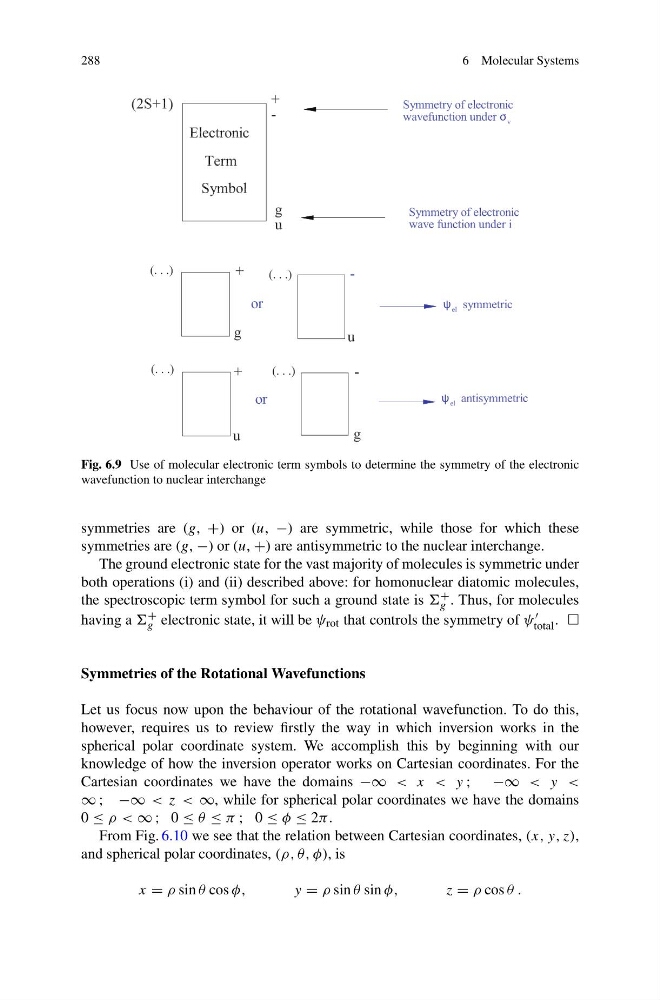
Fig. 6.9 Use of molecular electronic term symbols to determine the symmetry of the electronic
wavefunction to nuclear interchange
symmetries are (g, +) or (u, −) are symmetric, while those for which these
symmetries are (g, −) or (u, +) are antisymmetric to the nuclear interchange.
The ground electronic state for the vast majority of molecules is symmetric under
both operations (i) and (ii) described above: for homonuclear diatomic molecules,
the spectroscopic term symbol for such a ground state is +
g . Thus, for molecules
having a +
g electronic state, it will be ψ rot that controls the symmetry of ψ
total .
Symmetries of the Rotational Wavefunctions
Let us focus now upon the behaviour of the rotational wavefunction. To do this,
however, requires us to review firstly the way in which inversion works in the
spherical polar coordinate system. We accomplish this by beginning with our
knowledge of how the inversion operator works on Cartesian coordinates. For the
Cartesian coordinates we have the domains −∞ < x < y ; −∞ < y <
∞ ; −∞ < z < ∞, while for spherical polar coordinates we have the domains
0 ≤ ρ < ∞ ; 0 ≤ θ ≤ π ; 0 ≤ φ ≤ 2π .
From Fig. 6.10 we see that the relation between Cartesian coordinates, (x, y, z),
and spherical polar coordinates, (ρ, θ, φ), is
x = ρ sin θ cos φ,
y = ρ sin θ sin φ,
z = ρ cos θ .
6 Molecular Systems
σ
ψ
ψ
Fig. 6.9 Use of molecular electronic term symbols to determine the symmetry of the electronic
wavefunction to nuclear interchange
symmetries are (g, +) or (u, −) are symmetric, while those for which these
symmetries are (g, −) or (u, +) are antisymmetric to the nuclear interchange.
The ground electronic state for the vast majority of molecules is symmetric under
both operations (i) and (ii) described above: for homonuclear diatomic molecules,
the spectroscopic term symbol for such a ground state is +
g . Thus, for molecules
having a +
g electronic state, it will be ψ rot that controls the symmetry of ψ
total .
Symmetries of the Rotational Wavefunctions
Let us focus now upon the behaviour of the rotational wavefunction. To do this,
however, requires us to review firstly the way in which inversion works in the
spherical polar coordinate system. We accomplish this by beginning with our
knowledge of how the inversion operator works on Cartesian coordinates. For the
Cartesian coordinates we have the domains −∞ < x < y ; −∞ < y <
∞ ; −∞ < z < ∞, while for spherical polar coordinates we have the domains
0 ≤ ρ < ∞ ; 0 ≤ θ ≤ π ; 0 ≤ φ ≤ 2π .
From Fig. 6.10 we see that the relation between Cartesian coordinates, (x, y, z),
and spherical polar coordinates, (ρ, θ, φ), is
x = ρ sin θ cos φ,
y = ρ sin θ sin φ,
z = ρ cos θ .