

286
6 Molecular Systems
structure called a group. Molecular symmetry groups are referred to using a
generally agreed-upon notation that was introduced by chemists in the early part
of the twentieth century.
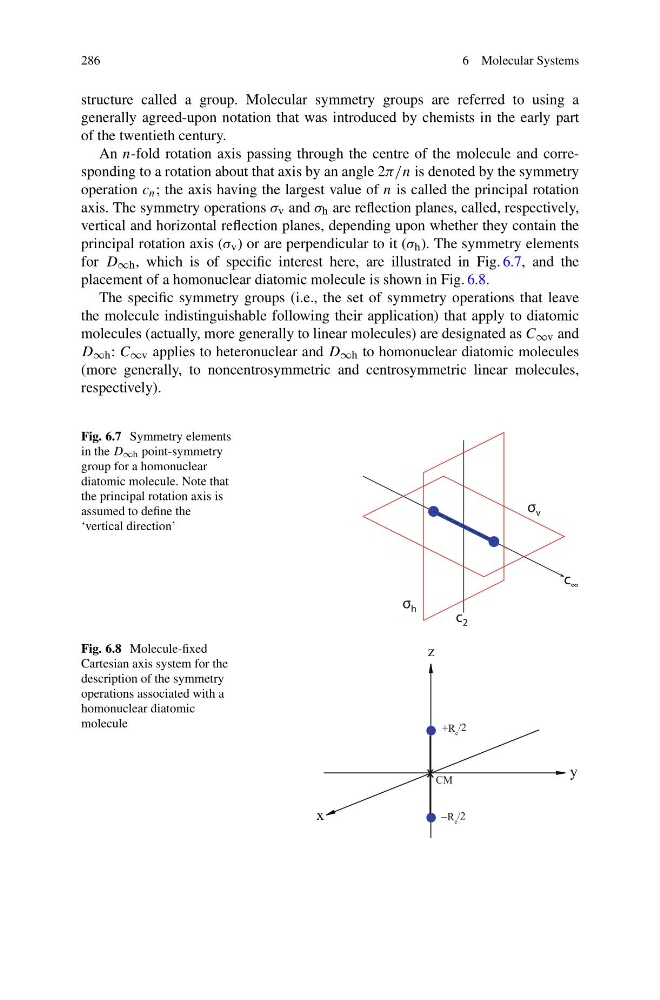
An n-fold rotation axis passing through the centre of the molecule and corresponding to a rotation about that axis by an angle 2π/n is denoted by the symmetry
operation c n ; the axis having the largest value of n is called the principal rotation
axis. The symmetry operations σ v and σ h are reflection planes, called, respectively,
vertical and horizontal reflection planes, depending upon whether they contain the
principal rotation axis (σ v ) or are perpendicular to it (σ h ). The symmetry elements
for D ∞h , which is of specific interest here, are illustrated in Fig. 6.7, and the
placement of a homonuclear diatomic molecule is shown in Fig. 6.8.
The specific symmetry groups (i.e., the set of symmetry operations that leave
the molecule indistinguishable following their application) that apply to diatomic
molecules (actually, more generally to linear molecules) are designated as C ∞v and
D ∞h : C ∞v applies to heteronuclear and D ∞h to homonuclear diatomic molecules
(more generally, to noncentrosymmetric and centrosymmetric linear molecules,
respectively).
Fig. 6.7 Symmetry elements
in the D ∞h point-symmetry
group for a homonuclear
diatomic molecule. Note that
the principal rotation axis is
assumed to define the
‘vertical direction’
Fig. 6.8 Molecule-fixed
Cartesian axis system for the
description of the symmetry
operations associated with a
homonuclear diatomic
molecule
x
z
x
y
+R e /2
−R e /2
CM
6 Molecular Systems
structure called a group. Molecular symmetry groups are referred to using a
generally agreed-upon notation that was introduced by chemists in the early part
of the twentieth century.
An n-fold rotation axis passing through the centre of the molecule and corresponding to a rotation about that axis by an angle 2π/n is denoted by the symmetry
operation c n ; the axis having the largest value of n is called the principal rotation
axis. The symmetry operations σ v and σ h are reflection planes, called, respectively,
vertical and horizontal reflection planes, depending upon whether they contain the
principal rotation axis (σ v ) or are perpendicular to it (σ h ). The symmetry elements
for D ∞h , which is of specific interest here, are illustrated in Fig. 6.7, and the
placement of a homonuclear diatomic molecule is shown in Fig. 6.8.
The specific symmetry groups (i.e., the set of symmetry operations that leave
the molecule indistinguishable following their application) that apply to diatomic
molecules (actually, more generally to linear molecules) are designated as C ∞v and
D ∞h : C ∞v applies to heteronuclear and D ∞h to homonuclear diatomic molecules
(more generally, to noncentrosymmetric and centrosymmetric linear molecules,
respectively).
Fig. 6.7 Symmetry elements
in the D ∞h point-symmetry
group for a homonuclear
diatomic molecule. Note that
the principal rotation axis is
assumed to define the
‘vertical direction’
Fig. 6.8 Molecule-fixed
Cartesian axis system for the
description of the symmetry
operations associated with a
homonuclear diatomic
molecule
x
z
x
y
+R e /2
−R e /2
CM