

6.2 Diatomic Molecules
283
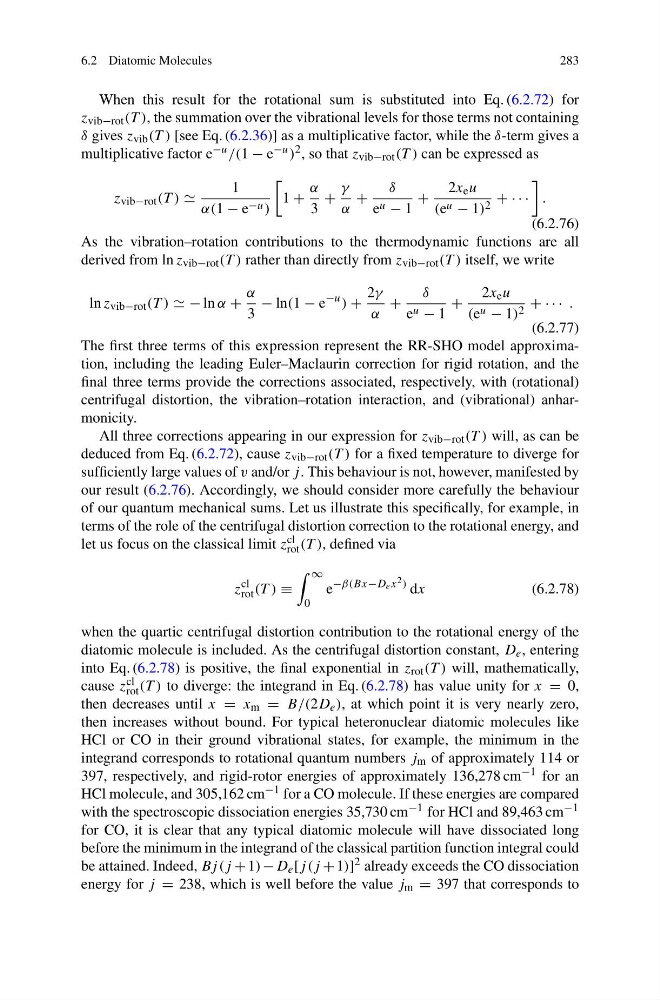
When this result for the rotational sum is substituted into Eq. (6.2.72) for
z vib−rot (T ), the summation over the vibrational levels for those terms not containing
δ gives z vib (T ) [see Eq. (6.2.36)] as a multiplicative factor, while the δ-term gives a
multiplicative factor e −u /(1 − e −u ) 2 , so that z vib−rot (T ) can be expressed as
z vib−rot (T )
1
α(1 − e −u )
1 +
α
3
+
γ
α
+
δ
e u − 1
+
2x e u
(e u − 1) 2 + · · ·
.
(6.2.76)
As the vibration–rotation contributions to the thermodynamic functions are all
derived from ln z vib−rot (T ) rather than directly from z vib−rot (T ) itself, we write
ln z vib−rot (T ) − ln α +
α
3
− ln(1 − e
−u ) +
2γ
α
+
δ
e u − 1
+
2x e u
(e u − 1) 2 + · · · .
(6.2.77)
The first three terms of this expression represent the RR-SHO model approximation, including the leading Euler–Maclaurin correction for rigid rotation, and the
final three terms provide the corrections associated, respectively, with (rotational)
centrifugal distortion, the vibration–rotation interaction, and (vibrational) anharmonicity.
All three corrections appearing in our expression for z vib−rot (T ) will, as can be
deduced from Eq. (6.2.72), cause z vib−rot (T ) for a fixed temperature to diverge for
sufficiently large values of v and/or j . This behaviour is not, however, manifested by
our result (6.2.76). Accordingly, we should consider more carefully the behaviour
of our quantum mechanical sums. Let us illustrate this specifically, for example, in
terms of the role of the centrifugal distortion correction to the rotational energy, and
let us focus on the classical limit z cl
rot (T ), defined via
z
cl
rot (T ) ≡
∞
0
e
−β(Bx−D e x 2 ) dx
(6.2.78)
when the quartic centrifugal distortion contribution to the rotational energy of the
diatomic molecule is included. As the centrifugal distortion constant, D e , entering
into Eq. (6.2.78) is positive, the final exponential in z rot (T ) will, mathematically,
cause z cl
rot (T ) to diverge: the integrand in Eq. (6.2.78) has value unity for x = 0,
then decreases until x = x m = B/(2D e ), at which point it is very nearly zero,
then increases without bound. For typical heteronuclear diatomic molecules like
HCl or CO in their ground vibrational states, for example, the minimum in the
integrand corresponds to rotational quantum numbers j m of approximately 114 or
397, respectively, and rigid-rotor energies of approximately 136,278 cm −1 for an
HCl molecule, and 305,162 cm −1 for a CO molecule. If these energies are compared
with the spectroscopic dissociation energies 35,730 cm −1 for HCl and 89,463 cm −1
for CO, it is clear that any typical diatomic molecule will have dissociated long
before the minimum in the integrand of the classical partition function integral could
be attained. Indeed, Bj (j + 1) − D e [j (j + 1)] 2 already exceeds the CO dissociation
energy for j = 238, which is well before the value j m = 397 that corresponds to
283
When this result for the rotational sum is substituted into Eq. (6.2.72) for
z vib−rot (T ), the summation over the vibrational levels for those terms not containing
δ gives z vib (T ) [see Eq. (6.2.36)] as a multiplicative factor, while the δ-term gives a
multiplicative factor e −u /(1 − e −u ) 2 , so that z vib−rot (T ) can be expressed as
z vib−rot (T )
1
α(1 − e −u )
1 +
α
3
+
γ
α
+
δ
e u − 1
+
2x e u
(e u − 1) 2 + · · ·
.
(6.2.76)
As the vibration–rotation contributions to the thermodynamic functions are all
derived from ln z vib−rot (T ) rather than directly from z vib−rot (T ) itself, we write
ln z vib−rot (T ) − ln α +
α
3
− ln(1 − e
−u ) +
2γ
α
+
δ
e u − 1
+
2x e u
(e u − 1) 2 + · · · .
(6.2.77)
The first three terms of this expression represent the RR-SHO model approximation, including the leading Euler–Maclaurin correction for rigid rotation, and the
final three terms provide the corrections associated, respectively, with (rotational)
centrifugal distortion, the vibration–rotation interaction, and (vibrational) anharmonicity.
All three corrections appearing in our expression for z vib−rot (T ) will, as can be
deduced from Eq. (6.2.72), cause z vib−rot (T ) for a fixed temperature to diverge for
sufficiently large values of v and/or j . This behaviour is not, however, manifested by
our result (6.2.76). Accordingly, we should consider more carefully the behaviour
of our quantum mechanical sums. Let us illustrate this specifically, for example, in
terms of the role of the centrifugal distortion correction to the rotational energy, and
let us focus on the classical limit z cl
rot (T ), defined via
z
cl
rot (T ) ≡
∞
0
e
−β(Bx−D e x 2 ) dx
(6.2.78)
when the quartic centrifugal distortion contribution to the rotational energy of the
diatomic molecule is included. As the centrifugal distortion constant, D e , entering
into Eq. (6.2.78) is positive, the final exponential in z rot (T ) will, mathematically,
cause z cl
rot (T ) to diverge: the integrand in Eq. (6.2.78) has value unity for x = 0,
then decreases until x = x m = B/(2D e ), at which point it is very nearly zero,
then increases without bound. For typical heteronuclear diatomic molecules like
HCl or CO in their ground vibrational states, for example, the minimum in the
integrand corresponds to rotational quantum numbers j m of approximately 114 or
397, respectively, and rigid-rotor energies of approximately 136,278 cm −1 for an
HCl molecule, and 305,162 cm −1 for a CO molecule. If these energies are compared
with the spectroscopic dissociation energies 35,730 cm −1 for HCl and 89,463 cm −1
for CO, it is clear that any typical diatomic molecule will have dissociated long
before the minimum in the integrand of the classical partition function integral could
be attained. Indeed, Bj (j + 1) − D e [j (j + 1)] 2 already exceeds the CO dissociation
energy for j = 238, which is well before the value j m = 397 that corresponds to