

282
6 Molecular Systems
with rot defined as
rot ≡
(1 −
1
2 δ)B e
k B
.
(6.2.71)
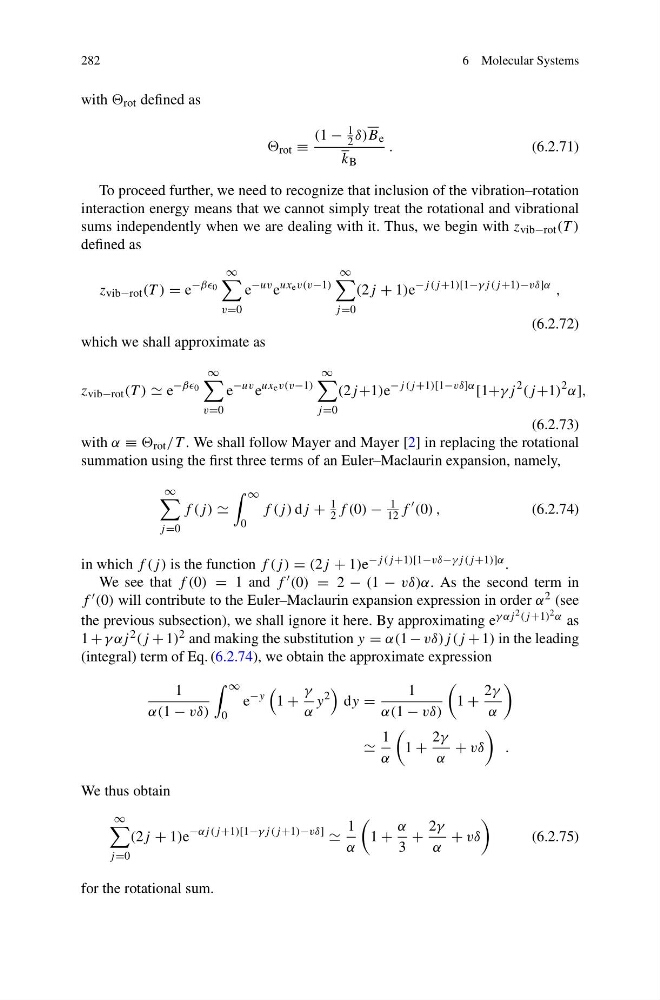
To proceed further, we need to recognize that inclusion of the vibration–rotation
interaction energy means that we cannot simply treat the rotational and vibrational
sums independently when we are dealing with it. Thus, we begin with z vib−rot (T )
defined as
z vib−rot (T ) = e
−ββ 0
∞
v=0
e
−uv e
ux e v(v−1)
∞
j =0
(2j + 1)e
−j (j+1)[1−γj (j +1)−vδ]α ,
(6.2.72)
which we shall approximate as
z vib−rot (T ) e
−ββ 0
∞
v=0
e
−uv e
ux e v(v−1)
∞
j =0
(2j +1)e
−j (j+1)[1−vδ]α
[1+γj
2 (j +1)
2 α],
(6.2.73)
with α ≡ rot /T . We shall follow Mayer and Mayer [2] in replacing the rotational
summation using the first three terms of an Euler–Maclaurin expansion, namely,
∞
j =0
f (j)
∞
0
f (j) dj +
1
2 f (0) −
1
12 f
(0) ,
(6.2.74)
in which f (j) is the function f (j) = (2j + 1)e −j (j+1)[1−vδ−γj (j +1)]α .
We see that f (0) = 1 and f (0) = 2 − (1 − vδ)α. As the second term in
f (0) will contribute to the Euler–Maclaurin expansion expression in order α 2 (see
the previous subsection), we shall ignore it here. By approximating e γ αj 2 (j +1) 2 α as
1 + γ αj 2 (j + 1) 2 and making the substitution y = α(1 − vδ)j (j + 1) in the leading
(integral) term of Eq. (6.2.74), we obtain the approximate expression
1
α(1 − vδ)
∞
0
e
−y
1 +
γ
α
y
2
dy =
1
α(1 − vδ)
1 +
2γ
α
1
α
1 +
2γ
α
+ vδ
.
We thus obtain
∞
j =0
(2j + 1)e
−αj (j +1)[1−γj (j +1)−vδ]
1
α
1 +
α
3
+
2γ
α
+ vδ
(6.2.75)
for the rotational sum.
6 Molecular Systems
with rot defined as
rot ≡
(1 −
1
2 δ)B e
k B
.
(6.2.71)
To proceed further, we need to recognize that inclusion of the vibration–rotation
interaction energy means that we cannot simply treat the rotational and vibrational
sums independently when we are dealing with it. Thus, we begin with z vib−rot (T )
defined as
z vib−rot (T ) = e
−ββ 0
∞
v=0
e
−uv e
ux e v(v−1)
∞
j =0
(2j + 1)e
−j (j+1)[1−γj (j +1)−vδ]α ,
(6.2.72)
which we shall approximate as
z vib−rot (T ) e
−ββ 0
∞
v=0
e
−uv e
ux e v(v−1)
∞
j =0
(2j +1)e
−j (j+1)[1−vδ]α
[1+γj
2 (j +1)
2 α],
(6.2.73)
with α ≡ rot /T . We shall follow Mayer and Mayer [2] in replacing the rotational
summation using the first three terms of an Euler–Maclaurin expansion, namely,
∞
j =0
f (j)
∞
0
f (j) dj +
1
2 f (0) −
1
12 f
(0) ,
(6.2.74)
in which f (j) is the function f (j) = (2j + 1)e −j (j+1)[1−vδ−γj (j +1)]α .
We see that f (0) = 1 and f (0) = 2 − (1 − vδ)α. As the second term in
f (0) will contribute to the Euler–Maclaurin expansion expression in order α 2 (see
the previous subsection), we shall ignore it here. By approximating e γ αj 2 (j +1) 2 α as
1 + γ αj 2 (j + 1) 2 and making the substitution y = α(1 − vδ)j (j + 1) in the leading
(integral) term of Eq. (6.2.74), we obtain the approximate expression
1
α(1 − vδ)
∞
0
e
−y
1 +
γ
α
y
2
dy =
1
α(1 − vδ)
1 +
2γ
α
1
α
1 +
2γ
α
+ vδ
.
We thus obtain
∞
j =0
(2j + 1)e
−αj (j +1)[1−γj (j +1)−vδ]
1
α
1 +
α
3
+
2γ
α
+ vδ
(6.2.75)
for the rotational sum.