

284
6 Molecular Systems
the integrand in Eq. (6.2.78) attaining its minimum value. Moreover, as the sextic
centrifugal distortion constant typically has values such that |H e /D e | is of order
10 −4 or smaller, it will not have a large influence on the behaviour of z rot (T ).
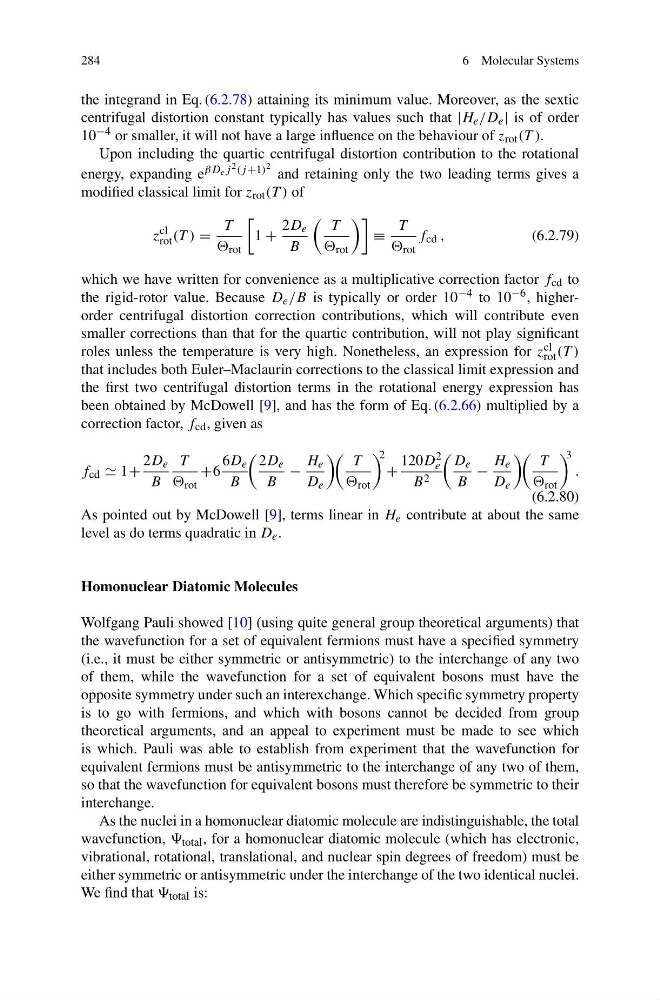
Upon including the quartic centrifugal distortion contribution to the rotational
energy, expanding e βD e j 2 (j +1) 2 and retaining only the two leading terms gives a
modified classical limit for z rot (T ) of
z
cl
rot (T ) =
T
rot
1 +
2D e
B
T
rot
≡
T
rot
f cd ,
(6.2.79)
which we have written for convenience as a multiplicative correction factor f cd to
the rigid-rotor value. Because D e /B is typically or order 10 −4 to 10 −6 , higherorder centrifugal distortion correction contributions, which will contribute even
smaller corrections than that for the quartic contribution, will not play significant
roles unless the temperature is very high. Nonetheless, an expression for z cl
rot (T )
that includes both Euler–Maclaurin corrections to the classical limit expression and
the first two centrifugal distortion terms in the rotational energy expression has
been obtained by McDowell [9], and has the form of Eq. (6.2.66) multiplied by a
correction factor, f cd , given as
f cd 1+
2D e
B
T
rot
+6
6D e
B
2D e
B
−
H e
D e
T
rot
2
+
120D 2
e
B 2
D e
B
−
H e
D e
T
rot
3
.
(6.2.80)
As pointed out by McDowell [9], terms linear in H e contribute at about the same
level as do terms quadratic in D e .
Homonuclear Diatomic Molecules
Wolfgang Pauli showed [10] (using quite general group theoretical arguments) that
the wavefunction for a set of equivalent fermions must have a specified symmetry
(i.e., it must be either symmetric or antisymmetric) to the interchange of any two
of them, while the wavefunction for a set of equivalent bosons must have the
opposite symmetry under such an interexchange. Which specific symmetry property
is to go with fermions, and which with bosons cannot be decided from group
theoretical arguments, and an appeal to experiment must be made to see which
is which. Pauli was able to establish from experiment that the wavefunction for
equivalent fermions must be antisymmetric to the interchange of any two of them,
so that the wavefunction for equivalent bosons must therefore be symmetric to their
interchange.
As the nuclei in a homonuclear diatomic molecule are indistinguishable, the total
wavefunction, total , for a homonuclear diatomic molecule (which has electronic,
vibrational, rotational, translational, and nuclear spin degrees of freedom) must be
either symmetric or antisymmetric under the interchange of the two identical nuclei.
We find that total is:
6 Molecular Systems
the integrand in Eq. (6.2.78) attaining its minimum value. Moreover, as the sextic
centrifugal distortion constant typically has values such that |H e /D e | is of order
10 −4 or smaller, it will not have a large influence on the behaviour of z rot (T ).
Upon including the quartic centrifugal distortion contribution to the rotational
energy, expanding e βD e j 2 (j +1) 2 and retaining only the two leading terms gives a
modified classical limit for z rot (T ) of
z
cl
rot (T ) =
T
rot
1 +
2D e
B
T
rot
≡
T
rot
f cd ,
(6.2.79)
which we have written for convenience as a multiplicative correction factor f cd to
the rigid-rotor value. Because D e /B is typically or order 10 −4 to 10 −6 , higherorder centrifugal distortion correction contributions, which will contribute even
smaller corrections than that for the quartic contribution, will not play significant
roles unless the temperature is very high. Nonetheless, an expression for z cl
rot (T )
that includes both Euler–Maclaurin corrections to the classical limit expression and
the first two centrifugal distortion terms in the rotational energy expression has
been obtained by McDowell [9], and has the form of Eq. (6.2.66) multiplied by a
correction factor, f cd , given as
f cd 1+
2D e
B
T
rot
+6
6D e
B
2D e
B
−
H e
D e
T
rot
2
+
120D 2
e
B 2
D e
B
−
H e
D e
T
rot
3
.
(6.2.80)
As pointed out by McDowell [9], terms linear in H e contribute at about the same
level as do terms quadratic in D e .
Homonuclear Diatomic Molecules
Wolfgang Pauli showed [10] (using quite general group theoretical arguments) that
the wavefunction for a set of equivalent fermions must have a specified symmetry
(i.e., it must be either symmetric or antisymmetric) to the interchange of any two
of them, while the wavefunction for a set of equivalent bosons must have the
opposite symmetry under such an interexchange. Which specific symmetry property
is to go with fermions, and which with bosons cannot be decided from group
theoretical arguments, and an appeal to experiment must be made to see which
is which. Pauli was able to establish from experiment that the wavefunction for
equivalent fermions must be antisymmetric to the interchange of any two of them,
so that the wavefunction for equivalent bosons must therefore be symmetric to their
interchange.
As the nuclei in a homonuclear diatomic molecule are indistinguishable, the total
wavefunction, total , for a homonuclear diatomic molecule (which has electronic,
vibrational, rotational, translational, and nuclear spin degrees of freedom) must be
either symmetric or antisymmetric under the interchange of the two identical nuclei.
We find that total is: