

274
6 Molecular Systems
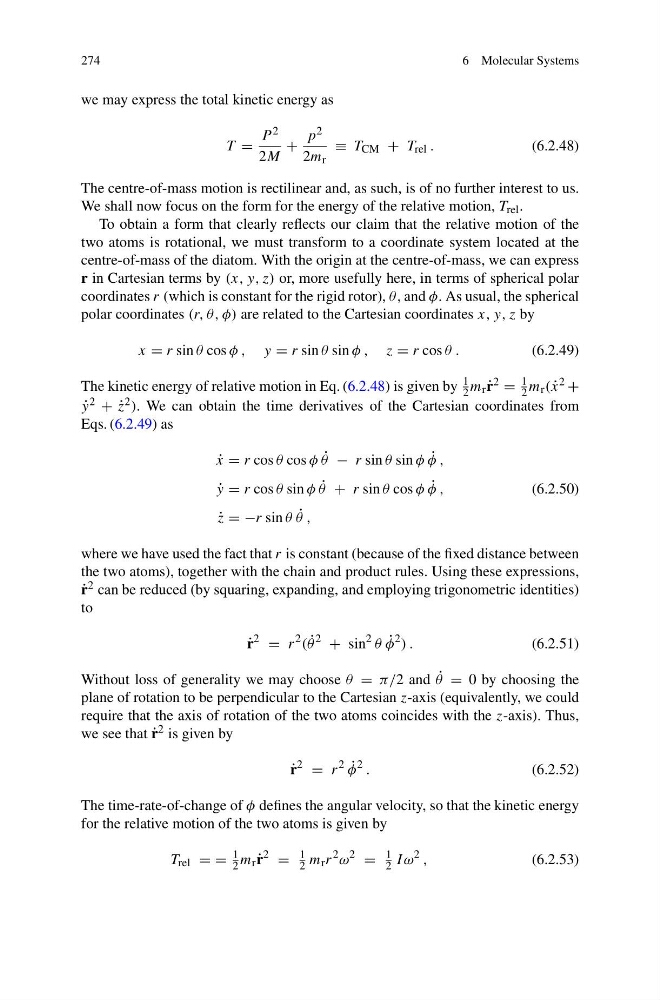
we may express the total kinetic energy as
T =
P 2
2M
+
p 2
2m r
≡ T CM + T rel .
(6.2.48)
The centre-of-mass motion is rectilinear and, as such, is of no further interest to us.
We shall now focus on the form for the energy of the relative motion, T rel .
To obtain a form that clearly reflects our claim that the relative motion of the
two atoms is rotational, we must transform to a coordinate system located at the
centre-of-mass of the diatom. With the origin at the centre-of-mass, we can express
r in Cartesian terms by (x, y, z) or, more usefully here, in terms of spherical polar
coordinates r (which is constant for the rigid rotor), θ , and φ. As usual, the spherical
polar coordinates (r, θ, φ) are related to the Cartesian coordinates x, y, z by
x = r sin θ cos φ , y = r sin θ sin φ , z = r cos θ .
(6.2.49)
The kinetic energy of relative motion in Eq. (6.2.48) is given by
1
2 m r ˙
r 2 =
1
2 m r ( ˙
x 2 +
˙
y 2 + ˙
z 2 ). We can obtain the time derivatives of the Cartesian coordinates from
Eqs. (6.2.49) as
˙
x = r cos θ cos φ ˙
θ − r sin θ sin φ ˙
φ ,
˙
y = r cos θ sin φ ˙
θ + r sin θ cos φ ˙
φ ,
(6.2.50)
˙
z = −r sin θ ˙
θ ,
where we have used the fact that r is constant (because of the fixed distance between
the two atoms), together with the chain and product rules. Using these expressions,
˙
r 2 can be reduced (by squaring, expanding, and employing trigonometric identities)
to
˙
r
2
= r
2 ( ˙
θ
2
+ sin
2 θ ˙
φ
2 ) .
(6.2.51)
Without loss of generality we may choose θ = π/2 and ˙
θ = 0 by choosing the
plane of rotation to be perpendicular to the Cartesian z-axis (equivalently, we could
require that the axis of rotation of the two atoms coincides with the z-axis). Thus,
we see that ˙
r 2 is given by
˙
r
2
= r
2 ˙
φ
2 .
(6.2.52)
The time-rate-of-change of φ defines the angular velocity, so that the kinetic energy
for the relative motion of the two atoms is given by
T rel = =
1
2 m r ˙
r
2
=
1
2 m r r
2 ω
2
=
1
2 I ω
2 ,
(6.2.53)
6 Molecular Systems
we may express the total kinetic energy as
T =
P 2
2M
+
p 2
2m r
≡ T CM + T rel .
(6.2.48)
The centre-of-mass motion is rectilinear and, as such, is of no further interest to us.
We shall now focus on the form for the energy of the relative motion, T rel .
To obtain a form that clearly reflects our claim that the relative motion of the
two atoms is rotational, we must transform to a coordinate system located at the
centre-of-mass of the diatom. With the origin at the centre-of-mass, we can express
r in Cartesian terms by (x, y, z) or, more usefully here, in terms of spherical polar
coordinates r (which is constant for the rigid rotor), θ , and φ. As usual, the spherical
polar coordinates (r, θ, φ) are related to the Cartesian coordinates x, y, z by
x = r sin θ cos φ , y = r sin θ sin φ , z = r cos θ .
(6.2.49)
The kinetic energy of relative motion in Eq. (6.2.48) is given by
1
2 m r ˙
r 2 =
1
2 m r ( ˙
x 2 +
˙
y 2 + ˙
z 2 ). We can obtain the time derivatives of the Cartesian coordinates from
Eqs. (6.2.49) as
˙
x = r cos θ cos φ ˙
θ − r sin θ sin φ ˙
φ ,
˙
y = r cos θ sin φ ˙
θ + r sin θ cos φ ˙
φ ,
(6.2.50)
˙
z = −r sin θ ˙
θ ,
where we have used the fact that r is constant (because of the fixed distance between
the two atoms), together with the chain and product rules. Using these expressions,
˙
r 2 can be reduced (by squaring, expanding, and employing trigonometric identities)
to
˙
r
2
= r
2 ( ˙
θ
2
+ sin
2 θ ˙
φ
2 ) .
(6.2.51)
Without loss of generality we may choose θ = π/2 and ˙
θ = 0 by choosing the
plane of rotation to be perpendicular to the Cartesian z-axis (equivalently, we could
require that the axis of rotation of the two atoms coincides with the z-axis). Thus,
we see that ˙
r 2 is given by
˙
r
2
= r
2 ˙
φ
2 .
(6.2.52)
The time-rate-of-change of φ defines the angular velocity, so that the kinetic energy
for the relative motion of the two atoms is given by
T rel = =
1
2 m r ˙
r
2
=
1
2 m r r
2 ω
2
=
1
2 I ω
2 ,
(6.2.53)