

6.2 Diatomic Molecules
273
X
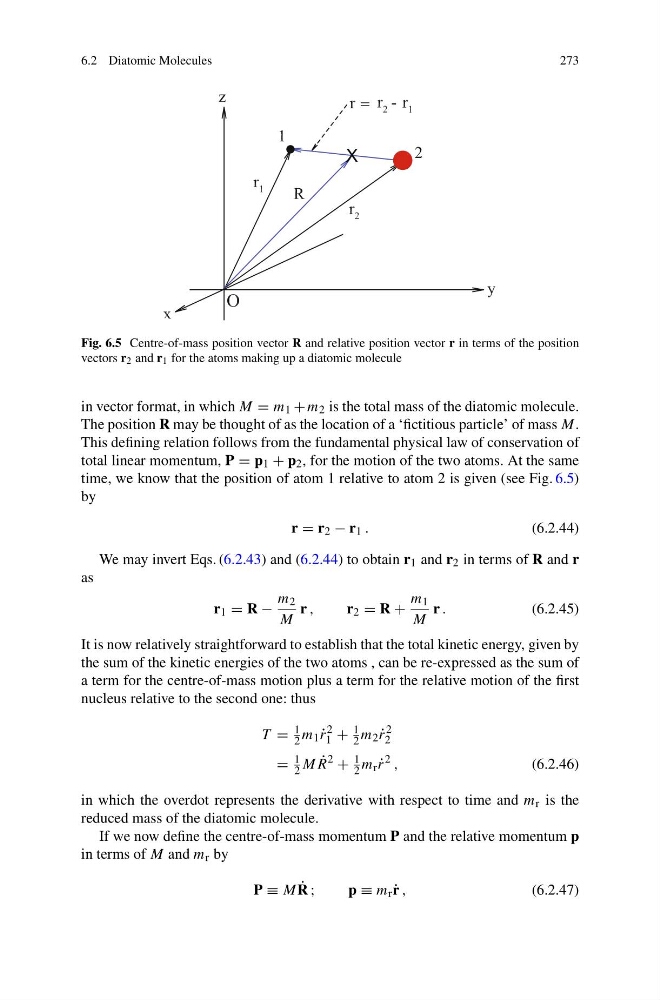
Fig. 6.5 Centre-of-mass position vector R and relative position vector r in terms of the position
vectors r 2 and r 1 for the atoms making up a diatomic molecule
in vector format, in which M = m 1 + m 2 is the total mass of the diatomic molecule.
The position R may be thought of as the location of a ‘fictitious particle’ of mass M.
This defining relation follows from the fundamental physical law of conservation of
total linear momentum, P = p 1 + p 2 , for the motion of the two atoms. At the same
time, we know that the position of atom 1 relative to atom 2 is given (see Fig. 6.5)
by
r = r 2 − r 1 .
(6.2.44)
We may invert Eqs. (6.2.43) and (6.2.44) to obtain r 1 and r 2 in terms of R and r
as
r 1 = R −
m 2
M
r ,
r 2 = R +
m 1
M
r .
(6.2.45)
It is now relatively straightforward to establish that the total kinetic energy, given by
the sum of the kinetic energies of the two atoms , can be re-expressed as the sum of
a term for the centre-of-mass motion plus a term for the relative motion of the first
nucleus relative to the second one: thus
T =
1
2 m 1 ˙
r
2
1 +
1
2 m 2 ˙
r
2
2
=
1
2 M ˙
R
2
+
1
2 m r ˙
r
2 ,
(6.2.46)
in which the overdot represents the derivative with respect to time and m r is the
reduced mass of the diatomic molecule.
If we now define the centre-of-mass momentum P and the relative momentum p
in terms of M and m r by
P ≡ M ˙
R ;
p ≡ m r ˙
r ,
(6.2.47)
273
X
Fig. 6.5 Centre-of-mass position vector R and relative position vector r in terms of the position
vectors r 2 and r 1 for the atoms making up a diatomic molecule
in vector format, in which M = m 1 + m 2 is the total mass of the diatomic molecule.
The position R may be thought of as the location of a ‘fictitious particle’ of mass M.
This defining relation follows from the fundamental physical law of conservation of
total linear momentum, P = p 1 + p 2 , for the motion of the two atoms. At the same
time, we know that the position of atom 1 relative to atom 2 is given (see Fig. 6.5)
by
r = r 2 − r 1 .
(6.2.44)
We may invert Eqs. (6.2.43) and (6.2.44) to obtain r 1 and r 2 in terms of R and r
as
r 1 = R −
m 2
M
r ,
r 2 = R +
m 1
M
r .
(6.2.45)
It is now relatively straightforward to establish that the total kinetic energy, given by
the sum of the kinetic energies of the two atoms , can be re-expressed as the sum of
a term for the centre-of-mass motion plus a term for the relative motion of the first
nucleus relative to the second one: thus
T =
1
2 m 1 ˙
r
2
1 +
1
2 m 2 ˙
r
2
2
=
1
2 M ˙
R
2
+
1
2 m r ˙
r
2 ,
(6.2.46)
in which the overdot represents the derivative with respect to time and m r is the
reduced mass of the diatomic molecule.
If we now define the centre-of-mass momentum P and the relative momentum p
in terms of M and m r by
P ≡ M ˙
R ;
p ≡ m r ˙
r ,
(6.2.47)