

272
6 Molecular Systems
m 2
m 1
c.ofm.
J
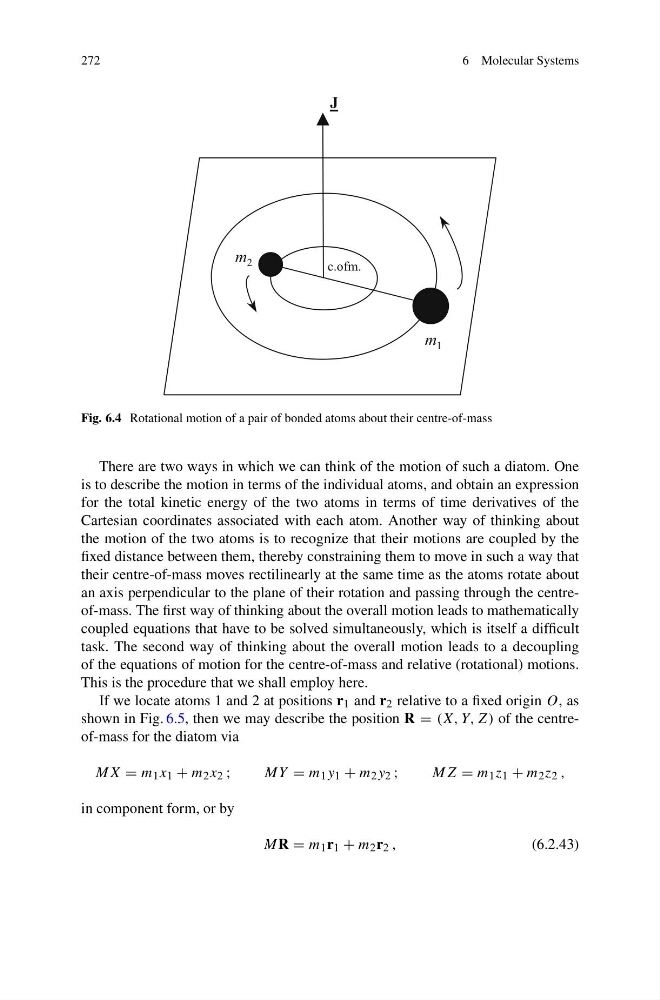
Fig. 6.4 Rotational motion of a pair of bonded atoms about their centre-of-mass
There are two ways in which we can think of the motion of such a diatom. One
is to describe the motion in terms of the individual atoms, and obtain an expression
for the total kinetic energy of the two atoms in terms of time derivatives of the
Cartesian coordinates associated with each atom. Another way of thinking about
the motion of the two atoms is to recognize that their motions are coupled by the
fixed distance between them, thereby constraining them to move in such a way that
their centre-of-mass moves rectilinearly at the same time as the atoms rotate about
an axis perpendicular to the plane of their rotation and passing through the centreof-mass. The first way of thinking about the overall motion leads to mathematically
coupled equations that have to be solved simultaneously, which is itself a difficult
task. The second way of thinking about the overall motion leads to a decoupling
of the equations of motion for the centre-of-mass and relative (rotational) motions.
This is the procedure that we shall employ here.
If we locate atoms 1 and 2 at positions r 1 and r 2 relative to a fixed origin O, as
shown in Fig. 6.5, then we may describe the position R = (X, Y, Z) of the centreof-mass for the diatom via
MX = m 1 x 1 + m 2 x 2 ;
MY = m 1 y 1 + m 2 y 2 ;
MZ = m 1 z 1 + m 2 z 2 ,
in component form, or by
MR = m 1 r 1 + m 2 r 2 ,
(6.2.43)
6 Molecular Systems
m 2
m 1
c.ofm.
J
Fig. 6.4 Rotational motion of a pair of bonded atoms about their centre-of-mass
There are two ways in which we can think of the motion of such a diatom. One
is to describe the motion in terms of the individual atoms, and obtain an expression
for the total kinetic energy of the two atoms in terms of time derivatives of the
Cartesian coordinates associated with each atom. Another way of thinking about
the motion of the two atoms is to recognize that their motions are coupled by the
fixed distance between them, thereby constraining them to move in such a way that
their centre-of-mass moves rectilinearly at the same time as the atoms rotate about
an axis perpendicular to the plane of their rotation and passing through the centreof-mass. The first way of thinking about the overall motion leads to mathematically
coupled equations that have to be solved simultaneously, which is itself a difficult
task. The second way of thinking about the overall motion leads to a decoupling
of the equations of motion for the centre-of-mass and relative (rotational) motions.
This is the procedure that we shall employ here.
If we locate atoms 1 and 2 at positions r 1 and r 2 relative to a fixed origin O, as
shown in Fig. 6.5, then we may describe the position R = (X, Y, Z) of the centreof-mass for the diatom via
MX = m 1 x 1 + m 2 x 2 ;
MY = m 1 y 1 + m 2 y 2 ;
MZ = m 1 z 1 + m 2 z 2 ,
in component form, or by
MR = m 1 r 1 + m 2 r 2 ,
(6.2.43)