

6.2 Diatomic Molecules
275
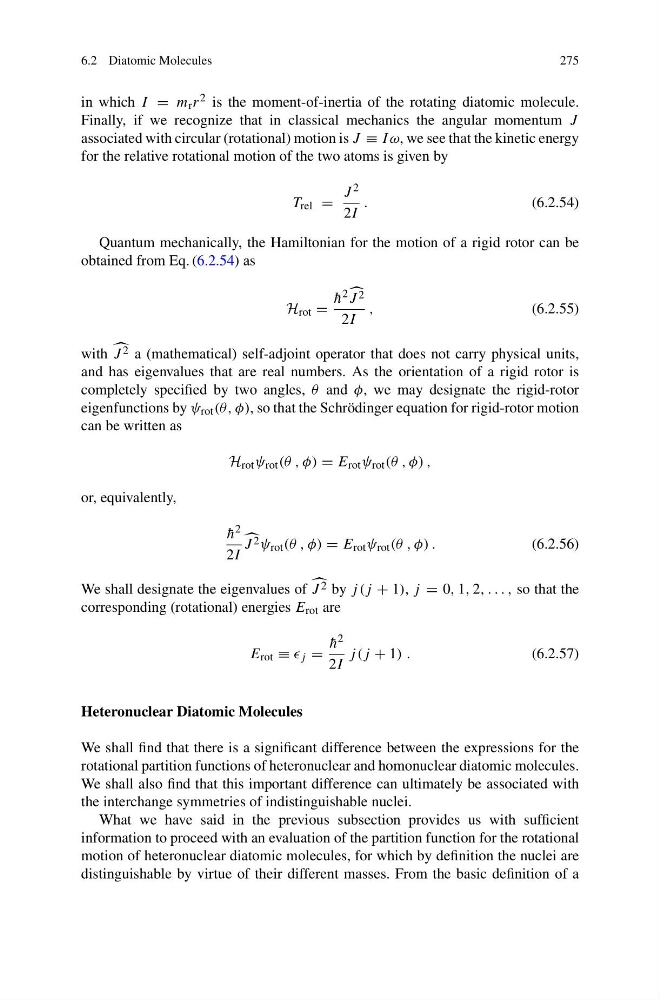
in which I = m r r 2 is the moment-of-inertia of the rotating diatomic molecule.
Finally, if we recognize that in classical mechanics the angular momentum J
associated with circular (rotational) motion is J ≡ I ω, we see that the kinetic energy
for the relative rotational motion of the two atoms is given by
T rel =
J 2
2I
.
(6.2.54)
Quantum mechanically, the Hamiltonian for the motion of a rigid rotor can be
obtained from Eq. (6.2.54) as
H rot =
¯
h 2 J 2
2I
,
(6.2.55)
with
J 2 a (mathematical) self-adjoint operator that does not carry physical units,
and has eigenvalues that are real numbers. As the orientation of a rigid rotor is
completely specified by two angles, θ and φ, we may designate the rigid-rotor
eigenfunctions by ψ rot (θ, φ), so that the Schrödinger equation for rigid-rotor motion
can be written as
H rot ψ rot (θ , φ) = E rot ψ rot (θ , φ) ,
or, equivalently,
¯
h 2
2I
J 2 ψ rot (θ , φ) = E rot ψ rot (θ , φ) .
(6.2.56)
We shall designate the eigenvalues of
J 2 by j (j + 1), j = 0, 1, 2, . . . , so that the
corresponding (rotational) energies E rot are
E rot ≡ j =
¯
h 2
2I
j (j + 1) .
(6.2.57)
Heteronuclear Diatomic Molecules
We shall find that there is a significant difference between the expressions for the
rotational partition functions of heteronuclear and homonuclear diatomic molecules.
We shall also find that this important difference can ultimately be associated with
the interchange symmetries of indistinguishable nuclei.
What we have said in the previous subsection provides us with sufficient
information to proceed with an evaluation of the partition function for the rotational
motion of heteronuclear diatomic molecules, for which by definition the nuclei are
distinguishable by virtue of their different masses. From the basic definition of a
275
in which I = m r r 2 is the moment-of-inertia of the rotating diatomic molecule.
Finally, if we recognize that in classical mechanics the angular momentum J
associated with circular (rotational) motion is J ≡ I ω, we see that the kinetic energy
for the relative rotational motion of the two atoms is given by
T rel =
J 2
2I
.
(6.2.54)
Quantum mechanically, the Hamiltonian for the motion of a rigid rotor can be
obtained from Eq. (6.2.54) as
H rot =
¯
h 2 J 2
2I
,
(6.2.55)
with
J 2 a (mathematical) self-adjoint operator that does not carry physical units,
and has eigenvalues that are real numbers. As the orientation of a rigid rotor is
completely specified by two angles, θ and φ, we may designate the rigid-rotor
eigenfunctions by ψ rot (θ, φ), so that the Schrödinger equation for rigid-rotor motion
can be written as
H rot ψ rot (θ , φ) = E rot ψ rot (θ , φ) ,
or, equivalently,
¯
h 2
2I
J 2 ψ rot (θ , φ) = E rot ψ rot (θ , φ) .
(6.2.56)
We shall designate the eigenvalues of
J 2 by j (j + 1), j = 0, 1, 2, . . . , so that the
corresponding (rotational) energies E rot are
E rot ≡ j =
¯
h 2
2I
j (j + 1) .
(6.2.57)
Heteronuclear Diatomic Molecules
We shall find that there is a significant difference between the expressions for the
rotational partition functions of heteronuclear and homonuclear diatomic molecules.
We shall also find that this important difference can ultimately be associated with
the interchange symmetries of indistinguishable nuclei.
What we have said in the previous subsection provides us with sufficient
information to proceed with an evaluation of the partition function for the rotational
motion of heteronuclear diatomic molecules, for which by definition the nuclei are
distinguishable by virtue of their different masses. From the basic definition of a