

6.2 Diatomic Molecules
269
as this is the value associated with the v = 0 →1 transition in the diatomic
molecule treated as a SHO. The result (6.2.30) may also be written in the form
z vib (T ) = e
−ββ 0
∞
v=0
e
−uv e
ux e v(v−v) .
(6.2.33)
For x e u 1, we may expand the second exponential in the summand of
Eq. (6.2.33), to obtain
z vib (T ) e
−ββ 0
∞
v=0
(e
−u )
v
[1 + x e u(v
2
− v) + · · · ]
= e
−ββ 0
1
1 − e −u + x e u
∞
v=0
e
−uv (v
2
− v) + · · ·
.
(6.2.34)
This expression can be further simplified by employing parameter differentiation in
the second term to obtain
z vib (T ) = e
−ββ 0
1
1 − e −u + x e u
d 2
du 2 +
d
du
1
1 − e −u + · · ·
= e
−ββ 0 z vib (T )
1 +
2x e u
(e u − 1) 2 + · · ·
,
(6.2.35)
with z vib (T ) as defined previously in Sect. 5.5.1. We shall rewrite this result as
z vib (T ) = e
−ββ 0 z vib (T )f anh (T ) ,
(6.2.36)
in terms of an anharmonic correction factor f anh (T ) given by
f anh (T ) = 1 +
2x e u
(e u − 1) 2 .
(6.2.37)
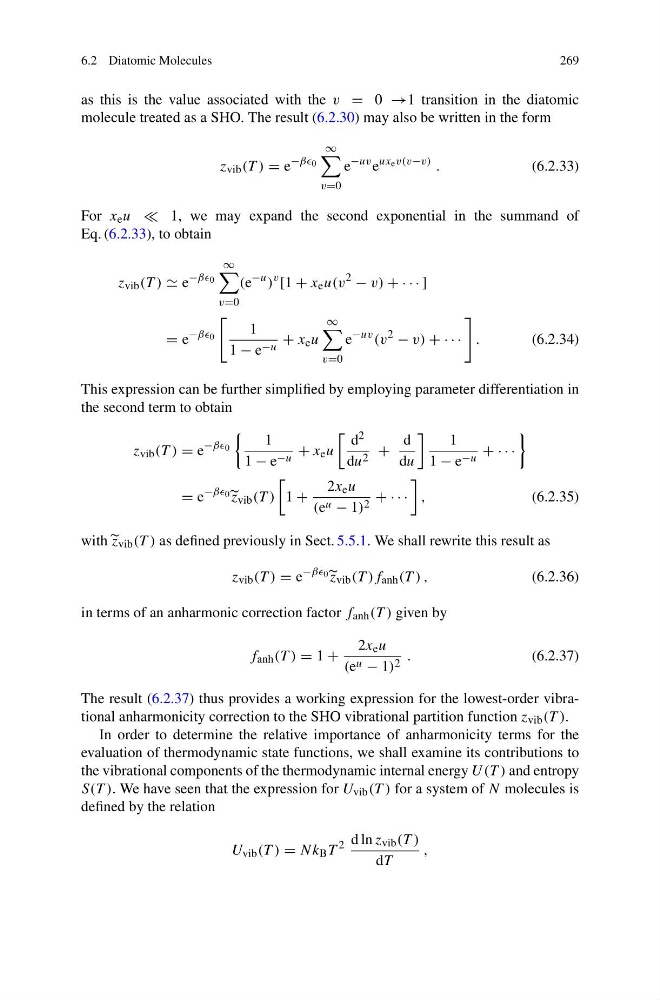
The result (6.2.37) thus provides a working expression for the lowest-order vibrational anharmonicity correction to the SHO vibrational partition function z vib (T ).
In order to determine the relative importance of anharmonicity terms for the
evaluation of thermodynamic state functions, we shall examine its contributions to
the vibrational components of the thermodynamic internal energy U(T ) and entropy
S(T ). We have seen that the expression for U vib (T ) for a system of N molecules is
defined by the relation
U vib (T ) = Nk B T
2 d ln z vib (T )
dT
,
269
as this is the value associated with the v = 0 →1 transition in the diatomic
molecule treated as a SHO. The result (6.2.30) may also be written in the form
z vib (T ) = e
−ββ 0
∞
v=0
e
−uv e
ux e v(v−v) .
(6.2.33)
For x e u 1, we may expand the second exponential in the summand of
Eq. (6.2.33), to obtain
z vib (T ) e
−ββ 0
∞
v=0
(e
−u )
v
[1 + x e u(v
2
− v) + · · · ]
= e
−ββ 0
1
1 − e −u + x e u
∞
v=0
e
−uv (v
2
− v) + · · ·
.
(6.2.34)
This expression can be further simplified by employing parameter differentiation in
the second term to obtain
z vib (T ) = e
−ββ 0
1
1 − e −u + x e u
d 2
du 2 +
d
du
1
1 − e −u + · · ·
= e
−ββ 0 z vib (T )
1 +
2x e u
(e u − 1) 2 + · · ·
,
(6.2.35)
with z vib (T ) as defined previously in Sect. 5.5.1. We shall rewrite this result as
z vib (T ) = e
−ββ 0 z vib (T )f anh (T ) ,
(6.2.36)
in terms of an anharmonic correction factor f anh (T ) given by
f anh (T ) = 1 +
2x e u
(e u − 1) 2 .
(6.2.37)
The result (6.2.37) thus provides a working expression for the lowest-order vibrational anharmonicity correction to the SHO vibrational partition function z vib (T ).
In order to determine the relative importance of anharmonicity terms for the
evaluation of thermodynamic state functions, we shall examine its contributions to
the vibrational components of the thermodynamic internal energy U(T ) and entropy
S(T ). We have seen that the expression for U vib (T ) for a system of N molecules is
defined by the relation
U vib (T ) = Nk B T
2 d ln z vib (T )
dT
,