

268
6 Molecular Systems
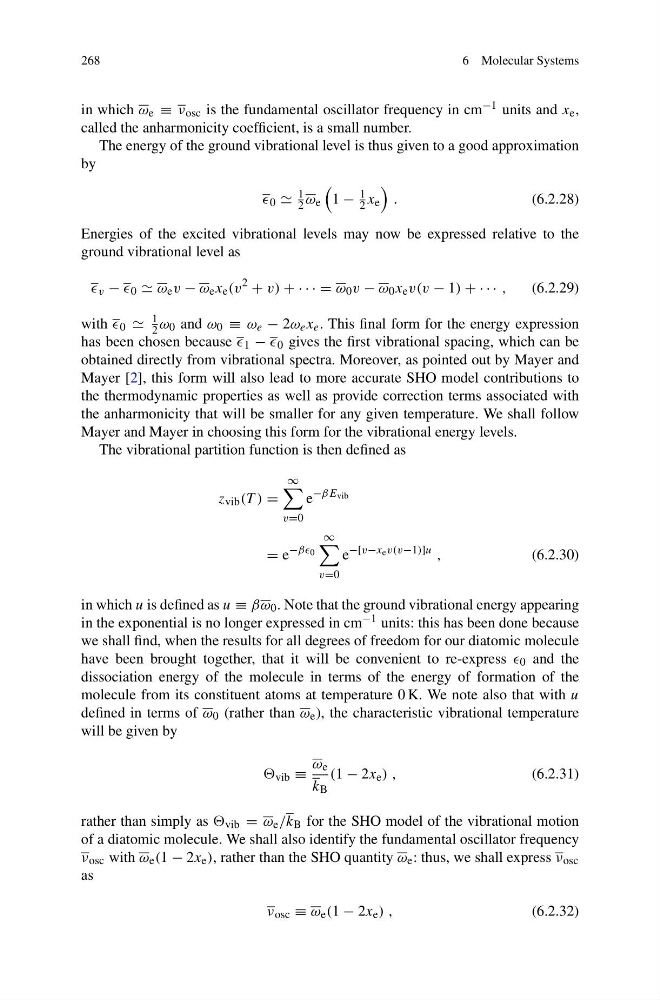
in which ω e ≡ ν osc is the fundamental oscillator frequency in cm −1 units and x e ,
called the anharmonicity coefficient, is a small number.
The energy of the ground vibrational level is thus given to a good approximation
by
0
1
2 ω e
1 −
1
2 x e
.
(6.2.28)
Energies of the excited vibrational levels may now be expressed relative to the
ground vibrational level as
v − 0 ω e v − ω e x e (v
2
+ v) + · · · = ω 0 v − ω 0 x e v(v − 1) + · · · ,
(6.2.29)
with 0
1
2 ω 0 and ω 0 ≡ ω e − 2ω e x e . This final form for the energy expression
has been chosen because 1 − 0 gives the first vibrational spacing, which can be
obtained directly from vibrational spectra. Moreover, as pointed out by Mayer and
Mayer [2], this form will also lead to more accurate SHO model contributions to
the thermodynamic properties as well as provide correction terms associated with
the anharmonicity that will be smaller for any given temperature. We shall follow
Mayer and Mayer in choosing this form for the vibrational energy levels.
The vibrational partition function is then defined as
z vib (T ) =
∞
v=0
e
−βE vib
= e
−ββ 0
∞
v=0
e
−[v−x e v(v−1)]u ,
(6.2.30)
in which u is defined as u ≡ βω 0 . Note that the ground vibrational energy appearing
in the exponential is no longer expressed in cm −1 units: this has been done because
we shall find, when the results for all degrees of freedom for our diatomic molecule
have been brought together, that it will be convenient to re-express 0 and the
dissociation energy of the molecule in terms of the energy of formation of the
molecule from its constituent atoms at temperature 0 K. We note also that with u
defined in terms of ω 0 (rather than ω e ), the characteristic vibrational temperature
will be given by
vib ≡
ω e
k B
(1 − 2x e ) ,
(6.2.31)
rather than simply as vib = ω e /k B for the SHO model of the vibrational motion
of a diatomic molecule. We shall also identify the fundamental oscillator frequency
ν osc with ω e (1 − 2x e ), rather than the SHO quantity ω e : thus, we shall express ν osc
as
ν osc ≡ ω e (1 − 2x e ) ,
(6.2.32)
6 Molecular Systems
in which ω e ≡ ν osc is the fundamental oscillator frequency in cm −1 units and x e ,
called the anharmonicity coefficient, is a small number.
The energy of the ground vibrational level is thus given to a good approximation
by
0
1
2 ω e
1 −
1
2 x e
.
(6.2.28)
Energies of the excited vibrational levels may now be expressed relative to the
ground vibrational level as
v − 0 ω e v − ω e x e (v
2
+ v) + · · · = ω 0 v − ω 0 x e v(v − 1) + · · · ,
(6.2.29)
with 0
1
2 ω 0 and ω 0 ≡ ω e − 2ω e x e . This final form for the energy expression
has been chosen because 1 − 0 gives the first vibrational spacing, which can be
obtained directly from vibrational spectra. Moreover, as pointed out by Mayer and
Mayer [2], this form will also lead to more accurate SHO model contributions to
the thermodynamic properties as well as provide correction terms associated with
the anharmonicity that will be smaller for any given temperature. We shall follow
Mayer and Mayer in choosing this form for the vibrational energy levels.
The vibrational partition function is then defined as
z vib (T ) =
∞
v=0
e
−βE vib
= e
−ββ 0
∞
v=0
e
−[v−x e v(v−1)]u ,
(6.2.30)
in which u is defined as u ≡ βω 0 . Note that the ground vibrational energy appearing
in the exponential is no longer expressed in cm −1 units: this has been done because
we shall find, when the results for all degrees of freedom for our diatomic molecule
have been brought together, that it will be convenient to re-express 0 and the
dissociation energy of the molecule in terms of the energy of formation of the
molecule from its constituent atoms at temperature 0 K. We note also that with u
defined in terms of ω 0 (rather than ω e ), the characteristic vibrational temperature
will be given by
vib ≡
ω e
k B
(1 − 2x e ) ,
(6.2.31)
rather than simply as vib = ω e /k B for the SHO model of the vibrational motion
of a diatomic molecule. We shall also identify the fundamental oscillator frequency
ν osc with ω e (1 − 2x e ), rather than the SHO quantity ω e : thus, we shall express ν osc
as
ν osc ≡ ω e (1 − 2x e ) ,
(6.2.32)