

6.2 Diatomic Molecules
267
C V ,vib (T ) = Nk B
vib
T
2
e − vib /T
(1 − e − vib /T ) 2 ,
(6.2.25)
S vib (T ) = Nk B
vib /T
e vib /T − 1
− ln(1 − e
− vib /T )
.
(6.2.26)
These expressions represent the contribution of the excited vibrational levels to the
thermodynamic properties of a diatomic gas.
We have isolated the ground vibrational contribution of
1
2 Nk B vib to the
Helmholtz energy A(T ) and the thermodynamic internal energy U(T ) in anticipation of its important role in the formation of the diatomic molecule. Note that there
is no need to present explicit expressions for the vibrational contributions H vib (T )
to the enthalpy and G vib (T ) to the Gibbs energy, as they are equal to U vib (T ) and
A vib (T ), respectively.
Beyond the SHO Approximation: Anharmonicity Effects
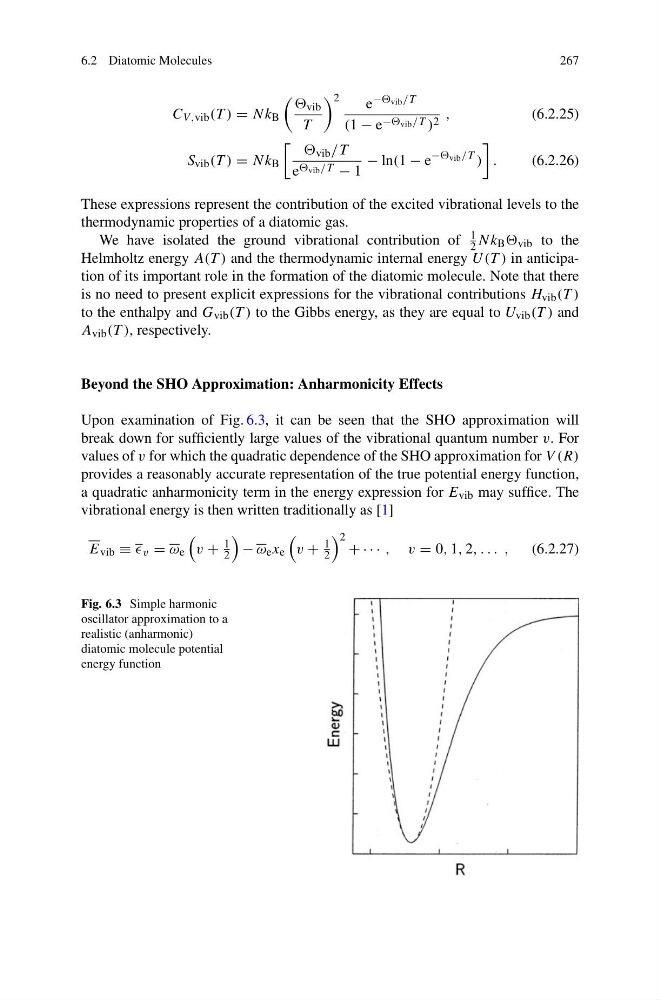
Upon examination of Fig. 6.3, it can be seen that the SHO approximation will
break down for sufficiently large values of the vibrational quantum number v. For
values of v for which the quadratic dependence of the SHO approximation for V (R)
provides a reasonably accurate representation of the true potential energy function,
a quadratic anharmonicity term in the energy expression for E vib may suffice. The
vibrational energy is then written traditionally as [1]
E vib ≡ v = ω e
v +
1
2
− ω e x e
v +
1
2
2 + · · · , v = 0, 1, 2, . . . , (6.2.27)
Fig. 6.3 Simple harmonic
oscillator approximation to a
realistic (anharmonic)
diatomic molecule potential
energy function
267
C V ,vib (T ) = Nk B
vib
T
2
e − vib /T
(1 − e − vib /T ) 2 ,
(6.2.25)
S vib (T ) = Nk B
vib /T
e vib /T − 1
− ln(1 − e
− vib /T )
.
(6.2.26)
These expressions represent the contribution of the excited vibrational levels to the
thermodynamic properties of a diatomic gas.
We have isolated the ground vibrational contribution of
1
2 Nk B vib to the
Helmholtz energy A(T ) and the thermodynamic internal energy U(T ) in anticipation of its important role in the formation of the diatomic molecule. Note that there
is no need to present explicit expressions for the vibrational contributions H vib (T )
to the enthalpy and G vib (T ) to the Gibbs energy, as they are equal to U vib (T ) and
A vib (T ), respectively.
Beyond the SHO Approximation: Anharmonicity Effects
Upon examination of Fig. 6.3, it can be seen that the SHO approximation will
break down for sufficiently large values of the vibrational quantum number v. For
values of v for which the quadratic dependence of the SHO approximation for V (R)
provides a reasonably accurate representation of the true potential energy function,
a quadratic anharmonicity term in the energy expression for E vib may suffice. The
vibrational energy is then written traditionally as [1]
E vib ≡ v = ω e
v +
1
2
− ω e x e
v +
1
2
2 + · · · , v = 0, 1, 2, . . . , (6.2.27)
Fig. 6.3 Simple harmonic
oscillator approximation to a
realistic (anharmonic)
diatomic molecule potential
energy function