

266
6 Molecular Systems
In this way, we may think of the vibrational motion of a diatomic molecule as
equivalent to that of a particle of mass m r suspended from a spring that has a force
constant k. The characteristic oscillator (radial) frequency ω osc can be replaced in
terms of its true frequency, ν osc , via the identity ω osc ≡ 2πν osc . The characteristic
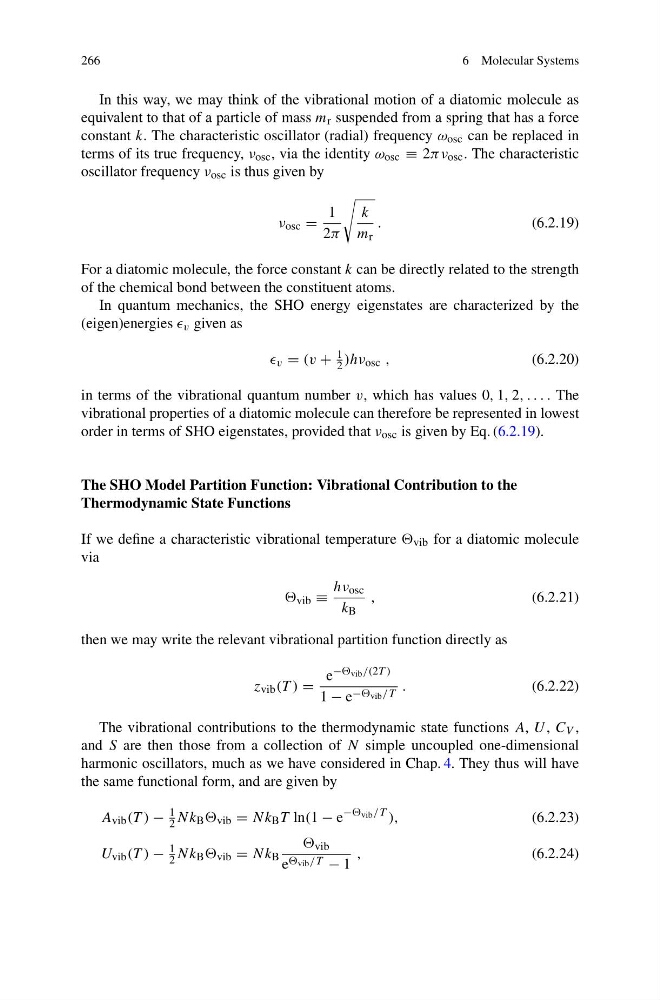
oscillator frequency ν osc is thus given by
ν osc =
1
2π
k
m r
.
(6.2.19)
For a diatomic molecule, the force constant k can be directly related to the strength
of the chemical bond between the constituent atoms.
In quantum mechanics, the SHO energy eigenstates are characterized by the
(eigen)energies v given as
v = (v +
1
2 )hν osc ,
(6.2.20)
in terms of the vibrational quantum number v, which has values 0, 1, 2, . . . . The
vibrational properties of a diatomic molecule can therefore be represented in lowest
order in terms of SHO eigenstates, provided that ν osc is given by Eq. (6.2.19).
The SHO Model Partition Function: Vibrational Contribution to the
Thermodynamic State Functions
If we define a characteristic vibrational temperature vib for a diatomic molecule
via
vib ≡
hν osc
k B
,
(6.2.21)
then we may write the relevant vibrational partition function directly as
z vib (T ) =
e − vib /(2T )
1 − e − vib /T .
(6.2.22)
The vibrational contributions to the thermodynamic state functions A, U , C V ,
and S are then those from a collection of N simple uncoupled one-dimensional
harmonic oscillators, much as we have considered in Chap. 4. They thus will have
the same functional form, and are given by
A vib (T ) −
1
2 Nk B vib = Nk B T ln(1 − e
− vib /T ),
(6.2.23)
U vib (T ) −
1
2 Nk B vib = Nk B
vib
e vib /T − 1
,
(6.2.24)
6 Molecular Systems
In this way, we may think of the vibrational motion of a diatomic molecule as
equivalent to that of a particle of mass m r suspended from a spring that has a force
constant k. The characteristic oscillator (radial) frequency ω osc can be replaced in
terms of its true frequency, ν osc , via the identity ω osc ≡ 2πν osc . The characteristic
oscillator frequency ν osc is thus given by
ν osc =
1
2π
k
m r
.
(6.2.19)
For a diatomic molecule, the force constant k can be directly related to the strength
of the chemical bond between the constituent atoms.
In quantum mechanics, the SHO energy eigenstates are characterized by the
(eigen)energies v given as
v = (v +
1
2 )hν osc ,
(6.2.20)
in terms of the vibrational quantum number v, which has values 0, 1, 2, . . . . The
vibrational properties of a diatomic molecule can therefore be represented in lowest
order in terms of SHO eigenstates, provided that ν osc is given by Eq. (6.2.19).
The SHO Model Partition Function: Vibrational Contribution to the
Thermodynamic State Functions
If we define a characteristic vibrational temperature vib for a diatomic molecule
via
vib ≡
hν osc
k B
,
(6.2.21)
then we may write the relevant vibrational partition function directly as
z vib (T ) =
e − vib /(2T )
1 − e − vib /T .
(6.2.22)
The vibrational contributions to the thermodynamic state functions A, U , C V ,
and S are then those from a collection of N simple uncoupled one-dimensional
harmonic oscillators, much as we have considered in Chap. 4. They thus will have
the same functional form, and are given by
A vib (T ) −
1
2 Nk B vib = Nk B T ln(1 − e
− vib /T ),
(6.2.23)
U vib (T ) −
1
2 Nk B vib = Nk B
vib
e vib /T − 1
,
(6.2.24)