

270
6 Molecular Systems
and we have shown that for x e u 1, z vib (T ) can be approximated by Eq. (6.2.36).
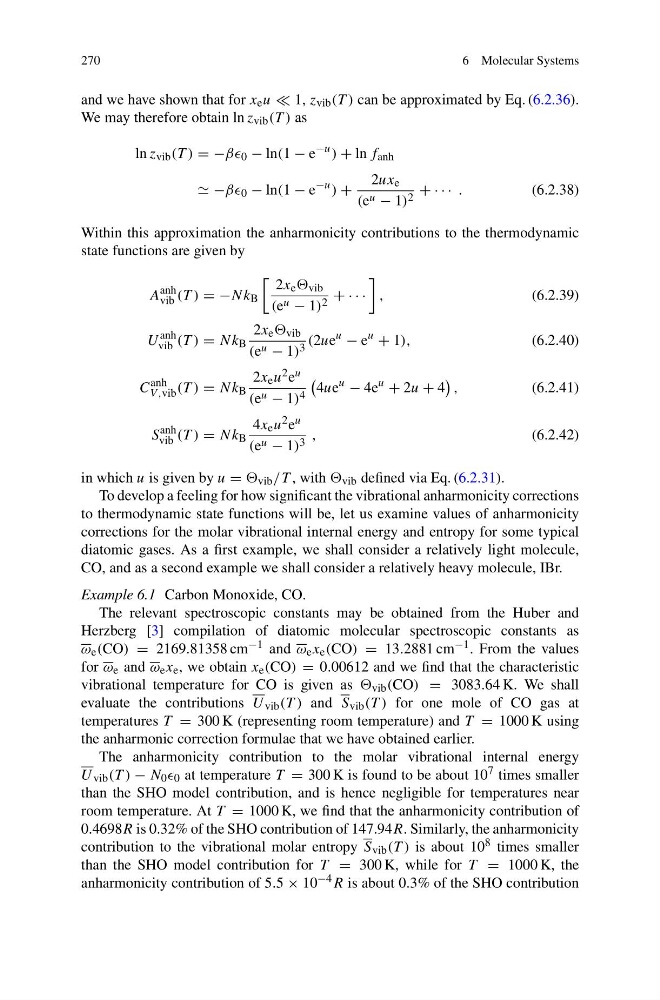
We may therefore obtain ln z vib (T ) as
ln z vib (T ) = −ββ 0 − ln(1 − e
−u ) + ln f anh
−ββ 0 − ln(1 − e
−u ) +
2ux e
(e u − 1) 2 + · · · .
(6.2.38)
Within this approximation the anharmonicity contributions to the thermodynamic
state functions are given by
A
anh
vib (T ) = −Nk B
2x e vib
(e u − 1) 2 + · · ·
,
(6.2.39)
U
anh
vib (T ) = Nk B
2x e vib
(e u − 1) 3 (2ue
u
− e
u
+ 1),
(6.2.40)
C
anh
V ,vib (T ) = Nk B
2x e u 2 e u
(e u − 1) 4
4ue
u
− 4e
u
+ 2u + 4
,
(6.2.41)
S
anh
vib (T ) = Nk B
4x e u 2 e u
(e u − 1) 3 ,
(6.2.42)
in which u is given by u = vib /T , with vib defined via Eq. (6.2.31).
To develop a feeling for how significant the vibrational anharmonicity corrections
to thermodynamic state functions will be, let us examine values of anharmonicity
corrections for the molar vibrational internal energy and entropy for some typical
diatomic gases. As a first example, we shall consider a relatively light molecule,
CO, and as a second example we shall consider a relatively heavy molecule, IBr.
Example 6.1 Carbon Monoxide, CO.
The relevant spectroscopic constants may be obtained from the Huber and
Herzberg [3] compilation of diatomic molecular spectroscopic constants as
ω e (CO) = 2169.81358 cm −1 and ω e x e (CO) = 13.2881 cm −1 . From the values
for ω e and ω e x e , we obtain x e (CO) = 0.00612 and we find that the characteristic
vibrational temperature for CO is given as vib (CO) = 3083.64 K. We shall
evaluate the contributions U vib (T ) and S vib (T ) for one mole of CO gas at
temperatures T = 300 K (representing room temperature) and T = 1000 K using
the anharmonic correction formulae that we have obtained earlier.
The anharmonicity contribution to the molar vibrational internal energy
U vib (T ) − N 0 0 at temperature T = 300 K is found to be about 10 7 times smaller
than the SHO model contribution, and is hence negligible for temperatures near
room temperature. At T = 1000 K, we find that the anharmonicity contribution of
0.4698R is 0.32% of the SHO contribution of 147.94R. Similarly, the anharmonicity
contribution to the vibrational molar entropy S vib (T ) is about 10 8 times smaller
than the SHO model contribution for T = 300 K, while for T = 1000 K, the
anharmonicity contribution of 5.5 × 10 −4 R is about 0.3% of the SHO contribution
6 Molecular Systems
and we have shown that for x e u 1, z vib (T ) can be approximated by Eq. (6.2.36).
We may therefore obtain ln z vib (T ) as
ln z vib (T ) = −ββ 0 − ln(1 − e
−u ) + ln f anh
−ββ 0 − ln(1 − e
−u ) +
2ux e
(e u − 1) 2 + · · · .
(6.2.38)
Within this approximation the anharmonicity contributions to the thermodynamic
state functions are given by
A
anh
vib (T ) = −Nk B
2x e vib
(e u − 1) 2 + · · ·
,
(6.2.39)
U
anh
vib (T ) = Nk B
2x e vib
(e u − 1) 3 (2ue
u
− e
u
+ 1),
(6.2.40)
C
anh
V ,vib (T ) = Nk B
2x e u 2 e u
(e u − 1) 4
4ue
u
− 4e
u
+ 2u + 4
,
(6.2.41)
S
anh
vib (T ) = Nk B
4x e u 2 e u
(e u − 1) 3 ,
(6.2.42)
in which u is given by u = vib /T , with vib defined via Eq. (6.2.31).
To develop a feeling for how significant the vibrational anharmonicity corrections
to thermodynamic state functions will be, let us examine values of anharmonicity
corrections for the molar vibrational internal energy and entropy for some typical
diatomic gases. As a first example, we shall consider a relatively light molecule,
CO, and as a second example we shall consider a relatively heavy molecule, IBr.
Example 6.1 Carbon Monoxide, CO.
The relevant spectroscopic constants may be obtained from the Huber and
Herzberg [3] compilation of diatomic molecular spectroscopic constants as
ω e (CO) = 2169.81358 cm −1 and ω e x e (CO) = 13.2881 cm −1 . From the values
for ω e and ω e x e , we obtain x e (CO) = 0.00612 and we find that the characteristic
vibrational temperature for CO is given as vib (CO) = 3083.64 K. We shall
evaluate the contributions U vib (T ) and S vib (T ) for one mole of CO gas at
temperatures T = 300 K (representing room temperature) and T = 1000 K using
the anharmonic correction formulae that we have obtained earlier.
The anharmonicity contribution to the molar vibrational internal energy
U vib (T ) − N 0 0 at temperature T = 300 K is found to be about 10 7 times smaller
than the SHO model contribution, and is hence negligible for temperatures near
room temperature. At T = 1000 K, we find that the anharmonicity contribution of
0.4698R is 0.32% of the SHO contribution of 147.94R. Similarly, the anharmonicity
contribution to the vibrational molar entropy S vib (T ) is about 10 8 times smaller
than the SHO model contribution for T = 300 K, while for T = 1000 K, the
anharmonicity contribution of 5.5 × 10 −4 R is about 0.3% of the SHO contribution