

1.3 Fluctuations
13
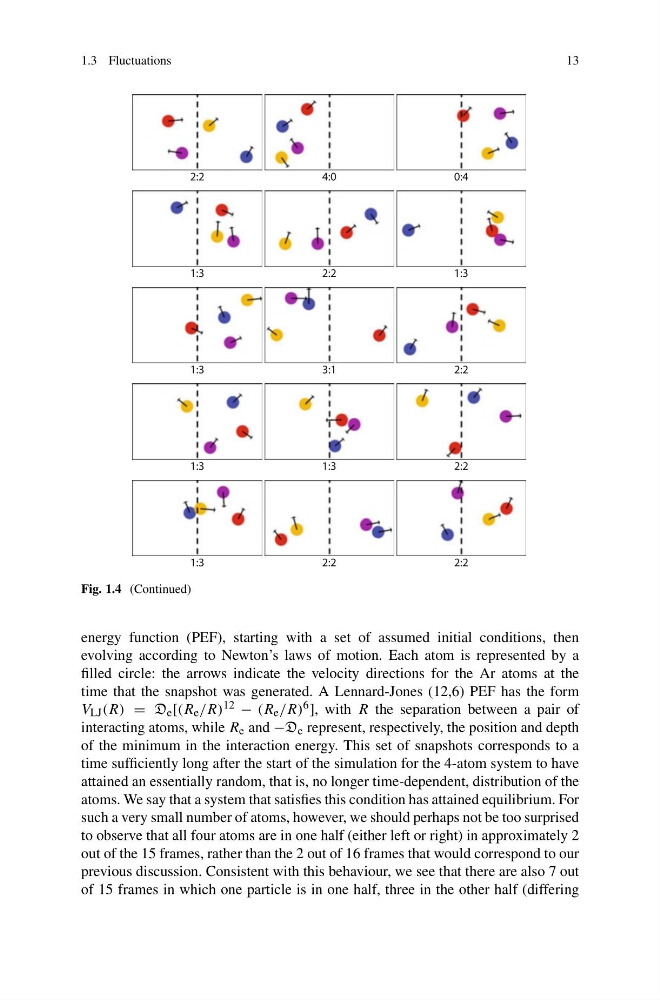
Fig. 1.4 (Continued)
energy function (PEF), starting with a set of assumed initial conditions, then
evolving according to Newton’s laws of motion. Each atom is represented by a
filled circle: the arrows indicate the velocity directions for the Ar atoms at the
time that the snapshot was generated. A Lennard-Jones (12,6) PEF has the form
V LJ (R) = D e [(R e /R) 12 − (R e /R) 6 ], with R the separation between a pair of
interacting atoms, while R e and −D e represent, respectively, the position and depth
of the minimum in the interaction energy. This set of snapshots corresponds to a
time sufficiently long after the start of the simulation for the 4-atom system to have
attained an essentially random, that is, no longer time-dependent, distribution of the
atoms. We say that a system that satisfies this condition has attained equilibrium. For
such a very small number of atoms, however, we should perhaps not be too surprised
to observe that all four atoms are in one half (either left or right) in approximately 2
out of the 15 frames, rather than the 2 out of 16 frames that would correspond to our
previous discussion. Consistent with this behaviour, we see that there are also 7 out
of 15 frames in which one particle is in one half, three in the other half (differing
13
Fig. 1.4 (Continued)
energy function (PEF), starting with a set of assumed initial conditions, then
evolving according to Newton’s laws of motion. Each atom is represented by a
filled circle: the arrows indicate the velocity directions for the Ar atoms at the
time that the snapshot was generated. A Lennard-Jones (12,6) PEF has the form
V LJ (R) = D e [(R e /R) 12 − (R e /R) 6 ], with R the separation between a pair of
interacting atoms, while R e and −D e represent, respectively, the position and depth
of the minimum in the interaction energy. This set of snapshots corresponds to a
time sufficiently long after the start of the simulation for the 4-atom system to have
attained an essentially random, that is, no longer time-dependent, distribution of the
atoms. We say that a system that satisfies this condition has attained equilibrium. For
such a very small number of atoms, however, we should perhaps not be too surprised
to observe that all four atoms are in one half (either left or right) in approximately 2
out of the 15 frames, rather than the 2 out of 16 frames that would correspond to our
previous discussion. Consistent with this behaviour, we see that there are also 7 out
of 15 frames in which one particle is in one half, three in the other half (differing