

12
1 Basic Background Material
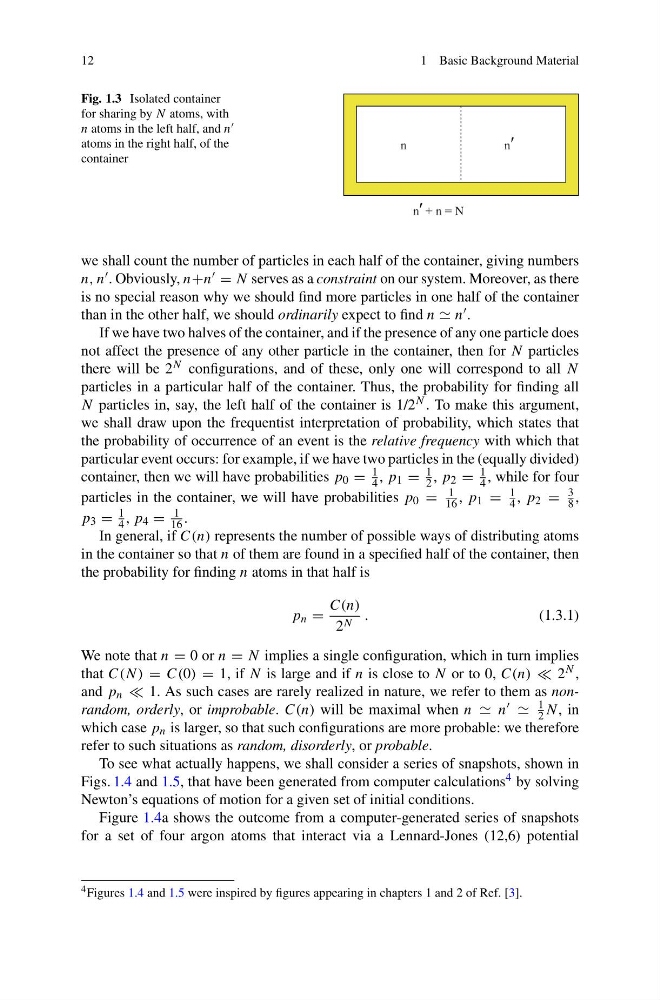
Fig. 1.3 Isolated container
for sharing by N atoms, with
n atoms in the left half, and n
atoms in the right half, of the
container
′
′
we shall count the number of particles in each half of the container, giving numbers
n, n . Obviously, n+n = N serves as a constraint on our system. Moreover, as there
is no special reason why we should find more particles in one half of the container
than in the other half, we should ordinarily expect to find n n .
If we have two halves of the container, and if the presence of any one particle does
not affect the presence of any other particle in the container, then for N particles
there will be 2 N configurations, and of these, only one will correspond to all N
particles in a particular half of the container. Thus, the probability for finding all
N particles in, say, the left half of the container is 1/2 N . To make this argument,
we shall draw upon the frequentist interpretation of probability, which states that
the probability of occurrence of an event is the relative frequency with which that
particular event occurs: for example, if we have two particles in the (equally divided)
container, then we will have probabilities p 0 =
1
4 , p 1 =
1
2 , p 2 =
1
4 , while for four
particles in the container, we will have probabilities p 0 =
1
16 , p 1 =
1
4 , p 2 =
3
8 ,
p 3 =
1
4 , p 4 =
1
16 .
In general, if C(n) represents the number of possible ways of distributing atoms
in the container so that n of them are found in a specified half of the container, then
the probability for finding n atoms in that half is
p n =
C(n)
2 N .
(1.3.1)
We note that n = 0 or n = N implies a single configuration, which in turn implies
that C(N) = C(0) = 1, if N is large and if n is close to N or to 0, C(n) 2 N ,
and p n 1. As such cases are rarely realized in nature, we refer to them as nonrandom, orderly, or improbable. C(n) will be maximal when n n
1
2 N, in
which case p n is larger, so that such configurations are more probable: we therefore
refer to such situations as random, disorderly, or probable.
To see what actually happens, we shall consider a series of snapshots, shown in
Figs. 1.4 and 1.5, that have been generated from computer calculations 4 by solving
Newton’s equations of motion for a given set of initial conditions.
Figure 1.4a shows the outcome from a computer-generated series of snapshots
for a set of four argon atoms that interact via a Lennard-Jones (12,6) potential
4 Figures 1.4 and 1.5 were inspired by figures appearing in chapters 1 and 2 of Ref. [3].
1 Basic Background Material
Fig. 1.3 Isolated container
for sharing by N atoms, with
n atoms in the left half, and n
atoms in the right half, of the
container
′
′
we shall count the number of particles in each half of the container, giving numbers
n, n . Obviously, n+n = N serves as a constraint on our system. Moreover, as there
is no special reason why we should find more particles in one half of the container
than in the other half, we should ordinarily expect to find n n .
If we have two halves of the container, and if the presence of any one particle does
not affect the presence of any other particle in the container, then for N particles
there will be 2 N configurations, and of these, only one will correspond to all N
particles in a particular half of the container. Thus, the probability for finding all
N particles in, say, the left half of the container is 1/2 N . To make this argument,
we shall draw upon the frequentist interpretation of probability, which states that
the probability of occurrence of an event is the relative frequency with which that
particular event occurs: for example, if we have two particles in the (equally divided)
container, then we will have probabilities p 0 =
1
4 , p 1 =
1
2 , p 2 =
1
4 , while for four
particles in the container, we will have probabilities p 0 =
1
16 , p 1 =
1
4 , p 2 =
3
8 ,
p 3 =
1
4 , p 4 =
1
16 .
In general, if C(n) represents the number of possible ways of distributing atoms
in the container so that n of them are found in a specified half of the container, then
the probability for finding n atoms in that half is
p n =
C(n)
2 N .
(1.3.1)
We note that n = 0 or n = N implies a single configuration, which in turn implies
that C(N) = C(0) = 1, if N is large and if n is close to N or to 0, C(n) 2 N ,
and p n 1. As such cases are rarely realized in nature, we refer to them as nonrandom, orderly, or improbable. C(n) will be maximal when n n
1
2 N, in
which case p n is larger, so that such configurations are more probable: we therefore
refer to such situations as random, disorderly, or probable.
To see what actually happens, we shall consider a series of snapshots, shown in
Figs. 1.4 and 1.5, that have been generated from computer calculations 4 by solving
Newton’s equations of motion for a given set of initial conditions.
Figure 1.4a shows the outcome from a computer-generated series of snapshots
for a set of four argon atoms that interact via a Lennard-Jones (12,6) potential
4 Figures 1.4 and 1.5 were inspired by figures appearing in chapters 1 and 2 of Ref. [3].