

14
1 Basic Background Material
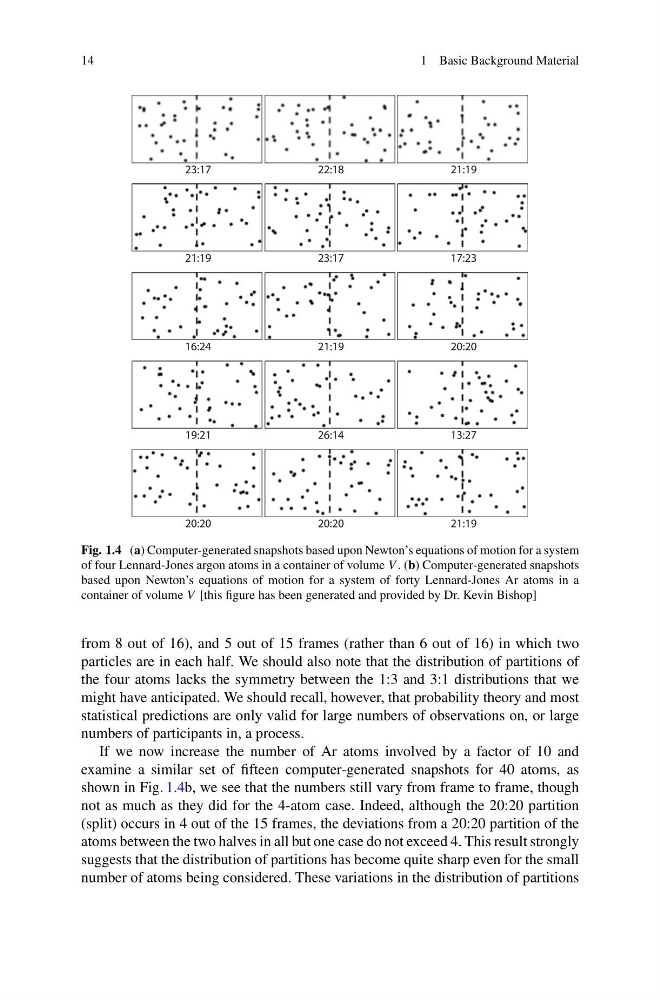
Fig. 1.4 (a) Computer-generated snapshots based upon Newton’s equations of motion for a system
of four Lennard-Jones argon atoms in a container of volume V . (b) Computer-generated snapshots
based upon Newton’s equations of motion for a system of forty Lennard-Jones Ar atoms in a
container of volume V [this figure has been generated and provided by Dr. Kevin Bishop]
from 8 out of 16), and 5 out of 15 frames (rather than 6 out of 16) in which two
particles are in each half. We should also note that the distribution of partitions of
the four atoms lacks the symmetry between the 1:3 and 3:1 distributions that we
might have anticipated. We should recall, however, that probability theory and most
statistical predictions are only valid for large numbers of observations on, or large
numbers of participants in, a process.
If we now increase the number of Ar atoms involved by a factor of 10 and
examine a similar set of fifteen computer-generated snapshots for 40 atoms, as
shown in Fig. 1.4b, we see that the numbers still vary from frame to frame, though
not as much as they did for the 4-atom case. Indeed, although the 20:20 partition
(split) occurs in 4 out of the 15 frames, the deviations from a 20:20 partition of the
atoms between the two halves in all but one case do not exceed 4. This result strongly
suggests that the distribution of partitions has become quite sharp even for the small
number of atoms being considered. These variations in the distribution of partitions
1 Basic Background Material
Fig. 1.4 (a) Computer-generated snapshots based upon Newton’s equations of motion for a system
of four Lennard-Jones argon atoms in a container of volume V . (b) Computer-generated snapshots
based upon Newton’s equations of motion for a system of forty Lennard-Jones Ar atoms in a
container of volume V [this figure has been generated and provided by Dr. Kevin Bishop]
from 8 out of 16), and 5 out of 15 frames (rather than 6 out of 16) in which two
particles are in each half. We should also note that the distribution of partitions of
the four atoms lacks the symmetry between the 1:3 and 3:1 distributions that we
might have anticipated. We should recall, however, that probability theory and most
statistical predictions are only valid for large numbers of observations on, or large
numbers of participants in, a process.
If we now increase the number of Ar atoms involved by a factor of 10 and
examine a similar set of fifteen computer-generated snapshots for 40 atoms, as
shown in Fig. 1.4b, we see that the numbers still vary from frame to frame, though
not as much as they did for the 4-atom case. Indeed, although the 20:20 partition
(split) occurs in 4 out of the 15 frames, the deviations from a 20:20 partition of the
atoms between the two halves in all but one case do not exceed 4. This result strongly
suggests that the distribution of partitions has become quite sharp even for the small
number of atoms being considered. These variations in the distribution of partitions