

248
5 Atomic Systems
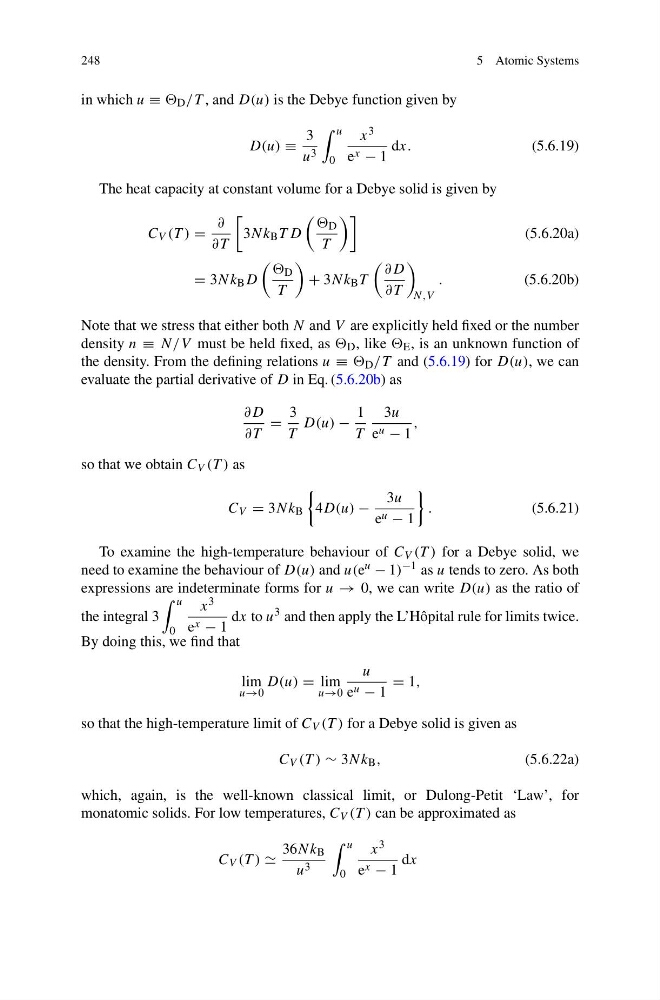
in which u ≡ D /T , and D(u) is the Debye function given by
D(u) ≡
3
u 3
u
0
x 3
e x − 1
dx.
(5.6.19)
The heat capacity at constant volume for a Debye solid is given by
C V (T ) =
∂
∂T
3Nk B T D
D
T
(5.6.20a)
= 3Nk B D
D
T
+ 3Nk B T
∂D
∂T
N,V
.
(5.6.20b)
Note that we stress that either both N and V are explicitly held fixed or the number
density n ≡ N/V must be held fixed, as D , like E , is an unknown function of
the density. From the defining relations u ≡ D /T and (5.6.19) for D(u), we can
evaluate the partial derivative of D in Eq. (5.6.20b) as
∂D
∂T
=
3
T
D(u) −
1
T
3u
e u − 1
,
so that we obtain C V (T ) as
C V = 3Nk B
4D(u) −
3u
e u − 1
.
(5.6.21)
To examine the high-temperature behaviour of C V (T ) for a Debye solid, we
need to examine the behaviour of D(u) and u(e u − 1) −1 as u tends to zero. As both
expressions are indeterminate forms for u → 0, we can write D(u) as the ratio of
the integral 3
u
0
x 3
e x − 1
dx to u 3 and then apply the L’Hôpital rule for limits twice.
By doing this, we find that
lim
u→0
D(u) = lim
u→0
u
e u − 1
= 1,
so that the high-temperature limit of C V (T ) for a Debye solid is given as
C V (T ) ∼ 3Nk B ,
(5.6.22a)
which, again, is the well-known classical limit, or Dulong-Petit ‘Law’, for
monatomic solids. For low temperatures, C V (T ) can be approximated as
C V (T )
36Nk B
u 3
u
0
x 3
e x − 1
dx
5 Atomic Systems
in which u ≡ D /T , and D(u) is the Debye function given by
D(u) ≡
3
u 3
u
0
x 3
e x − 1
dx.
(5.6.19)
The heat capacity at constant volume for a Debye solid is given by
C V (T ) =
∂
∂T
3Nk B T D
D
T
(5.6.20a)
= 3Nk B D
D
T
+ 3Nk B T
∂D
∂T
N,V
.
(5.6.20b)
Note that we stress that either both N and V are explicitly held fixed or the number
density n ≡ N/V must be held fixed, as D , like E , is an unknown function of
the density. From the defining relations u ≡ D /T and (5.6.19) for D(u), we can
evaluate the partial derivative of D in Eq. (5.6.20b) as
∂D
∂T
=
3
T
D(u) −
1
T
3u
e u − 1
,
so that we obtain C V (T ) as
C V = 3Nk B
4D(u) −
3u
e u − 1
.
(5.6.21)
To examine the high-temperature behaviour of C V (T ) for a Debye solid, we
need to examine the behaviour of D(u) and u(e u − 1) −1 as u tends to zero. As both
expressions are indeterminate forms for u → 0, we can write D(u) as the ratio of
the integral 3
u
0
x 3
e x − 1
dx to u 3 and then apply the L’Hôpital rule for limits twice.
By doing this, we find that
lim
u→0
D(u) = lim
u→0
u
e u − 1
= 1,
so that the high-temperature limit of C V (T ) for a Debye solid is given as
C V (T ) ∼ 3Nk B ,
(5.6.22a)
which, again, is the well-known classical limit, or Dulong-Petit ‘Law’, for
monatomic solids. For low temperatures, C V (T ) can be approximated as
C V (T )
36Nk B
u 3
u
0
x 3
e x − 1
dx