

5.6 Monatomic Solids
249
≈
36Nk B
(( D /T ) 3
∞
0
x 3
e x − 1
dx.
The definite integral in this expression has the value π 4 /15, so that the Debye heat
capacity behaves as
C V (T ) ∼
12Nk B π 4
5
T
D
3
(5.6.22b)
for temperature T such that T D . This latter result is known as the Debye T 3
law for the heat capacity.
Notice also that, just as we have seen for the heat capacity of an Einstein solid,
the expression for the heat capacity for a Debye solid can be written as
C V
Nk B
= f (( D /T ),
(5.6.23)
which expresses the law of corresponding states for a monatomic Debye crystal.
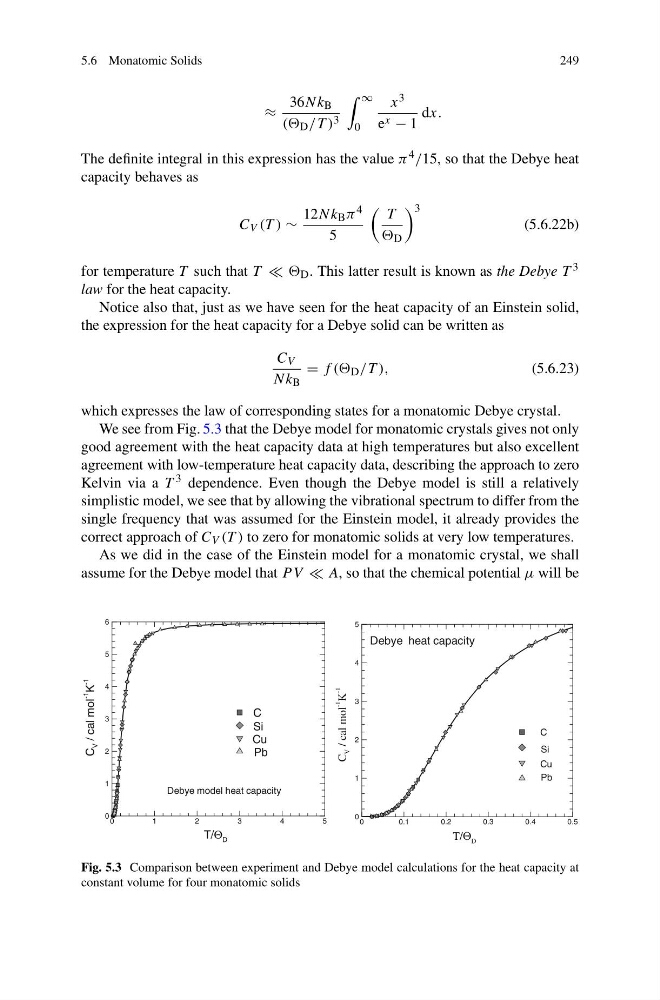
We see from Fig. 5.3 that the Debye model for monatomic crystals gives not only
good agreement with the heat capacity data at high temperatures but also excellent
agreement with low-temperature heat capacity data, describing the approach to zero
Kelvin via a T 3 dependence. Even though the Debye model is still a relatively
simplistic model, we see that by allowing the vibrational spectrum to differ from the
single frequency that was assumed for the Einstein model, it already provides the
correct approach of C V (T ) to zero for monatomic solids at very low temperatures.
As we did in the case of the Einstein model for a monatomic crystal, we shall
assume for the Debye model that P V A, so that the chemical potential μ will be
0
1
2
3
4
5
0
1
2
3
4
5
6
T/Θ D
C
V / cal mol
-1
K
-1
C
Si
Cu
Pb
Debye model heat capacity
0
0.1
0.2
0.3
0.4
0.5
0
1
2
3
4
5
T/Θ D
C
V
/ cal mol
-1
K
-1
C
Si
Cu
Pb
Debye heat capacity
Fig. 5.3 Comparison between experiment and Debye model calculations for the heat capacity at
constant volume for four monatomic solids
249
≈
36Nk B
(( D /T ) 3
∞
0
x 3
e x − 1
dx.
The definite integral in this expression has the value π 4 /15, so that the Debye heat
capacity behaves as
C V (T ) ∼
12Nk B π 4
5
T
D
3
(5.6.22b)
for temperature T such that T D . This latter result is known as the Debye T 3
law for the heat capacity.
Notice also that, just as we have seen for the heat capacity of an Einstein solid,
the expression for the heat capacity for a Debye solid can be written as
C V
Nk B
= f (( D /T ),
(5.6.23)
which expresses the law of corresponding states for a monatomic Debye crystal.
We see from Fig. 5.3 that the Debye model for monatomic crystals gives not only
good agreement with the heat capacity data at high temperatures but also excellent
agreement with low-temperature heat capacity data, describing the approach to zero
Kelvin via a T 3 dependence. Even though the Debye model is still a relatively
simplistic model, we see that by allowing the vibrational spectrum to differ from the
single frequency that was assumed for the Einstein model, it already provides the
correct approach of C V (T ) to zero for monatomic solids at very low temperatures.
As we did in the case of the Einstein model for a monatomic crystal, we shall
assume for the Debye model that P V A, so that the chemical potential μ will be
0
1
2
3
4
5
0
1
2
3
4
5
6
T/Θ D
C
V / cal mol
-1
K
-1
C
Si
Cu
Pb
Debye model heat capacity
0
0.1
0.2
0.3
0.4
0.5
0
1
2
3
4
5
T/Θ D
C
V
/ cal mol
-1
K
-1
C
Si
Cu
Pb
Debye heat capacity
Fig. 5.3 Comparison between experiment and Debye model calculations for the heat capacity at
constant volume for four monatomic solids